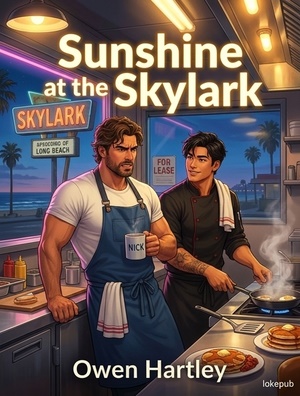
Sunshine at the Skylark
Chapter 1
First Light
The skylark had lost a wing.
Not the whole bird — just the neon tube that ran the top edge of the left wing, the one that had buzzed and flickered for three weeks before it quit entirely and left the thing looking like it had taken a hit out over the water and was going down somewhere above Fourth Street.
Nick Roussos stood at the top of the eight-foot ladder in the dark, a flashlight clamped in his teeth, and confirmed what he already knew.
Dead. Same as it had been dead yesterday.
Same as it would be dead tomorrow, because the guy who used to fix the sign had retired to Bullhead City, and the guy Nick had called about a replacement tube quoted him four hundred dollars, and four hundred dollars was currently doing more important work. Like existing.
He took the flashlight out of his mouth. "You're embarrassing us," he told the bird.
The bird declined to comment. Above it the rest of the sign still held — THE SKYLARK in fat gold script, DINER underneath, a little starburst his father had picked out of a catalog in 1986 because he said a place should look glad to see you before you got in the door.
The gloom sat low over the street the way it did every morning this time of year, the marine layer shoved in off the harbor and turning everything the color of a dirty nickel until the sun got around to burning it off around noon.
Retro Row didn't wake up early. The vintage shops and the record store and the flower place next door wouldn't roll their gates till ten.
For a couple of hours every morning the block was just Nick, the gulls, and a wounded neon bird.
He climbed down, folded the ladder, and let himself in through the front.
Inside it smelled the way it had smelled his whole life.
Coffee and hot metal and, underneath, something sweeter that had soaked into the walls over four decades — cinnamon, the ghost of every galaktoboureko his father had ever pulled out of that oven.
Nick flipped the breakers in order, the way you did, and the Skylark came up around him one buzz at a time.
The pie case. The Coca-Cola clock that ran four minutes fast. The long horseshoe counter with its worn chrome edge and its row of cracked red vinyl stools, and at the far end, seat number one, the one nobody sat on.
His father's stool.
Nick looked at it for exactly as long as he let himself, which was not long, and went to start the coffee.
He was three scoops into the big urn when the bell over the door went and Gloria came in backward, shouldering it open with a tray of something and her enormous purse and the entire day's worth of the Press-Telegram under one arm.
"Don't," she said, before he'd said anything.
"I wasn't going to."
"You were going to tell me I'm late. I'm not late.
I'm exactly on time, and I brought pan de sal because Auntie Baby's grandson opened a bakery on Anaheim and I am legally required to support him.
" She set the tray down on the counter and looked at him the way she'd been looking at him for twenty-two years, which was like a woman who had changed his diapers and would say so in front of customers if pushed. "You were up on the ladder again."
"The wing's dead."
"I know the wing's dead. The whole neighborhood knows the wing's dead. It's been dead since your birthday." She started tying her apron. "You're going to break your neck for a lightbulb, and then who fixes the sign, huh? Ghost of you?"
"It's a neon tube, not a lightbulb."
"Ghost of you," she repeated, satisfied, and slid the mail across the counter at him. "This came certified. You have to sign the little card."
Nick knew what it was before he touched it.
He'd been feeling it coming for a month, the way you feel weather in a bad knee.
The return address said MERIDIAN in a gray, expensive font, no exclamation points, no starburst, nothing glad to see you about it.
He signed the little card. He opened the envelope.
He read it twice, because the first time his eyes went over the numbers and simply refused to bring them inside.
We are pleased to offer a renewal of the tenancy.
Three thousand nine hundred a month becoming seven thousand four hundred.
Effective October 1. Which meant the current lease was up September 30, which meant fifteen weeks, which meant a hair over three months, and at the bottom, courteous as a knife, an invitation to submit any proposal you may wish us to consider.
"Nick." Gloria had gone still. "What is it."
He set the letter face-down on the counter, because his father had never once in his life let a customer see him rattled and Nick wasn't about to start with the coffee urn. "Nothing. Landlord stuff."
"That's not a nothing face."
"It's my regular face."
"Your regular face is worse," she allowed, "but that's not your regular face."
She waited. He didn't fill it. That was one more thing his father had never taught him on purpose and taught him anyway — how to stand inside a silence and let it be the other person's problem. Gloria had known the man thirty years, though. She could out-wait a stone.
"It's the rent," Nick said finally, because it was her diner too, in every way that wasn't on paper. "Come October."
"Bad?"
"We'll figure it out."
Which was a yes, and she knew it was a yes.
She looked for a second at the empty stool at the end of the counter, and then she picked up the tray of pan de sal and carried it out to the booths like it was any other Tuesday — because that was the job.
You carried the bread out and you smiled and nobody ever saw the envelope.
Nick loved her a little, right then, in the specific way you love a person who knows exactly how bad it is and lies about it beautifully anyway.
***
He was still not thinking about the number — he'd gotten very good, this past year, at not thinking about numbers while standing directly on top of them — when the back door opened.
Not the delivery knock. Not Manny early for his coffee. The door just opened, the alley door, the one that stuck in the damp and had to be shouldered, and a voice came through it ahead of the body, easy and unhurried, like it had every right.
"Okay, so I'm going to be honest with you, that alley smells like a crime, but the building — " and then the rest of him came around the pass, and Nick's whole morning tilted a degree off level.
The guy was maybe Nick's age, lean the way line cooks got lean, in a plain gray tee gone soft at the collar with a knife roll slung over one shoulder like it weighed nothing.
Dark hair pushed back off his forehead with the back of a wrist even though his hands were clean.
Forearms inked — a branch of something, a line of handwriting Nick couldn't read from here — and a grin already halfway up his face like it had been there since the parking lot and just kept going.
"— the building," the guy finished, looking around the kitchen with open, unguarded want, "is gorgeous. That's a 1970s flat-top. That's a real one. They don't — hi. Hi. You're Nick."
"Who's asking."
"Dante." He said it like it explained everything, and stuck out a hand, and when Nick didn't take it he didn't seem to mind, just turned the offered hand into a gesture at the room.
"Villanueva. Your dad —" the grin dimmed, just a watt, just for a second, and then recovered "— your dad hired me.
I know I'm a couple weeks late, I had to close out the pop-up. But I'm here."
I'm here. Like it was good news. Like Nick had been standing in this kitchen for ten months waiting for exactly this.
Nick knew who he was. That was the trouble.
He'd known since January, since he'd finally made himself open the accordion folder in his father's office and found, clipped behind the insurance binder, an agreement in his father's terrible slanting hand and a stranger's clean signature under it.
Head chef. And below that, in a phrase Nick had read maybe forty times and still couldn't make sit flat in his chest — and a fifteen percent interest in the business, in recognition of same.
His father had given a piece of the Skylark to a man he'd known for what, a season? And hadn't mentioned it. Not once. Not in any of the last conversations Nick would ever get to have with him.
"There's no job," Nick said.
Dante's grin held, but something behind it recalibrated. "Okay."
"There's no money for a chef. There's barely money for the guy who already works here for free, and that guy is me.
" He heard how it landed and didn't soften it.
"I don't know what my father told you. I don't know what he promised.
But things are different now than they were when he — than they were before. So I'm sorry you drove out here."
For a second Dante just looked at him. Not hurt, exactly. Reading him, the way you'd read a pan to see if it was ready. Then he set the knife roll down on the stainless, gentle, like it was a thing he cared about, and said, "He made me a stollen. First time we met."
"What?"
"Stavros. First time we talked, at the pop-up, he tried my food and he didn't say anything, he just kind of grunted, which I have since learned is a whole language in this family — and then two days later he showed up at my apartment in Wilmington with a stollen he'd baked me.
Christmas bread. In August. Because he said I looked like a guy who'd forgotten somebody used to feed him.
" Dante's voice didn't wobble. It just went quieter, carrying more.
"So I'm not going to pretend I don't know what different means.
I'm real sorry, man. I liked him a lot, and I didn't get to for very long, and I know that's nothing next to —" a small tip of his head at the room, the whole freighted room "— this. "
Nick's jaw did something he didn't authorize. He looked at the flat-top so he wouldn't have to look at the guy.