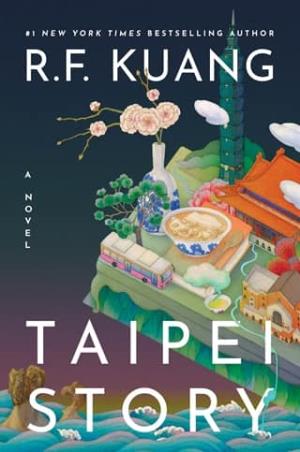
Taipei Story
Chapter 1
Courtesy of the author
When I reached my gate at Logan Airport, I discovered there were a lot of Chinese American students boarding the United flight from Boston to Taipei with a layover in San Francisco.
In fact, I recognized one of them. We’d had some lecture classes together, and I was pretty sure her name was either Joyce or Jessica.
I didn’t know the others. But I knew they were Chinese Americans on their way to study Chinese in Taipei because it was the first week of June, when all the intensive summer language programs began, and because they were chattering about whether the layover was long enough, whether they would have to go through another security check, and whether they would have to re-check their bags before the next flight.
They looked Chinese, but not Chinese Chinese.
You could tell from the summer tans, the ruddy cheeks, the sun-browned hair.
Chinese Americans always looked like Chinese people put through a broiler.
Two of them were clearly friends, and the rest seemed at least familiar with one another.
One girl had a Harvard sweatshirt on, so I assumed they were students from the area.
Perhaps they were headed to Harvard Taipei Academy, a rival of the program I would be attending.
They were now chattering about their bucket lists, which mainly involved food: the famous Taiwanese beef noodle soup, the black truffle soup dumplings at the original Din Tai Fung, the takoyaki and sizzling steak cubes at the Shilin Night Market, the roast chicken at Hawker Chan’s.
These foods were also on my bucket list. We had read the same travel blogs.
We were all headed to the same city to do the same things in the same little alleys.
This should not have surprised me, but it was strange to share an itinerary with so many students of my type, departing from the same airport on the same day, circumnavigating the world for precisely the same purpose.
An hour ago, as I’d waved goodbye to my parents, I had felt grown-up, adventurous: Here I was, spending ten weeks in a country I’d never visited to learn a language I had long forgotten.
I was on a coming-of-age journey to reconnect with my culture.
As it happened, lots of students were on a journey to reconnect with their culture.
We boarded. The girl with the Harvard sweatshirt and one of her new friends were seated in the row in front of me.
They marveled at this coincidence and, naturally, began to flirt.
He went to MIT. She went to, yes, Harvard.
Did she know Priya? Priya, from Choate? Did he know Pete?
Pete, from the film club? Yes, wow! The world was so small.
He was touring Japan afterward; five days in Tokyo, five in Kyoto.
She was going to the mainland to visit some relatives.
“My grandparents live in Guangzhou,” she told him.
“But I’ve never really spent time with them.
Once I’m better at Chinese, I can really get to know them. ”
My family was also from Guangzhou! I also wanted to get to know my grandparents! I almost leaned forward and tapped her on the shoulder to share this, but I thought about how I would feel if an eavesdropper tapped me on the shoulder to interject, and I kept quiet.
They discovered they had used the same Chinese language textbook that semester, and the boy started joking about one of the characters in the textbook, Wang Peng.
Will Wang Peng get with Li You? Isn’t Wang Peng such a Chad?
The girl laughed, and I felt a sudden, intense dislike for these two.
I knew them. I bet they were from the Bay Area.
I bet they had grown up attending Kumon or Russian Math.
I bet they’d joined Asian American affinity groups in college, where they had learned paper-cutting and tea-pouring techniques and practiced calligraphy on special mats that turned black under water instead of ink, so that their shaky, uneven brushstrokes disappeared as they dried.
I bet they wept at Ang Lee films and pretended to understand Wong Kar-wai films. I bet they gave their friends red pocket envelopes on Lunar New Year stuffed with cute little notes as if they were Valentine’s Day cards.
I bet they bought stale mooncakes at overpriced Asian delis for Mid-Autumn Festival, proof they kept up with ancient traditions.
I bet they took selfies with these mooncakes and put them on Instagram, with captions copied and pasted from Google Translate: 中秋節快樂!
The engines started, and I strained to follow the conversation. I wanted to hear them speak in Chinese so I could confirm that their tones were bad, that their vocabulary was strained—that they were fundamentally more Americanized, more corrupted, than I was.
But their Chinese was no better and no worse than mine.
I had also used the Integrated Chinese textbook.
I, too, knew Wang Peng. We were on the same itinerary so that we could fill in the same gaping lack, and the only thing that would resolve this was the passage of time—ten weeks in Taipei, immersed in our mother tongue—until we returned with perfect tones spilling out of our mouths, and we were no longer so bad at being Chinese.
SEVERAL WEEKS AGO I HAD TAKEN TWO VIRTUAL ENTRANCE EXAMS to determine my language placement. One was a written exam, the other an interview. The written exam was structured so that the questions became harder and harder as I went on, but I was feeling okay until I reached the final section.
This was reading comprehension: four dense paragraphs of Chinese text, followed by four multiple-choice questions about their content.
I always panicked at the sight of full paragraphs in Chinese.
Alone, characters were eventually legible to me.
Together, they formed this impenetrable Great Wall of meaning; the strokes ran together, and even if I approached the characters one by one, I couldn’t decode them quickly enough to link their meanings.
I kept glancing at the timer. I had only eleven minutes left.
My eyes darted around the first passage, trying to crack it open, but I could only make out random phrases.
It was a letter home from a university student to her parents.
This I knew because it opened with the words “Dear Mom and Dad,” and it closed with “your daughter, Something-Something.” I was terrible with Chinese names.
They were always composed of rare nouns that meant things like “plum blossom” or “incandescence”—nouns that I had no reason to have studied.
Something-Something was doing fairly well this semester.
There was something about exams and winter break.
Something about an open window. From there I lost the plot.
I skipped ahead to the questions. The first two were easy enough. Who was this letter from? A college student. What term was it? Winter term. The third question was: Why was her room dirty?
Why indeed? I tried again to extract clues from fragments within the passage. The window was open, and something had fallen off her desk. I guessed and chose the last answer: Because of a thief.
The next two passages involved motorcycles and birth control.
I had no time to read the passages; reading the questions was hard enough.
I chose answers based on common sense. Why was traffic density a problem in Taipei?
Because there were too many cars. Why were more Taiwanese women using birth control?
Because having babies was expensive. It occurred to me I could just paste the passages into a translation app, since the exam website had no anti-cheating protocol.
But I resisted. I had to be honest about my weaknesses.
The final passage was written in Classical Chinese.
Classical Chinese was to modern Mandarin as Latin was to English: No one spoke it colloquially, but quoting it made you sound smarter.
I had long ago decided there was no reason for me to know, or ever use, Classical Chinese, and so I scrolled past those questions and hit submit.
THE INTERVIEW EXAM WAS CONDUCTED OVER VIDEO.
I WAS NERVOUS, although the whole point was to demonstrate what I didn’t know so that they could teach me over the summer.
I was certain that once we began they would discover I couldn’t speak any Chinese at all, and that I would be revealed as a fraud, completely unteachable.
I wanted to cram the day before, but I couldn’t prepare in any meaningful way, because if I could teach myself an entire language overnight, then I wouldn’t have to go to Taipei.
Everything was scheduled on Taipei time—the exam was at midnight for me.
When I entered the virtual meeting room I saw a video frame of two women sitting at a desk.
One was older and wore glasses; the other was younger and seemed friendlier.
They introduced themselves respectively as Teacher Zhang and Teacher Huang.
“Tell us about yourself,” said Teacher Huang. She did all the talking throughout the interview. Teacher Zhang took notes and occasionally smiled without looking up.
“I’m a rising sophomore at Yale University, and I’m majoring in East Asian Studies.
” I was able to say all this very smoothly, since I’d looked up the translations for “Yale” and “East Asian Studies” the night before.
I had taped a small cheat sheet on my screen: translations for phrases like “heritage speaker” and “immigrated when I was a baby” and “non-Chinese environment” and “forgot all of my vocabulary because I never have a reason to speak Chinese.”
“What kind of classes are you interested in taking?” asked Teacher Huang.
“Classes?”
“Yes! We have a big variety of classes here. You can choose from electives on culture, history, literature, and film.”
“I like literature.” I nodded. “Literature!”