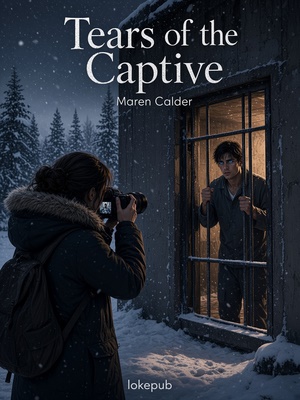
Tears of the Captive
1
Three doors between me and whatever poor sod sits on the other side with a murder charge stapled to his name.
I stiffen when the metal groans behind me as the first one shuts. I don’t expect it to echo so loudly, as if the building is clearing its throat for the next part. They sit at measured intervals, each with a narrow, armoured window that gives away nothing but shadow.
I trail along the overlit corridor, past cream walls browned at the corners and scuffed to shoulder height.
Linoleum gleams under thousands of reluctant footsteps.
Every step cuts through a lingering cloud of bleach, dust and a fouler undertone no photograph could capture unless the person behind the lens had felt it first.
I’ve snapped shots of tombs that felt warmer than this.
Stone remembers the hands that shaped it, at least; these walls are trying to forget them.
They’ve been made to erase, to look clean while reminding you exactly what the people inside are to the system: bodies to be moved, counted and contained.
Behind the last door, there’s a man I’m supposed to… befriend? Support? Teach, or…?
The paperwork should have read ‘self-destruction, with a volunteer badge’ in fine print.
My pulse seems to be trying to outrun me, but I keep my face smooth, mouth set like I’m here by choice, like I’m not listening for the next groan of metal as if it’s going to call out my name.
In all honesty, I’ve made worse decisions. Heartbreak scrambled the part of my brain responsible for self-preservation.
The guard beside me doesn’t bother hiding his boredom.
‘First time?’ he asks.
I swallow back the unease, eyeing his cap with shielded disdain.
Uniforms have never inspired much confidence in me. They often stood on my sister’s doorstep reciting procedure, while her abusive husband remained unblamed. Perhaps it wasn’t the whole system that failed her, just the badges that frequented her address.
‘Is it that obvious?’ I ask, already regretting the question.
He shrugs. ‘You look it.’
I wrinkle my nose at him. Lovely. Like a lamb to slaughter.
My attention – and anxiety – drag back to the final door. It opens with a mechanical shudder like something straight out of a disaster film. I half expect black smoke to start pouring through the gap.
It’s colder in this area. No windows, just CCTV cameras and signs that warn off unauthorised items.
My eyes catch on the bottom of the list: string, gum, hope – though I might have made up that last one.
‘Gum?’ I say as we pass through the checkpoint, where paint peels in small strips from the institutional green walls. They remind me of old, forgotten scabs. Might look almost macabre in a photo.
Mum’s reprimand resurfaces in the back of my head: Easy on the sarcasm, Leah.
‘They get creative around here,’ says the guard escorting me, his badge crooked and his tone bone-dry. ‘She’s all yours, George.’
A barred gate moans open and a heavyset man steps through. He moves with the weary confidence of someone who stopped believing in urgency years ago.
‘Afternoon,’ he says, his South London accent flattened by the stale heat of the corridor.
It isn’t his voice that makes my face tighten, or even the cough that follows, sounding bad enough to finish him off with the next heave.
It’s the smell. Like vinegar and stale coffee, familiar in the worst way.
I used to breathe that in every day as a teenager, back when my dad favoured the bottle. You don’t forget an odour that could double as paint stripper.
His bloodshot eyes sweep over me in stark, clinical motions.
My shoulder lifts to feel the weight of the missing camera strap, fingers closing around air before I remember the camera is locked behind two gates and a sheet of reinforced glass. I didn’t mind them taking the handbag. It’s just receipts and lipstick I hang on to but never remember to apply.
But the camera—
I’m still nursing the dismissive finger-wag the woman at the gate gave me when she locked my equipment away.
Without it, the fluorescent light seems to reach inwards, revealing the parts of me better left in the dark.
I really should try therapy again.
Grunting inelegantly, the guard jerks his head for me to follow.
As I fall into step behind him, our shadows begin stretching across the corridor floor, and my nerves cinch tighter. Every step feels like a fresh entry in the ledger of my own stupidity.
My sister always said I had the devil’s own stubbornness and that it would get me hurt one day. I bet she didn’t think the lighting would be fluorescent, the paint would be peeling, or that the devil would come in shackles.
A camera pegs me from the corner, blinking red as if to warn me off while I still have the chance.
Which is exactly the kind of feeling that keeps me right where I am. Photographing trauma for a living, unfortunately, does not qualify me to bring a lens into His Majesty’s prison, even for this programme. Grudgingly, it had been the strongest reason for my application.
‘You’re in Visitation Room Seven,’ George mutters, pointing ahead. ‘Your placement’s been authorised for non-contact supervision.’
I blink up at him in question.
‘A probable long-timer. Restraints authorised. Don’t let the charm fool you,’ he clarifies succinctly.
I stare at the tips of my boots. My silence gives me away and George catches on, filling in the rest: my new best friend behind that door is on remand.
Even with what little I’d managed to glean from his file, that still lands wrong. Remand is meant to be temporary. Seven years of it could only mean extension after extension, each one argued before a judge.
Goodness. His case is so tangled it has become its own organism.
And that was one of the splinters that lodged into my brain when the Programme Coordinator slid a stack of summaries across the desk – options on paper in the shape of broad case categories, as if people could be shortlisted like equipment.
I worked through them one by one while she explained which placement risked which part of my mind. I weighed offences and notes until that file turned from risky case to pulsing question.
I tell myself it wasn’t anything specific that made me go for Crane – definitely not the way the light caught his pale blue eyes in the photo attached to his file, turning them almost translucent.
Definitely not.
Restraints, George mentioned.
I shelve that somewhere between cheating fiancé and compulsive self-saboteur. Because what else would explain me signing up for a programme that pairs emotionally derailed civilians like me with prisoners no one wants to be near?
Jesus Christ, I could’ve taken up fucking pottery when therapy shot blind.
Or just… disappeared quietly into Greenland with my camera and Riesling.
Instead, I’m here chasing ghosts in my black jeans and an AC/DC shirt I may have overgrown – because I wasn’t sure what the dress code was for meet your last mistake.
A barred door clanks and sighs open, ushering me into a secure visitation room so barren that even my most optimistic creative gene retreats in horror.
The concrete has never seen paint save for the dark stains climbing partway up the walls. If I didn’t know I was in prison, I’d think someone had begun converting the room into a medieval dungeon and abandoned the project halfway through.
My eyes swipe sideways and clock him in the middle of the open space.
Elias Crane.
He sits turned away from me, thick black hair dragged back as if every rebellious curl has been bullied into obedience with a promise to come apart the moment he makes one wrong movement.
As my gaze falls to his feet, recognition rattles through me: chains span from his wrists to his ankles, threaded through a steel ring bolted to the floor. My hand jerks towards the camera bag that isn’t there.
Pointless reflex.
Irritating.
‘Restraints authorised. Don’t let the charm fool you.’ The guard’s words echo in my ears. Seems like they really don’t take chances with Crane.
I ease the panic out on the next breath, reminded again that having no camera around my chest means I’m on my own. With a head full of bad instincts.
Still. The glint of the metal as it catches the light against his alabaster skin—
It’s a composition begging to be frozen in a frame.
He sits hunched over the bolted desk while I cross the room towards the opposite chair with a brittle semblance of calm.
The nearer I get, the more the room appears to have been measured for an ordinary man and forced to accommodate a giant.
His shoulders are broad enough to throw shadow across the entire table; his forearms heavy with dense muscle.
Old scars stripe his arms in thin, pale cuts like faded tally marks of some private war.
His hands are clasped loosely on the tabletop, wrists married by institutional steel, but there’s no surrender in him. He isn’t slumped so much as contained; wound tight and still, as if patience is just another form of defiance.
‘Afternoon, Mr Crane,’ I try, because good afternoon feels like a lie in here.
As I sink into my seat, my gaze catches on the line of his jaw and the thick beard dusting it dark – enough to make him look dangerous, not enough to make him look unkempt. In fact, his face is one a person might trust right up to the moment reality shows otherwise.
And right now, those eyes – rimmed with thick fans of obsidian lashes – are fixed on his hands.
There’s something bruised in the set of his mouth.
His thumb moves once over the pale scar beside his cuff. For one disorienting second, the monster described in the briefing slips out of focus.
My finger twitches over my lap where the camera bag typically sits.
He doesn’t look up in the first few heartbeats we sit in silence. Just lets the quiet do its work.
My gaze betrays me immediately, tracking the aristocratic line of his nose and the firm mouth beneath eyes seemingly incapable of kindness. My mind starts reducing him to composition and I can’t switch it off.