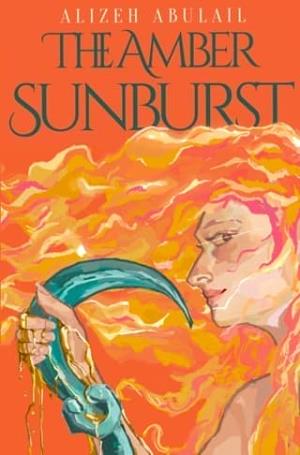
The Amber Sunburst
1. Alexander
ALEXANDER
Alexander jolts awake to the unfamiliar feeling of being waterboarded.
He gasps—or at least, tries to—but his lungs are too full of water for any air to get in. To be expected, given that, again, he’s being waterboarded.
Another breath?
Water.
Well, shit. This is how he’s going to die. He can hear the headline clear as day: Heir of the Holy American Empire assassinated by water overconsumption. His brother will just love that.
He might finally laugh when he hears the news. Alexander can hardly remember what that sounds like—it’s been far too long since his brother laughed. But maybe he’s been laughing this whole time behind Alexander’s back, planning to betray him in a way that Alexander never thought he really would.
And, God, just thinking about that makes him want to give in. It wouldn’t even be hard—his life is a garbage fire now anyways. All he’d need to do is close his eyes and let go.
It’s just, Alexander is really not one for letting go. No—he’s a stubborn bastard and a fighter till the end. So if he’s going out, and it seems like he might just be, he’ll have to go out kicking.
He lashes out with his limbs, and hits… nothing. No cloth, no hands holding him down, no assailant at all. Just water, everywhere, and the muffled roar of it in his mind so, so loud. He wants to shut his ears, but he can hardly feel his arms anymore.
Then, cutting through it all, his father’s voice, somewhere in the distance. Not even words, just the intonations, the ups and downs.
If he’s here, this must be the end. Nothing to be done. At least Alexander will get to see him again.
He reaches out with a shaking hand, and he can feel that something invisible is about to take it. Something warm and soft and—
And gone.
Because without warning, his reflexes finally kick in and every muscle in his body shakes violently, dragging him up and heaving him over onto his side. He would be convinced it was fire he was coughing up if not for the overwhelmingly salty taste of it.
The first breath he takes shreds his vocal cords—little drops of water clinging to his throat enough to burn, and burn, and burn—until the burning stops, and nothing follows.
No second onslaught. No kick to the stomach. No nothing.
Which doesn’t seem right. Shouldn’t his assailant be… well, assailing him?
He forces his eyes open. The sun is merciless, practically burning his brains out with its brightness, but when he squints, he sees ship debris covering a shore that stretches empty in both directions.
Maybe his brother hired someone to kill him slow, without dignity. He could have told them to leave Alexander here, half-dead on a desolate beach with no one around to even see it happen. That would be a Hell of a final blow to his self-esteem.
Oh.
Salt water. Sand.
“I’m an idiot,” he realizes aloud as he pushes himself to stand—pausing briefly to squeeze his eyes shut and allow the dizziness to fade—and whips around to find no mysterious attacker, just an empty beach.
An empty beach whose sand now covers him head to toe because he collapsed on it in his exhaustion, because he was not being waterboarded. He drowned.
Almost drowned.
And he almost drowned because he was on a ship, because…
“Oh,” he whispers. He remembers now: waking up on the boat, still groggy from sleep-inducing draughts. The crew’s kindness, despite being tight-lipped about where they were taking him. And the lightning. He’ll never forget the crack of the lightning.
“Oh, God,” he groans.
Memories from the storm hit him like those old bullet trains his father used to describe. The strong winds yanking the boat back and forth. The screaming and grabbing and freezing cold water. The sight of people going under and not coming back up.
He stumbles over his feet and scans the terrain around him. He can’t be the only one who made it. He can’t.
But if he isn’t, then where is everyone else? Only a few wooden planks, and a log from the mast keep him company on the shoreline, and the sand is indented only from where he navigated it, empty of footprints from the rest of the crew.
Half of them refused to look him in the eye out of respect for his status as heir—as if he wasn’t out playing cards or in someone’s bed every other night—but the rest were personable and kind.
“Michael? Lucy? Augustine?” he yells out to the horizon in a doubtful hope that they’ll appear right down the coast.
“Mary?” His voice breaks on her name.
She wasn’t everything to him and he wasn’t everything to her, but they kept each other company on the ship. He knows her as well as a stranger can. Knows her sighs and her soft morning smiles. He doesn’t want her to be dead.
But as the weak echo of his voice reverberates up and down the miles of visible shore, he acknowledges what he already knows. She is dead. They all are.
Subjects of the sea and her mercurial whims until their bones are sand on the ocean floor. Unless the Post-Fall Catholicism he was raised on really is to be believed, and they’ve woken up in a world beyond their wildest dreams.
Alexander, for one, has always tried to believe. He just isn’t sure, standing here, that belief has ever once done him any good.
He wants to take revenge on the waters lapping gently in front of him. But he can’t. So he settles for glaring at the horizon.
The beach is strangely serene, unaffected by the violent, stormy ocean just beyond it, and it snags at him. It’s… unnatural.
Goosebumps run across his arms, and he drops down to the sand, eyes stinging. None of this is right, all of it is wrong, and all he can do now is wallow here, alone, staring into a sandy expanse of nothing.
He really, really hates being alone.
Tears cling to his lashes, but he forces his eyes shut to stop them.
This is a crossroads, his voice of reason explains. It has always sounded suspiciously similar to his brother, ever the rational to his uninhibited. You can sit here and waste your water on tears, or you can stand up and make do. So, what’s it gonna be?
“I don’t know,” he whispers. It’s loud compared to the silence on the beach. Goosebumps again.
“I don’t know,” he screams into the sea. It echoes.
Get up, Alexander.
He sighs. His brother was always smarter than him.
His dad, too. Alexander knows what he would say. He would whisper, You are stronger than you know, my brave little lion.
Alexander releases a big breath, stands, and turns to face inland. He should look for water first, probably, but—
“What the hell,” he exhales. The beach is not as empty as he thought.
Ancient Greek columns stand sentinel about twenty feet from the shore, stretching in both directions for the entire visible coast.
And now he can’t help but wonder whether he is even still alive at all. Or awake, at least.
How on earth did you not notice that before? his brother’s voice scolds.
“Oh, well, I don’t know. Maybe I was too busy drowning,” Alexander replies aloud.
And, he’s off to a great start, isn’t he? Only a half-hour in and he’s already talking to the air. And seeing things, apparently, because the pillars have to be another manifestation of his madness.
They were probably built to be uniform, but now their heights are inconsistent, and their patterns are damaged by the sea air, victims of time—how much time, Alexander isn’t sure.
The sparse Greek ruins still standing before the Fall of Nations were completely destroyed during it; the nuclear bombs left nothing untouched.
On the unlikely chance that there are some still remaining, they would be in Rumi, the country containing all of the livable land left in the Mediterranean.
But Alexander’s been there, and he’s never seen anything like this.
He should focus on surviving first and foremost, but he lets the pillars draw him closer instead. Because there’s something about them. They’re off. Or perhaps not off. Too not off.
He isn’t making any sense. He is cognizant enough to realize that.
As he closes the distance, the hairs on his arms rise, and his eyes dry up. A quiet buzz that sounds impossibly mechanical fills the air.
The effects of the columns on his body set his internal alarms screeching, but his brother has always said that trouble is like a siren song to him. Alexander can’t help but agree as he lays a palm flat against the cool marble.
A jolt of electricity shoots through him, and he jumps backward.
But rather than wonder how this random coast has electricity when every remaining country on the globe has been steam-powered since the Fall, he makes the terrible, ill-advised, dangerous decision to storm through two of the crumbling pillars.
A gentler static travels up his arms, through his body, and back again, making his hairs stand even more on end than they were before.
Then, for a moment, Alexander is sure that he really has died.
All of the muscles in his body relax without him telling them to, and every color on the spectrum flashes before his eyes all at once. The silence is so absolute it’s screaming in his ears.
He doesn’t know whether he feels overwhelmed, horrified, or peaceful, but he’s tempted to stay and find out.
That is, before the lights sharpen and the silence turns into an all-consuming shriek and everything in him tenses until…
“Mom, can we go to—”
“Academy-patented tablets for all of the news you—”
“And then he said to me—”
“Odysseus, get your ass back inside before I—”
“I’ve already started planning my watch party for the Trials—”
He is surrounded by people bustling about on cobblestone city streets.
Streets that he sees, right in front of him. Streets that he wasn’t seeing just moments ago when he was facing the same direction.
His eyes go so wide he’s surprised they don’t just pop out of his head.
“What the actual fu—”
A lady swiftly passing by knocks him on the shoulder. “Sorry, love,” she calls behind her.
He’s going insane. Was he, or was he not just on a beach alone?