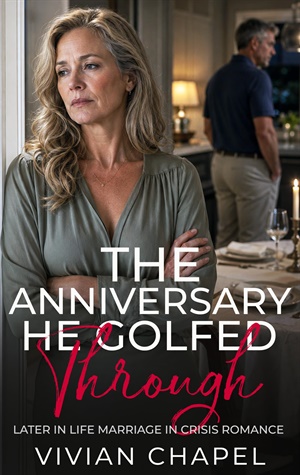
The Anniversary He Golfed Through (Marriage In Crisis #25)
Chapter 1
ELLEN
The Tuesday before our anniversary, I spread my grandmother's tablecloth across the dining room table, checked it for stains, and sat down in the chair across from the head — Jack's chair, empty.
From there I could see the room the way he would on Saturday night, and I sat a while trying to guess what he'd notice first.
The cloth was ivory linen, its scalloped edge embroidered by hand the year my grandmother married.
My mother had used it maybe twice a decade.
I used it for our anniversaries, for our children's baptisms, for the two Christmases my father was well enough to travel.
It came out of the hall closet folded in tissue, carrying the faint smell of the cedar block I kept in the box.
When I ran my thumb along the hem, one thread had pulled loose against the weave. I'd mend it before Saturday.
Thirty years. The number sat in me like something swallowed whole.
On the kitchen calendar, a small pencil star marked the second Saturday in October. I'd drawn it back in January, before the page held anything else.
Jack came in from the garage while I was still sitting there, work shirt on, the blue one with the company logo stitched over the pocket. He smelled like cold air and the coffee he drank in the truck.
"You're up early," he said.
"Couldn't sleep." I smoothed the loose thread flat. "Checking the cloth."
He looked at the table, then at me, and his face went soft.
He wasn't a handsome man in the way magazines mean it.
He was solid, gone gray at the temples, with hands that had carried sample cases for thirty-one years.
But when he looked at me like that, I was the girl again who'd let him walk her to her car in a parking lot in 1995.
"Big one this year," he said.
"Thirty."
"Thirty." He said it the way he'd read off the score of a game already over. A number, filed. Then he crossed to the counter, poured the last of the pot into my cup, added the splash of milk I liked without being asked, and set it by my hand. "There you go, El."
That was Jack. He'd forget to say the tender thing, then fill my gas tank so I never had to stand at a cold pump in December.
He noticed when the coffee ran low. He noticed the ice on the front steps and salted them before I woke, warmed my car on winter mornings so the seat was already soft heat by the time I climbed in with my travel mug.
I wrapped both hands around the cup he'd filled and let it warm my palms.
"I've got the Cleveland numbers to close out today," he said, shrugging into his jacket. "Then Thursday I'm off to Pinehurst with the guys."
I looked up. "Thursday."
"Stu booked the block. We tee off Friday, play Saturday morning." He caught something in my face and lifted a hand, easy, reassuring. "I'll be back Saturday by four. Plenty of time. I wouldn't miss it, El. Thirty years."
"You'd be driving three hours after eighteen holes."
"I've done it a hundred times." He kissed the top of my head, the way you'd pat a dog that worried too much. "Four o'clock. I promise. Get the good wine."
Then the door, the truck, the settling sounds of the garage, and my coffee going cool between my palms. A man who warms your car doesn't need to be taught how to love you.
I'd said it to myself so many times over thirty years that it came now without my asking, the way grace comes to a mouth that's said it since childhood.
I mended the thread that afternoon and planned the menu the way I planned everything, on the back of an envelope: the standing rib roast he liked, potatoes done in cream, green beans with the almonds, a chocolate tart from the good bakery because I didn't trust my own pastry after a full day.
I bought two tapers, ivory to match the cloth, for the way candlelight softened a room.
I bought the wine he told me to buy, then a second bottle he didn't know about, a better one, because thirty years seemed to me to deserve the better bottle whether or not he noticed.
Wednesday I took the shoebox down from the hall closet shelf.
I don't know why. I told myself I was hunting for a card I'd bought early and misplaced.
The cardboard had gone soft at the corners, and inside stood thirty years of anniversary cards on their spines like files.
I'd kept every one. I ran my finger along their tops the way you'd walk your hand across a fence.
Most of them said lovely things. Jack couldn't say a tender word out loud, but he could write one, and over the years he'd written me a great deal of love into that box. I pulled a few and read them at the kitchen table with the afternoon coming sideways through the window.
I wasn't looking for the phrase. But by the third card I'd seen it three times, in that back-slanted hand of his, added at the bottom of each like a stamp.
A little late.
He wrote it when the card came a day after, or a week after, or the weekend after.
As a joke, I think, a small rueful shrug put into words.
I'd always read it as tenderness. That afternoon I counted, though I didn't mean to, my hands doing it on their own.
Eleven cards. Eleven times in thirty years the card had come after the day, and eleven times he'd written those same three words, as though lateness were a little tradition we shared, as though it were ours, as though it were sweet.
I put the cards back. I squared the box on the shelf so its edge lined up with the shelf's, then squared it again, though it was already square, and closed the closet door.
I didn't think about it after that. Or I thought about it the way you think about a sound in the walls, a thing you've decided is only the house settling, because the alternative is to go and look.
Saturday came clear and cold, a good October day, the maple in the front yard gone the color of a struck match.
I cleaned the house I'd already cleaned.
I set the table at two so I could stand back and look at it: the ivory cloth, my mother's water glasses, the two tapers waiting unlit in their holders.
I ironed the napkins. I put the roast in at three so it would rest by six, and I told myself six was generous, that four o'clock plus a shower plus a fresh shirt still left us two hours of light before dinner.
At three thirty I went upstairs and put on the green dress.
Jack had told me once, years ago, that green was my color, and I'd believed him because he wasn't a man who said things he didn't mean.
I did my hair and found my mother's earrings.
In the mirror I looked like a woman waiting for something good, and I let myself feel it — thirty years in and still glad, still half a girl about a Saturday night.
Four o'clock came.
I didn't worry at four. Traffic on a Saturday, a slow foursome ahead of them on the course, a stop for gas.
Jack was always a little late; the cards in the closet said so in his own back-slanted hand.
I went down and basted the roast, moved the beans to the back burner, and lit the oven light so I could watch the potatoes brown.
Four thirty. I poured a small glass of the wine he didn't know about and carried it to the front window.
The maple burned in the last of the sun, and down the street the Kowalskis' boy rode his bike in slow circles.
I sipped and told the empty street that my husband would be pulling in any minute, that he had promised, that thirty years was not a thing even Jack would let slide.
Five o'clock. I lit the candles, then blew them out again, because it was too early, because you don't burn your good tapers on an empty table.
I straightened the two forks that were already straight and turned the water glasses so the etched sides faced the chairs.
Then I sat down in my place and looked at his, the way I had on Tuesday, and waited while the roast rested and the light went out of the maple one branch at a time.