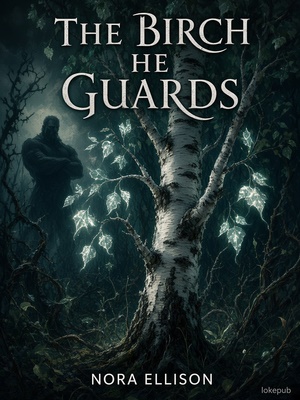
The Birch He Guards
1. Chapter One
Chapter One
Ayse
Blades of grass tickled my skin as I dug my toes into the soft dirt. Branches swayed above with each passing breeze, the scratch of my quill harmonizing with the gentle rustle of their leaves. I scrunched my face, scrutinizing the blooms before me.
Did I miss anything?
The tip of my quill dipped low into the inkpot on the ground, and I retraced a few of my strokes for good measure. Once I was fully satisfied with the sketch, my attention shifted to the blank space on the page. There, I transcribed everything I knew about the flower with neat precision.
Meadow Lily. Yellow, orange, or red petals with freckles. Yellow stamen. Entirely edible. Crush bulb for poultice to apply to burns and ulcers.
With a sigh, I closed my journal and carefully loosened the earth around the lilies’ roots, then gently placed the plants in my basket. Rising from my crouched position, I moved slowly to avoid the lightheadedness that I knew would threaten to overwhelm me. It always did.
Five bulbs. That was it. They were the only edible plants I’d stumbled upon all day, and my stomach growled in anticipation.
Brushing the dirt from my dress, I leaned against a nearby tree, grounding myself as I slipped my shoes on. After retrieving my belongings, I set off on the journey home, each step deliberate and measured as my eyes scanned for any more untapped sources of food.
The dense foliage was easy enough to maneuver, allowing me to concentrate on searching for other edible plants.
That was, until a prickling sensation crawled up my spine, as if unseen eyes were boring into my back.
I halted, but the forest remained eerily silent, save for the rustle of leaves overhead.
Brushing aside my unease, I hastened my pace, determined to reach the safety of town as soon as possible.
Emerging from the dense thicket, the trodden path below me gradually widened, transitioning from packed dirt to smooth cobblestones.
With each step onto the road, the tension in my chest began to ease.
Ahead, the comforting sight of familiar half-timbered buildings constructed from wood and ivory plaster greeted me on either side.
Taking a deep breath, I glanced back at the forest again and saw nothing. Townspeople filled the street ahead, their presence bringing life to the thoroughfare. It was a reassuring sight, helping me regain my composure.
As I entered the bustling town square, a gust of wind cooled the air as a cloud passed overhead. I wrapped my arms around me to ward off the chill until the sunlight returned.
When it did, its warmth caressed my skin, prompting me to pause and bask in it. With my eyes closed, I savored the sensation—until I was abruptly jostled to the side as someone crashed into me from behind.
Startled, I spun around, instinctively raising my fists in a defensive stance.
Okay, maybe not fully composed quite yet.
I took a deep breath to steady myself after the collision before looking up to see who had bumped into me.
It was a man in his early twenties, with a broad frame and an angular nose.
Pale coppery curls framed his freckled face.
With a disdainful sneer, he glared at me over his shoulder, huffed loudly, and walked off, adjusting his bulging rucksack as he disappeared into the crowd.
As the moment passed, I lowered my fists.
You’re in town. You're safe.
There was no reason to feel so on edge. The village of Punhelm was my home.
Shaking my head to clear my thoughts, the man’s face from moments ago surfaced.
Why are the attractive ones always so haughty?
I imagined the comical expression he might have had if he’d fallen on his backside after our collision.
The thought was an amusing distraction. I chuckled as I walked past the cobbler, the potter, the weaver, and finally the last storefront before ours: the abandoned bakery, empty since the family fled south a year ago.
I lived with my father above his apothecary. As I entered our shop, an herbal, peppery scent filled my nostrils, and the weighty door closed behind me with a tinkle from the bell above.
Inside, walls embraced shelves, crammed full of dried herbs and delicate tinctures nestled in glass bottles. To my right, rows of wooden drawers held a trove of meticulously organized ingredients amassed over countless years.
The apothecary stretched deeper than its width.
An elongated aisle extended from the front door to the kitchen and stairway at the rear.
Spanning nearly the room’s entire length, a robust wooden counter stood a few feet from the drawer-lined wall, creating just enough space for a single person to navigate between them.
Behind the counter, my father diligently ground a fine orange powder in a mortar before him.
I watched him for a moment, hunched over the bowl in concentration. White hair sprinkled the sides of his tawny, balding head.
Papa paused his work and looked up at me expectantly.
He gave me a tight smile when he saw that I had not come home empty-handed.
Returning the smile with a small one of my own, I placed the basket on the worn, smooth counter.
It wasn’t much, but it was something. That had become our motto for the past two years, ever since our family’s once peaceful world had been turned upside down.
“I’ll fetch some needles for tea,” I declared, and Papa nodded in agreement.
We needed to save at least three bulbs to sell.
Even if we ate the rest of the plants, along with the last bit of bread from our rations, it wouldn’t be enough to fill our aching bellies.
We would still be kept awake tonight with hunger.
Not that either of us slept much anyway.
Still, a warm cup of pine needle tea from the spruce out back worked wonders on both the inflammatory system and the soul.
As I stepped out onto the porch, dusk was already settling over the town. I hurried around the building to the tree out back.
It wasn’t always like this. While rumors of food scarcity in the northernmost regions circulated in the year before my birth, the famine didn’t impact our town until around two years ago.
On that fateful day when everything changed, the Withering quickened, sweeping through our nation at an accelerated pace.
Before that, the cursed famine had only trickled down from the north, diminishing crop size and slowing growth.
Papa mentioned that apples and potatoes used to grow as large as fists, but I’d never seen either grow past the length of my thumb.
He even claimed squash could grow bigger than a person’s head, and I still couldn’t figure out if he was kidding or not about that.
Now, as I approached my twentieth year, crops were nonexistent once the Withering overtook a region. Strangely, it targeted only crops and fruit trees, completely bypassing everything else.
It was as if the famine intentionally sought to undermine our food sources, a cruel joke, like nature itself held a grudge.
Many had turned to hunting and fishing, but without proper restrictions in place, far too many animals were now on the brink of extinction.
Horses had been named a protected species due to their usefulness to the crown after too many Ittorans tried to slaughter theirs for food.
And only those with permits could hunt, unless you found yourself facing a dirus.
No rules applied to those terrible beasts.
Luckily for Ittora, most grain farming—rice and wheat, to be exact—occurred in the more southern, temperate regions. Rumors suggested the Withering was still far from the south, and our monthly rations of bread or rice were small but consistent. Again, it wasn’t much, but it was something.
As I gathered a handful of needles, I glanced out past the town's skyline to where the sun had just disappeared.
Long shadows stretched around me, urging me not to linger.
With the needles in hand, I made my way back to the porch.
Just before reaching the door, I spotted a vaguely familiar woman inside, speaking with my father behind the counter.
Her cropped gray hair and pointed jawline tugged at my memory as I paused to get a better look through the window before stepping inside.
“Ah, Olika, you remember my daughter, yes?” my father asked. Olika. That triggered my memory. She was the healer from Greenhaven, the next village over.
“Yes… Ice, right?” Olika asked tentatively, as if she was trying to place me in her memory, just as I was doing to her moments ago. At least she was vaguely close with her pronunciation.
“It’s pronounced Eye-sheh,” I corrected with a curtsey. “Pleasure to see you again, Olika.”
“Eye-sheh,” she said, drawing my name out, likely in an attempt to commit it to memory. “Yes, sorry about that. It is good to see you again.” She turned to watch my father as he rummaged through his drawers.
“I’m grateful you have sleeproot here in Punhelm,” she said softly. “It appears even the less edible plants have become scarce nowadays, with all the foragers trying their luck in the woods.”
I headed toward the back of the shop, where the door to our small kitchen awaited. Passing by Olika, I noticed her expression—lips pursed and eyebrows drawn. Something was wrong.
“Will you be staying long, Olika?” I called from the kitchen doorway. “I’m about to make pine tea, but I’m afraid it will take about twenty minutes to steep.”
“No, but thank you for the offer, Ayse.” She nodded.
I passed into the kitchen, pouring two mugs of hot water from the kettle Papa had put on the stove, settling the needles neatly inside each cup.
Seated at the table, I listened as Olika’s hushed voice carried through the thin kitchen wall, my fingers tapping lightly on my steeping cup.
“We lost two little girls last month, Saul. Not even ten years, either of them. And a baby boy because his mother couldn’t produce any milk.”
My fingers paused, gripping my mug as my gut twisted.
The blacksmith’s wife took her life only a month ago, and it was well-known she did so because she lost her new babe after not being able to produce milk, nor could she find a wet nurse for the child. No one had anything to spare… and everything to lose.
“It’s getting dangerous, and there doesn’t seem to be an end in sight. What will we do when the Withering spreads to the south?”
“We just have to trust Queen Xia,” Papa said quietly. “Surely, she has a plan.”
A few beats passed, and my spine straightened as I waited for Olika to respond. My muscles tightened as I strained to hear her whisper, “For everyone’s sake, Saul, I desperately hope so.”
The clinking of golden kinsen coins exchanging hands was followed by the jingle of the doorbell.
Moments later, Papa came into the kitchen and began cooking the bulbs.
We didn’t speak for the rest of the evening, sharing our meager meal in solemn silence.
As night fell, I drifted into sleep with Papa and Olika’s conversation lingering in my mind and hunger aching in my belly.