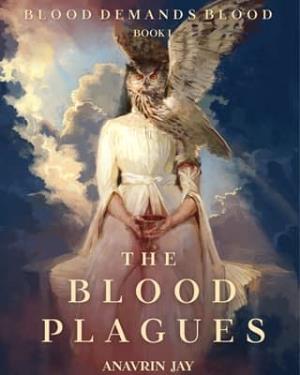
The Blood Plagues (Blood Demands Blood #1)
Prologue
It hurt.
It hurt.
It hurt.
More than the offering. More than communion. More than all the pain of before.
It hurt when we were ripped from the soil.
Our roots ran deep, deep into the earth.
You are immoveable, she had told us. You are eternal, my children.
You shall stay with me forever, and shall be cherished and faithful and mine.
You will never leave the warmth of my side, or pluck your mouths from my breast, or be torn from the touch of my hands.
Is it not a blessing, my children? That I will care for you always.
We adored Mother.
We wanted to stay, to be held by Her, to be touched by Her, instructed by Her. It was rapture to be with Her. “We love you, Mother,” we would sing. “Glory be to you, Mother.” And She would smile and laugh and bathe us in warmth. We loved Her warmth so much, we had forgotten the cold.
When we heard it—the shifting of dirt and the scratching of metal—we cried. “Someone is coming, Mother. They are going to hurt us. Do not let them take us, Mother.”
“Hold strong,” she called from a place we were never allowed to go. “Have faith and hold strong. Do not heed to metal and axes and hands. Have faith, and they will not harm you.”
But so many of us were already broken: branches splintered, leaves torn from their buds, limbs wrenched apart. And it hurt. We screamed, “Stop! Stop, stop, no more… Mercy, have mercy!” But the men kept digging, and Mother kept yelling.
“You have betrayed me, my children. You have cast me aside. Why do you let them take you?”
“We would never, Mother,” we promised. “Never. We love you, we love you, we love you. Let us stay, Mother. Do not let the men with their metal and axes and hands take us from you.”
But take they did.
We bled the whole way. Without earth, our blood pooled, unable to drain. It hurt to swell with it. Writhing like snakes, we longed to bite, to scratch, to rage, but it had been an age since we were flesh, with muscle and sinew and strength.
Ready to burst, we couldn’t stop bleeding—all of us, drowning.
But then we felt the coolness of peat, the dampness of earth, the powder of soil. We would be reunited with Her, and all would be well.
“Mother,” we chorused, “we missed you.”
Wrong. Wrong. Wrong.
The ground was cold; the dirt, too silent. It was empty, and we could not find Her, no matter the breadth of our search. “Where are you, Mother?” Without Her warmth, without Her light, we were lost in the dark and cold.
Then, blind in the shadows, we felt it.
Warmth.
Not the radiance of Mother that bloomed like a sun, but an ember above. We scrambled, the mass of us racing towards the small patch of heat.
But it was not Mother, only a child.
“A child,” we sang. “She’ll help us.”
“Help us! We are lost; help us,” we begged at her feet, but she recoiled from our touch. She screamed, louder and louder, as we crawled up her legs.
“Mama, mama, mama!” she cried.
“Mother, Mother, Mother,” we echoed.
She was so warm, and we had grown so cold.
We clung to her body, to her feet, ribs, and neck, before flooding into the heat of her mouth, painting it red. It was warmer inside. We’d forgotten what it was like to have tongues, teeth, and throats.
“Khloye!” another ember cried.
“Khloye!”
“Khloye,” we chimed. This one was warm, too. We did not want her to leave—either of them—so we made sure they stayed.
So cold.
But soon, so were they.
Surging up from the cobbles, we rummaged under each stone, climbed every tree, searching, searching, searching…
We rose, higher and higher, until we were taller than mountains. We swelled, larger and larger, until we were broader than valleys. We curled into one monstrous wave, and we crashed, scouring the ground for morsels of warmth.
Nothing like Mother, but warm.
Until they grew cold, too.
And thus, we seeped back into the soil. “Mother,” we keened, “do you punish us? We are cold, Mother.”
But Mother was gone.
And it hurt…so much more than before.