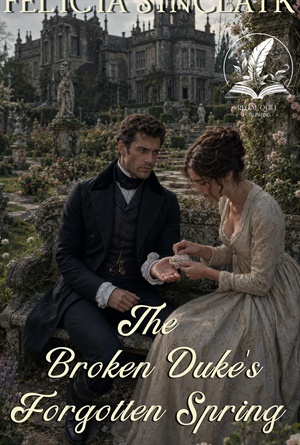
The Broken Duke's Forgotten Spring
Chapter 1
Alexander Hargrove, the Duke of Ashbourne, returned to his father’s estate under a sky that was drained of color.
He was thirty-one years old, tall and broad-shouldered, with a commanding presence he had never quite been able to subdue. His hair was dark brown, kept short though never entirely tamed and with a slight wave that became more noticeable when dampened.
His eyes were a cold gray-blue, and they narrowed as his destination came into view.
The Ashbourne estate rose ahead of him as the carriage slowed, its vast structure sitting perfectly preserved, as though time itself had chosen not to disturb it.
He had been there in years, and if he had had it his way, he never would have seen it again, but that was never a possibility.
The wheels crunched over gravel, and when the carriage door opened, the air that met him was cold enough to bring him back to where he was. He stepped out and began to walk toward the entrance without haste, the estate responding to his presence with the same indifference it had always shown.
Inside, he moved through corridors that carried no sound beyond his own footsteps. Nothing appeared disturbed, yet nothing appeared inhabited either, and the absence of change gave the impression that his father had grown as complacent with his household as he had with his son.
In the study, he found the letter already placed on the desk waiting for him. He recognized the handwriting before he touched it, the familiar script of the duke before him, his father, whose control had once shaped every corner of the estate and, for too long, every corner of Alexander’s life.
When he broke the seal and read the contents, the words were as direct as ever, as it demanded he marry in order to secure the future of the dukedom, framing it as duty rather than any real desire, and Alexander had to admit that he agreed with that at least.
There was no surprise in the request, only confirmation of what had already been set in motion long before he had arrived.
Marriage, in his mind, was something to be completed as any other task, efficiently rather than questioned, and done with in order to secure his family name. It was easier that way.
The estate around him remained still as he set the letter aside, its silence pressing against the walls. Ashbourne had always been quiet, but it was suffocating after so many years, as though the house itself had been emptied of anything that once gave it warmth.
He crossed to the decanter, pouring himself a measure of amber liquid before turning toward the hearth.
The fire within it was weak, reduced to embers that glowed, offering little warmth but enough light.
He drank in silence, the sensation grounding him briefly as he stood watching the dying glow, and in that moment he could not help but make the comparison: the estate, the embers, and himself, each maintained in function but diminished in life.
When he finally turned away from the hearth, he took his place at the writing desk, the surface already prepared for him. The war had ended, but that did not mean that he had nothing more to contend with. He laughed hollowly, wondering whether fighting or finding a wife would be worse.
But he did not break his rhythm once the decision to begin his search had been made. At once, he took to writing, not bothering to offer any pleasantries as he personally never read them, and did not see any use in subjecting the recipients to them either, especially as they would have been empty.
Instead, he wrote requesting only what was necessary. Marriage, in his view, did not require familiarity; it required suitability. He made no attempt to disguise the finality of his intention, nor did he care at all which one of them was eventually chosen.
A finished letter lay open before him before he sealed it, and he reread it with a sigh.
To the House of Westbridge,
In accordance with the obligations of my title and the continued preservation of the Ashbourne line, I write to request details of any eligible daughters within your household or extended family who may be considered suitable for marriage.
Kindly provide only the following information: full name, age, and confirmation of lineage. No portraiture or personal correspondence is required, as meetings will not be arranged prior to selection.
This request is made in the interest of securing a prompt and appropriate alliance in accordance with the expectations placed upon the Dukedom of Ashbourne.
Cordially,
Alexander Hargrove
The Duke of Ashbourne
He folded the sheet once, then again, sealing it with the crest of Ashbourne. The process was repeated with variations in the recipients and the addresses, but never in intent, each letter identical in its refusal to engage with anything beyond necessity.
When the final seal was pressed, Alexander allowed himself a brief stillness. There was no romance in it at all, but he considered that would be beneficial, given that he had no interest in suggesting that he would be offering anything of the sort.
Memories surfaced immediately, carrying with it the war in fragments rather than in sequence—the deafening rupture of gunfire cutting through night air, the hollow silence that followed when the fighting stopped, and the strange unreality of quiet after chaos, as though the world itself had forgotten how to continue.
From there, his thoughts shifted inevitably to his father, and to the war that the man had waged all his life.
Their conflicts returned, ones that never resolved and were only concluded through withdrawal.
Doors slammed with force that shook the frames, voices raised until they fractured into silence, and words that lingered far longer than the arguments themselves.
Alexander was not made for peace, nor for gentleness, and love in any form was something he would never be permitted to claim without consequence. That was what his father had said, at least.
It had never been cruelty, but a matter of fact. It was simply how things were, and there was no changing that, and he hoped his future wife would understand that too.
Alexander set the final letter aside, aligning it precisely with the others. Suddenly, the study doors opened, and the butler, Mr. Thornton, stepped inside without announcing himself beyond the soft click of the latch.
He was fifty-four years old with thinning gray hair kept parted tightly to one side, and his face was long with deep lines running from his nose to the corners of his mouth and across his forehead.
Alexander remembered that he wore a dark uniform that was always pressed and buttoned fully to the throat, even when others in the house were less formal. That had not changed.
The room swallowed him immediately.
“I did not request assistance.”
Mr. Thornton’s pale brown eyes narrowed slightly at that, and he did not move immediately.
He had served the house long enough to know when obedience was expected and when concern was unavoidable.
He set his gaze on the letter in Alexander’s hand, then on the ink stains on his fingertips, the half-opened correspondence already stacked in ordered rows.
“The tray is not why I am here, Your Grace,” he said carefully. “I came because the staff noticed you have not slept yet. You ought to sleep before responding to those.”
“The staff has too much time to observe things that do not concern them, then.”
A pause followed, and then Mr. Thornton stepped closer to the desk, but not too close. No one ever dared go too close.
“The late duke would have approved of such isolation,” he said at last, softer now, almost cautious. “But that does not mean that you have to do the same. Your father liked to be alone, to—”
“To be in control,” Alexander cut in sharply. “He controlled, Mr. Thornton. Let us not disguise it as anything nobler, and let us not believe that I will be any different.”
“Even so, Your Grace, control does not require solitude. You are not obliged to carry everything without counsel, and I am more than happy to offer you mine.”
Alexander’s jaw set slightly. He reached for the letter again instead of answering, as though it could anchor him back. The silence that followed was deliberate on his part, a dismissal without words, but Mr. Thornton did not retreat.
“I have served this family since you were a boy,” he said quietly. “And I have seen what this house does to men when they begin to believe they must become stone in order to survive it.”
Alexander’s fingers paused on the edge of the parchment. For a brief moment, recognition flickered across his face. When he spoke again, his voice was lower.
“I am not a boy now,” he said. “And this house does not require survival.”
Mr. Thornton nodded slightly, as though accepting the boundary had been drawn, yet he did not leave.
“Your Grace, the decision you have been presented with may seem simple,” Mr. Thornton said, “but time has a way of revealing what haste conceals. You are not required to choose immediately, and you need not mistake duty as something that is always so urgent.”
A silence followed, sharper than before. The fire crackled once, breaking it. Alexander finally spoke again.
“That will be all.”
For a moment, Mr. Thornton did not move. Then he gave a small bow and turned toward the door.
“Very well, Your Grace. If you require anything, I will be here for you. It may not feel like it as yet, but we do all want what is best for you.”
The door closed softly behind him, and Alexander sighed. He wanted to believe him, and to trust that his staff had his best interests at heart, but it was easier said than done. The only person that he had ever been able to trust was himself, and that would never change. He was certain of it.
He remained still for a long moment, staring at the space where the man had stood. He reached for the sealing wax beside him without fully deciding to move, as though motion might quiet the unease that had begun to settle under his ribs.