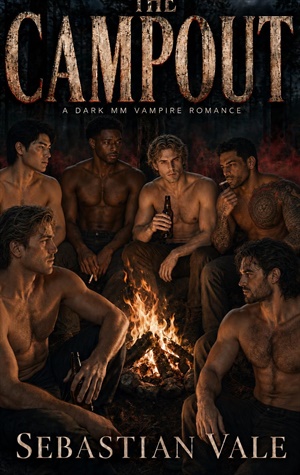
The Campout (Black Fern Bloodlines #1)
1. The Stranger at Site Seven
Chapter one
The Stranger at Site Seven
Luca
The storm found me forty minutes past the last gas station, right where the map said Black Fern Basin began and my phone signal said nothing at all.
Rain came down the windshield in sheets thick enough to erase the road.
I’d driven through worse — I’d driven through a Category 2 to get to a twelve-hour shift once, because that’s the kind of person I am, the kind who shows up — but this rain had a weight to it.
It didn’t fall so much as press. The wipers gave up pretending around mile marker nine, and the pines on either side of the road closed in until the headlights were tunneling through a green throat.
I should have stopped an hour earlier. There’d been a motel in Waycross with a lit vacancy sign and a diner attached, and I’d driven past it doing sixty because the retreat’s welcome packet said check-in began at ten a.m. and I had planned — with the specific, white-knuckled precision I bring to things I’m terrified of — to be first in line.
Seven years of waiting compresses strangely at the end.
The last fifty miles felt longer than the first seven years.
The wheel shuddered. I overcorrected, felt the back end float, caught it, and admitted that continuing was no longer driving.
It was gambling. And when the sign for BLACK FERN CAMPGROUND — VACANCY floated out of the gray like a drowned thing surfacing, I took the turn, because the alternative was hydroplaning into two hundred feet of pine one day short of the ground where my brother’s life ended.
Or didn’t. Depending on which version of me you asked, and at what hour of the night.
The campground was nearly empty. One RV with its blinds down and a wheel cover gone brittle in the sun of some previous decade.
One truck under a tarp. A cinderblock bathhouse glowing a sick fluorescent yellow through the downpour.
And a pavilion — open-sided, tin-roofed, the rain hammering it like applause — with a single man standing under it, dry, unhurried, watching my headlights come in.
I want to say I noticed him the way you notice anyone. I didn’t. I noticed him the way you notice a drop in blood pressure: something in the room has changed, and your body knows before the monitors do.
I parked. Sat there a second, letting the engine tick, watching him not move. Then I pulled my hood up and ran for the pavilion, because I’d driven six hours to reach the place that ate my brother, and I wasn’t going to spend the night before it hiding in a Corolla.
Under the tin roof the rain was deafening and the man was worse.
Tall. Dark hair pushed back wet at the temples, though I couldn’t figure out when he’d been in the rain — the concrete around him was dry in a neat circle, like weather was a thing that happened to other people.
Mid-thirties, maybe, though something about the way he stood made the number feel like a guess with a wide error bar.
He had the kind of face that looked assembled by someone with strong opinions: hard jaw, soft mouth, and eyes that were doing something no stranger’s eyes should do, which was cataloguing me.
Lightning turned his irises ember-red for one blink.
When the dark came back they were brown again, or black, or whatever color reasonable men’s eyes become when you stop checking them for fire.
Not checking me out — I know that look, I’ve weaponized that look — but reading me. Line by line. Chart review.
“You’re driving badly for a man who drives well,” he said. His voice fit under the rain without raising itself, which should have been impossible.
“Excuse me?”
“You overcorrected twice on the turn-in and once on the county road. Someone taught you controlled braking and you ignored it tonight. That’s not inexperience.” He tilted his head a degree. “That’s distraction.”
“You watched me park in a monsoon.”
“There’s nothing else to watch.”
I laughed before I decided to, which annoyed me. “Are you the campground’s welcoming committee, or its warning label?”
“That depends on the camper.” His gaze moved over me once — my car, the duffel visible through the back window, the state of my hands where they’d come out of my pockets. “You’re not here for the fishing.”
“Nobody said I wasn’t.”
“Your hands did. No calluses where a rod wears them. Calluses where a stretcher does. Nails cut to the quick — glove discipline.” He said it lightly, like a party trick, but the accuracy went through me like a needle finding the vein on the first stick.
“Medical. Emergency, I’d guess. You stand like a man who’s used to bad news arriving fast, and used to being the one who catches it. ”
“You do this to everyone who parks here?”
“Only the interesting ones.”
The rain roared. Somewhere out in the dark, thunder unrolled itself down the basin like something enormous turning over in its sleep, and the fluorescent light over the bathhouse flickered, steadied, flickered.
“Luca,” I said, because you have to call a thing something.
“Rhys.”
He didn’t offer a hand. I noticed that. I noticed, too, that he’d angled himself so that I stood between him and the warm light, and he stood between me and the trees — and I couldn’t decide whether he’d put himself in the position of a threat or a door.
“There’s coffee,” Rhys said, nodding at a thermos on the picnic table like it had been waiting for me, “if you’re staying until it passes.”
“It’s not passing.” I’d watched the radar until the signal died. The cell was parked over the basin like it had reservations. “It’s settling in.”
“Yes,” he said, with an odd, private weight. “It does that here.”
I should explain something about me, because otherwise the next hour looks like recklessness, and it wasn’t. Recklessness is doing a dangerous thing without understanding it. I understood exactly what I was doing. I’d been doing it, in one form or another, for seven years.
When Nolan disappeared, I learned that the people you love are on loan and the bank can call the debt any hour of any night, without notice, without cause, without a body to bury.
So I built a life where nothing could be repossessed.
Work I was excellent at, because competence can’t leave you.
Friends I kept at a warm arm’s length. And men — beautiful, temporary men in cities I was passing through — whom I could be astonishingly close to for one night, because one night has no future to lose.
It’s not sad. Everyone assumes it’s sad.
It’s efficient. You get the closeness. You skip the amputation.
We drank his coffee and traded insults dressed as questions for the better part of an hour, and he was good at it — good in the way that made me better, the way a strong opponent raises your game — and the whole time, that animal-brain corner of me that has kept me alive in parking garages and psych holds kept sending up the same flare: this one is dangerous.
And a different corner, the one that had been driving toward a missing brother for six hours, answered: good.
“I have a tent,” I heard myself say, finally, into a gap in the thunder. “Somewhere in that duffel. It’s a one-man and it’s terrible.”
“I have one that isn’t,” Rhys said. “Site seven. I’ll share.” A pause — and then the first genuinely human thing he did all night: he looked briefly uncertain, like the offer had come out ahead of whatever plan he’d been running. “If you want.”
“I don’t take up much room.”
“That,” he said, “I doubt.”
The inside of his tent was warm in a way that had nothing to do with insulation. He’d strung a battery lantern from the ridgeline, and in its amber light he sat back on his heels — this big, coiled, unhurried man — and instead of reaching for me, he said:
“Tell me the rules.”
“The rules.”
“Yours. Everyone has them. Most men make me guess.” Something crossed his face, there and gone, an expression from a much older conversation. “I don’t want to guess with you.”
No one had ever asked me that. In six years of temporary men, not one. I’d supplied the rules myself, mid-act, as corrections. Being asked in advance, in full sentences, in lantern light, felt more intimate than anything that came after — and plenty came after.
So I told him. What I liked. What I didn’t.
Protection, non-negotiable — I took the condoms and the lube out of my duffel and set both between us where the lantern could see them, and he nodded once, no bargain hidden anywhere in it.
And then — because his mouth kept drifting to my throat when he looked at me, and because some deep-brainstem part of me had noticed his teeth the way you notice a scalpel out of its tray — I added, half-joking, mostly not:
“And no biting. Unless I say.”
He went very still. Completely still, in a way people can’t do; people are always breathing, blinking, swaying against their own heartbeat, and for one second Rhys was a photograph of a man.
“Unless you say,” he repeated.
“Unless I say.”
“Then I’ll wait,” Rhys said, “until you say,” and kissed me like a man setting down something heavy he’d carried a very long way.
I won’t pretend I understood, that night, what I was inside of.
I only knew that no one had ever paid attention to me like that.
Not close — forensic. He touched me like he was memorizing evidence, like there’d be an inquest later and he intended to testify accurately.
Every reaction I had, he filed and used and returned to, patient as tide, until I stopped performing pleasure the way you do with strangers and started actually having it, which is rarer than anyone admits and which I would have denied needing under oath.
He asked before he changed anything. He stopped, twice, unprompted, to check my face — not for permission, he had that, but for truth, like the difference mattered to him more than the act itself.
And somewhere in the middle of it, the strangest thing: he laughed. Once, low, startled out of him by something I said, and the sound was rusty, like a door used twice a century, and he looked almost betrayed by it. I filed that too. I file everything. It’s the job.
At the end, when I was past pride, past strategy, past the version of myself that keeps one hand on the door — I pulled his mouth to my throat and said it.
“Now. Now — do it—”
The bite was nothing like teeth. It was a fuse finding powder.
Heat went down me in a line from throat to heel, and I heard myself make a sound I’d never made in front of another living person, and Rhys held me through the whole of it with a care so total it felt, absurdly, like grief — like he was doing a beloved thing for the last time instead of the first.
Afterward he cleaned me up with warm water he shouldn’t have had, and pressed something soft to my throat, and arranged the sleeping bag over me with the brisk competence of a man who’d made ten thousand beds.
When I touched the spot on my neck later there were two small marks already half-healed, which I attributed to endorphins and bad light, because the alternative attributions were not available to a reasonable person.
“Question,” I said into his shoulder, floating. “Genuinely. How are you real?”
“I’m not sure I am,” said Rhys, and I laughed, and he didn’t.
I was almost asleep — wrecked and warm and, for one night, in a stranger’s tent at the edge of the forest that ate my brother, safe, a sensation so foreign I nearly didn’t recognize it — when he traced the line of my collarbone with one finger and said, quietly, like a man reading a headstone:
“Sleep, Mercer.”
My eyes opened in the dark.
I never told him my last name.
I lay still, heart working, running the whole evening back like security tape — the pavilion, the coffee, the rules, every sentence I’d said — and no. I’d said Luca and nothing more. No last name, no hometown, no hospital. My wallet had never left the car.
By the time I built up the nerve to say his name, his warmth was gone from beside me and the tent flap was breathing in the wind.
I looked out. The rain had thinned to a drizzle, silver in the last of the moon.
Rhys stood thirty feet away at the edge of the tree line with his back to me — no coat, no shirt, no reaction to the cold at all — his head tilted like a man listening to a conversation being held on the far side of the forest, and not liking what he heard.
He’d walked there barefoot across thirty feet of soaked, open ground.
Behind him, in the mud, all the way from the tent to where he stood —
there wasn’t a single footprint.