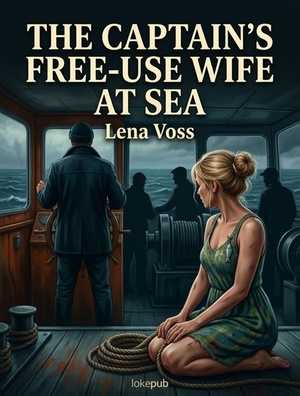
The Captain's Free-Use Wife at Sea
Chapter 1 — The Sea Has His Eyes
---
The *Merrily* left the harbor the way Elias Harlan did everything that involved water: like a man keeping a promise.
He stood at the wheel with his shirt open one button too far and his cap shoved back, talking. Not to Mara. To the heading. To the light on the channel markers. To a brown pelican that paced them past the last jetty and then peeled off toward the fish-house roofs.
"There she is," he said, and for a second Mara thought he meant her. He meant the open water. The color change where the harbor brown gave up and the real stuff began, that harder blue that made his whole face go young.
Mara stood at the starboard rail in a dress that had been a good idea on land.
Thin cotton, pale yellow, the kind of thing a wife wears when she is meant to look like luck.
Wind plastered it to her thighs. Salt was already in her mouth.
Behind her the deck was all coil and cleat and the wet slap of work, and she was the only thing on it that did not have a job.
"Beautiful day to be married to the sea," Elias called, without turning.
He said things like that the way other men said good morning.
He had said them on their wedding night, standing at a hotel window that faced the bay, one hand on the glass, the other forgetting it was supposed to be on her.
She had thought it was poetry then. She had been twenty-six and new at wanting a man who wanted something bigger than a bed.
She was thirty-one now, and the poetry had a wake.
Cole was already watching her.
He had the look first mates got when they had decided a problem was not going to fix itself: square, unhurried, a little mean around the mouth.
He was coiling line amidships and doing it too slowly for the work to be the point.
When Mara caught him, he did not glance off toward the water or invent a knot.
He held the look the way he held the rope, until she felt it land between her shoulder blades and slide down.
She could have gone inside. She stayed at the rail and let the dress do what thin cotton does in a channel wind.
Below, the engine found its note. A hatch banged. Ruiz's voice came up through the grate, cheerful as a wrench.
"Captain's wife is the only thing aboard that isn't lashed down," he said, not quite to anyone. Someone laughed. A second voice, Ben or Tate, answered that some cargo liked to shift. Ruiz made a noise that was not quite a word.
Elias heard none of it. He had the wind and a clean heading and the particular joy of a man whose favorite person in the world was a stretch of water that could not talk back.
Mara had married that joy on purpose. That was the part that still surprised her, on mornings like this, with the town falling astern and her husband's shoulders easy under washed cotton.
She had wanted a life that moved. She had wanted a man who did not go gray in an office.
She had not understood, not really, that you could stand three feet from someone and still be the scenery.
Lila crossed the deck with a bosun's economy, paused beside Mara just long enough to take in the dress, the rail, Cole's attention like weather.
"If you're going to stand there," Lila said, "stand to weather of the work. Tate's about to swing a crate."
"I'll move."
"Or don't." Lila's mouth almost smiled. "Just know what's coming."
She went forward. Mara moved one step and no more. The crate swung. Tate watched it, then watched her ankles, then the crate again, professional enough to keep his hands on the line.
Nia stuck her head from the galley hatch, flour on one wrist, and called that coffee was up if anybody loved themselves. Elias shouted that he loved the morning. Nia rolled her eyes in a way that included Mara, a small female conspiracy that lasted half a second and then went back to bacon.
Mara took coffee to the wheelhouse because that was what a captain's wife did when she was trying to be in the picture.
The wheelhouse smelled like sun-warmed vinyl and Elias's soap and the ghost of a thousand paper cups.
Charts were clipped where a sane man would have clipped them.
A photograph of the two of them on the dock at their wedding was taped beside the compass, already bleached to the color of old lemon.
In the picture Elias was looking past her left ear.
She had never noticed that until this year.
"Brought you some," she said.
He took the cup with his free hand and kissed the air near her cheek, a bright little miss. "Taste that air. You feel her under us? She's happy. I told you she'd be happy once we cleared the bar."
"I feel her."
"That's my girl." He said it to the bow. "We'll make good time if this holds. I want you to see the light off Coriolis at dusk. There's a green in it that doesn't happen anywhere else. I dreamed about that green before I ever had a license."
Mara put her hip against the unused stool and drank her own coffee black.
From here she could see the whole working deck: Cole's shoulders, Ruiz wiping his hands on a rag as he came up from below, Ben laughing at something Tate had said with his mouth too close to Ben's ear.
Ordinary men. Ordinary morning. The look Cole had given her was still sitting on her skin like a hand that had not been withdrawn.
"You should come to bed earlier," she said.
Elias laughed, delighted, as if she had told a joke about fish. "Can't rob the twilight. Twilight's when she tells you the truth. You know that."
"I know that."
He squeezed her waist with the hand that was not married to the wheel, a warm, husbandly squeeze that landed and left. Then he pointed at a smear of brighter water and started talking about current the way some men talked about God.
Mara went back down.
The day arranged itself the way days on a small boat always did.
Work happened around her. She was offered kindnesses that were not quite work: Nia let her peel potatoes.
Lila handed her a length of line and showed her a hitch, then undid it and did it properly when Mara's fingers made a pretty mess.
Ruiz came up for water and looked at her mouth when he drank.
Ben asked if she wanted a cigarette and looked briefly panicked when she said yes, as if the captain's wife was not supposed to do anything with her lips that produced smoke.
She smoked it on the aft deck and felt ridiculous and then did not. The yellow dress had a damp print at the small of her back. Her nipples had been tight since the channel. She could have changed. She did not.
Cole passed her with a crate of fruit Nia had ordered and stopped, not touching her, close enough that she smelled diesel and sun on him.
"You going to be on this run the whole way, Mrs. Harlan?"
"Mara."
"Mara." He tested it. "Captain says you're good luck."
"Captain says a lot of things."
Cole's eyes went to her throat, then lower, then back up with no apology. "If you need anything that isn't luck, you find me. Hatch is unlocked. Always is, on my watch."
It was not a metaphor and he did not dress it up as one. A man offering a door. A man who had already decided what the door was for.
"That's kind," she said.
"It isn't." He shifted the crate. "Kind is what he is. I'm the other thing."
He went down the companionway. Mara stood there with the dead cigarette and a pulse she could feel in her teeth.
Supper was beans and fried fish and Elias at the head of the table telling the story of a bar crossing from ten years ago, complete with voices for the wind.
The crew laughed in the right places. They were fond of him.
That was the trick of Elias Harlan: he was easy to be fond of.
He passed bread. He remembered that Tate's sister had a baby.
He told Mara she made the table look like home.
Under the table, someone's boot found the side of her bare foot and stayed there, a quiet, deliberate pressure. She did not look down the bench to see whose. She did not move her foot. When the boot withdrew, her skin kept the shape of it.
After dishes she walked the deck in the last light.
Coriolis was a rumor on the horizon, the green Elias loved not yet sprung.
The *Merrily* talked to herself in little wooden ticks.
From the wheelhouse came her husband's voice, a low running commentary meant for no human audience, praise and weather and the names of stars he would wait up to see.
Mara went to their cabin.
It was a decent cabin for a boat this size: narrow bunk built into the hull, a locker that smelled like wool, a porthole that turned the dusk into a coin.
She stripped the yellow dress off and hung it on the hook, where it looked like a decision she had not finished making.
In the little mirror her mouth was windburned.
There was a stripe of sun across her chest.
She looked like a woman who had been taken outdoors and not quite used.
She lay down naked on top of the blanket because the cabin was close and because she wanted, childishly, to be found that way.
Elias came later than twilight and earlier than sense.
He moved through the dark with the confidence of a man who knew every board.
He smelled like the wheel and cold coffee.
He sat on the edge of the bunk and put his hand on her hip with real affection, the unconfused love of someone who believed he had already given her the best thing he had.
"You missed the green," he whispered, happy. "It came. I thought of you."
"Did you."
"Mm. Next time I'll haul you up by the wrist. You have to see it to believe it."
He kissed her hair. His mouth was gentle.
His body was already tilting toward sleep, that clean sailor's drop.
"We're going to have a beautiful run. I can feel it in her. She's glad you're aboard. I'm glad you're aboard."
"Come here," Mara said.
He did, mostly. He tucked against her back and fitted his knees behind hers and made a sound of simple contentment, as if the bunk were a harbor.
His hand rested on her stomach and did not travel.
He was hard for a minute the way sleeping men are sometimes hard, an accident of blood, and then he wasn't.
His breath went long. Salt and satisfaction.
The little smile still in the muscles of his face.
Mara lay with her eyes open and his hand a warm, useless weight.
She could have woken him. She had done it before, in the first year, and he had been sweet and a little startled and good enough in the way of a man who liked her and liked coming and liked getting back to the weather.
He would do it again if she asked. He would even apologize, warmly, for being tired, and then tell her about a current.
That was the marriage: a kind man, a live boat, a wife who had become a story he told the sea about luck.
The engine's note came through the hull, steady as a pulse that did not belong to either of them.
Somewhere forward a hatch opened and shut.
Boots. A low male laugh cut off. The boat was full of men who did not look past her ear.
Cole's door was unlocked. Ruiz had already named the fact of her, unsecured.
Lila had told her to know what was coming. The boot under the table had known.
Mara turned Elias's hand over and held it once, not unkindly. He did not wake. He murmured something that might have been a heading.
She looked at the porthole, at the black that was not empty, only waiting.
She was done being luck.
She was done waiting to be wanted by the one person on the boat who could not take his eyes off the water long enough to try.
In the morning she would wear the dress again, or she would wear less, and she would stand where the work could see her, and she would find out what an unlocked hatch was for.
The *Merrily* carried them into the dark, and the captain slept like a man who had everything he loved under his hands.