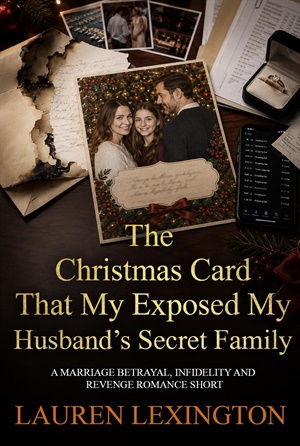
The Christmas Card That Exposed My Husband's Secret Family (Proof of Betrayal #16)
Chapter One
The Card
Tilda Webb had always believed Christmas made liars work harder.
All year, people could hide a marriage behind routine.
A missed dinner became a client emergency.
A distracted glance became fatigue. A locked phone became privacy.
In December, however, lies required ribbon, postage, guest lists, charitable smiles, and the careful arrangement of family photographs sent to two hundred people who believed what the picture told them.
For twenty-seven years, Tilda had managed the Webb Christmas card.
Jeremy liked to call it their tradition, although his contribution began with approving the photograph and ended with complaining that stamps had become absurdly expensive.
Tilda chose the paper, updated the addresses, corrected the spelling of clients’ names, and removed the dead with the tact required of a woman who understood both manners and database hygiene.
This year’s card showed Tilda and Jeremy standing on the front steps of their Charleston house, with garland around the columns and candlelight glowing in the windows behind them.
Jeremy wore a dark coat, his silver hair neatly combed, one hand resting at Tilda’s back. Tilda had smiled because the photographer told her to. The result was elegant enough to satisfy Jeremy and distant enough to be honest.
The dining room table had disappeared beneath envelopes, address labels, ribbon, and the small gold seals Jeremy insisted made everything look more personal. Tilda was correcting the address of a retired client in Virginia when the mail dropped through the brass slot in the hall.
Several envelopes lay on the mat when she reached the door.
Most were expected. A charity appeal. A catalog.
A thick square envelope from a couple who sent photographs of their grandchildren with the seriousness other people reserved for tax documents.
Beneath those sat a plain white card with no return address.
Tilda carried everything back to the dining room and opened the anonymous card with a letter opener Jeremy had received from a bank president. The blade slid beneath the flap. Inside was a glossy photograph printed on heavy paper.
At first, Tilda noticed the tree.
It was enormous, too large for the modest room behind it, decorated with red glass ornaments and strands of white lights. A woman stood beside it, smiling with her arm around a teenage girl.
The girl had dark hair, a narrow face, and the self-conscious posture of someone old enough to dislike being photographed but young enough to submit to it. A man stood on the girl’s other side, turned partly away as if someone had called his name at the instant the picture was taken.
His face was blurred by motion.
His watch was not.
Tilda placed the card on the table.
The watch had a black leather strap and a rectangular silver face.
She had bought it for Jeremy’s fiftieth birthday after three months of listening to him mention, with heroic restraint, that good watches were becoming difficult to find.
He had kissed her in the restaurant that night, in front of the waiter, and told her she understood him better than anyone.
Beneath the photograph, someone had written in blue ink.
Maybe this year, you’ll finally tell her.
Tilda read the sentence again. The house remained orderly around her. Gold seals gleamed in a shallow bowl. Their own Christmas cards waited in neat stacks. On the mantel, silver bells reflected a room that had suddenly become too still.
The woman in the photograph had blonde hair cut just below her jaw and a smile Tilda had once known very well.
The woman was Claire Hollis.
For a moment, the name opened a door inside Tilda’s mind and let in an older room, an older Christmas, and Claire at this same table helping tie ribbon around client gifts while Jeremy praised her efficiency.
Claire had been Jeremy’s office manager in those days and Tilda’s friend by slow accumulation. She had stayed for dinner often, cried in Tilda’s kitchen during her divorce, and vanished from Charleston after what Jeremy called a necessary break from painful memories.
Tilda turned the card over with careful fingers.
On the back, beside a small smear of ink, someone had written four more words.
The message read, “Ask him about Lila.”
The front door opened.
Tilda slid the card beneath a stack of envelopes as Jeremy entered the hall, speaking into his phone in the smooth voice he used for clients with large accounts and fragile egos.
“I understand your concern, Arthur, but family money becomes vulnerable when decisions are made emotionally. That’s precisely why people need structure.”
Jeremy paused in the doorway of the dining room and smiled at her. He looked expensive without appearing vain, which Tilda had always considered his greatest business skill. His coat was cashmere, his shoes were polished, and his wedding ring caught the chandelier light as he ended the call.
“You’re heroic,” he said. “I came home expecting chaos, and somehow you’ve turned the card list into an act of governance.”
“Governance requires snacks.”
“I knew I married wisely.”
Jeremy leaned down to kiss her cheek. The gesture brushed the edge of her skin and moved away before it could become intimate. His gaze passed over the table.
Something in his face altered.
Tilda watched him notice the corner of the anonymous card. Only a sliver showed beneath the envelopes, but the photograph paper had a different gloss from their stationery.
“What’s that?” he asked.
“A card.”
“From whom?”
“There wasn’t a return address.”
Jeremy reached for it before Tilda could answer further. The stack of envelopes slid aside, and the photograph lay between them.
For several seconds, Jeremy made no sound. A man accustomed to advising others on risk should have hidden himself better. His hand closed around the card so quickly that the paper bent.
“Where did this come from?” he asked.
“The mail.”
“That’s not what I meant.”
Tilda folded her hands in her lap. “It’s the answer I have.”
Jeremy looked toward the hallway, although no one else lived in the house and no guest was expected. “This is ridiculous.”
“Is it?”
“You mustn’t let strange mail upset you. People send cruel things at Christmas because they’re lonely, or resentful, or mentally unwell.”
“Claire Hollis looks well enough in the photograph.”
His eyes returned to her. “You recognized her?”
“We were friends.”
“A long time ago.”
“Yes,” Tilda said. “She left rather suddenly.”
Jeremy gave a short laugh that sounded rehearsed and abandoned halfway through. “Claire had difficulties. You remember that. The divorce, the anxiety, all those imagined slights at the office. I tried to help her because she worked for me, and because you cared about her.”
“The girl’s name is Lila.”
Jeremy glanced at the card in his hand.
Tilda watched that small mistake land.
“Is it?” he said.
“The back of the card says to ask you about her.”
Jeremy’s expression softened into something meant to look patient. Tilda had seen him use the same face with widows who disliked signing complicated forms.
“Tilda, listen to me carefully. Claire was unstable near the end. I don’t say that unkindly. She had a talent for attaching meaning to ordinary kindness. If she’s sending things like this again, we should ignore it rather than feed whatever story she’s telling herself.”
“You believe Claire sent it?”
“Who else would?”
The question sat there, too ready.
Jeremy turned toward the fireplace, where a small flame moved among the logs Tilda had lit because clients would visit later in the week and the house needed to smell festive. Before she could rise, he dropped the card into the fire.
Tilda stood so quickly that her chair struck the rug behind her. “Jeremy?”
“That’s enough,” he said, and the command in his voice showed itself. “I won’t have some disturbed woman throwing ugliness into our home during Christmas.”
The photograph curled at the edges. The glossy paper blackened slowly, resisting the flame.
Tilda did not move while Jeremy watched it burn. His shoulders lowered after the center caught. For the first time in their marriage, Tilda understood that he was not waiting for her to believe him. He was waiting for the evidence to disappear.
A phone rang in his coat pocket.
Jeremy looked at the screen and turned it facedown against his palm.
“I have to go back to the office,” he said. “Arthur is panicking about year-end transfers, and apparently I’m the only person in Charleston who understands grown-up money.”
“Of course.”
Jeremy studied her for a moment. “Are you all right?”
Tilda looked at the fireplace. “You burned a Christmas card in the middle of the afternoon.”
“I simply removed something unpleasant. I know this looked strange, but I need you to trust me.” Jeremy stepped closer and touched her arm. His fingers were warm. “There is nothing in my life you need to worry about.”
Tilda looked down at his hand until he removed it.
After Jeremy left, the house resumed its arranged quiet.
A delivery truck moved past outside. Somewhere in the kitchen, the ice maker dropped a fresh load into the tray.
The dining room table remained covered in the Webb Christmas cards, each one waiting to tell a hundred households that Jeremy and Tilda were exactly what they appeared to be.
Tilda went to the kitchen and returned with metal tongs.
The fire had eaten most of the card, but one corner had fallen onto the stone hearth, singed rather than destroyed. Tilda lifted it carefully and placed it on a white saucer.
Claire’s face remained at the edge, half smoke-stained. The teenage girl’s hand rested against the sleeve of the man beside her. The watch remained visible, black strap and silver face, bright against the char.
On the reverse, the heat had spared part of the message.
The message read, “Ask him about Lila.”
Tilda photographed the fragment from several angles. Afterward, she opened a new folder on her laptop and named it Christmas.
The cursor blinked inside the empty file window, patient and indifferent.
Tilda placed the burned card inside an envelope from her own stationery drawer, sealed it, and tucked it behind a stack of unused place cards for the client party.
Outside, afternoon light slid across the polished floor. Tilda returned to the dining room table, picked up an address label, and corrected a client’s name with a steady hand.
By the time Jeremy came home, every Webb Christmas card would be ready to send.
Tilda would make certain of it.