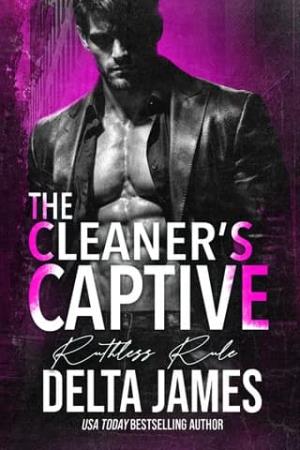
The Cleaner’s Captive (Ruthless Rule #2)
Chapter 1
SOFIA
Twelve counts. Twelve chances for a jury to look Alejandro Reyes in the eye and tell him his life is over. I've been waiting twenty-three months for this moment, and the foreperson hasn't looked at the defense table once since she stood up.
That's how I know.
"Has the jury reached a verdict?"
The foreperson stands a little straighter. She's a retired schoolteacher from Astoria, sixty-two years old, with reading glasses on a beaded chain around her neck.
"We have, Your Honor."
"On the first count of the indictment, racketeering conspiracy under Title 18, United States Code, Section 1962, how does the jury find?"
"Guilty."
The word lands like a hammer strike. Behind me, someone in the gallery exhales. To my left, at the defense table, Alejandro Reyes doesn't move. He sits in his expensive suit with his expensive haircut and his hands folded on the table like a man at church, and he doesn't react at all.
His lawyer does, though. William Prescott, one of the most expensive criminal attorneys on the East Coast, leans over and whispers something in Alejandro's ear. Alejandro shakes his head once.
"On the second count, conspiracy to distribute and possess with intent to distribute controlled substances, how does the jury find?"
"Guilty."
Count after count, the same word. Guilty. Guilty. Guilty. Twelve counts in total, and the schoolteacher from Astoria reads each one in the same steady, unaffected voice.
I keep my face neutral, allowing no smile, no visible satisfaction.
The cameras are watching, and the last thing I need is footage of me gloating that ends up on some defense attorney's appeal brief.
But beneath the table, my hands are trembling, not from nerves but from the kind of adrenaline that comes when something you've poured your entire life into actually works.
Judge Whitmore thanks the jury and sets sentencing for six weeks out. My co-counsel, Aaron, squeezes my arm as the courtroom dissolves into noise. Reporters shout questions. Defense attorneys confer. Marshals move toward the defendant.
Alejandro Reyes finally turns. Not toward his lawyer, not toward the marshals approaching with handcuffs. Toward me.
He looks at me the way a man looks at the person who just ended his life, not with anger but with something colder, something that says I will remember your face.
I hold his gaze. I don't look away until the marshals take him through the side door and it clicks shut behind him.
Then I gather my files, slide them into my briefcase, and walk out of the courtroom like it's any other day.
But it's not any other day.
In the hallway, Aaron catches up to me. He's grinning so hard it looks like it hurts. "Twenty-five years minimum on the sentencing guidelines. Twenty-five, Sofia. We just put away the Vega cartel's entire northeast distribution network."
"We put away one man," I correct him, but I'm smiling now because we're past the cameras and past the gallery and it's just us in the fluorescent-lit corridor. "The network will restructure. They always do."
"Can you just enjoy this for five seconds?"
"I enjoyed it for the entire jury reading. That was at least ninety seconds."
He laughs and shakes his head. "You're impossible. Drinks tonight? The whole office is going to Murray's."
"Maybe. I have to call my mother first."
"Your mother can wait. This is the biggest RICO conviction this office has had in years."
He's right. It is. And I should go celebrate with the team that helped me build it, the paralegals who organized tens of thousands of documents.
The junior attorneys who drafted motions at midnight and the investigators who risked their lives getting witnesses to cooperate.
They deserve a night out. They deserve to feel this win.
I pull out my phone as Aaron walks ahead, already texting the group chat. Three missed calls from numbers I don't recognize. Two voicemails. I delete them without listening. I know what they'll say. I've been getting calls like these for months.
Drop the case. Back off. We know where you live. We know where your mother lives. We know where you get your coffee.
The threats started small and escalated steadily.
Notes left on my car. A dead bird on my apartment doorstep.
A man following me from the subway who disappeared when I turned to confront him.
The U.S. Marshals offered protective detail twice, and twice I refused.
Protective detail means fear, and fear means they've already won something.
I call my mother instead. She picks up on the second ring.
"Mija. Tell me."
"Guilty. All twelve counts."
She's quiet for a moment. Then she laughs, this bright, startled sound that makes my chest ache. "Your father would be so proud."
"I know, Mamá."
"Come for dinner Sunday. I'll make mole."
"I'll be there."
I hang up and stand in the hallway for a minute, letting the reality settle.
My father came to this country with nothing.
He worked construction until his back gave out, then drove a cab until the cancer took his lungs.
He never saw the inside of a courtroom except once, for a traffic ticket, and he was so nervous he could barely speak.
He wanted me to be a doctor. Safe. Stable. Well-paid.
Instead, I became the woman who puts men like Alejandro Reyes in cages.
Sorry, Papá. But you also taught me that if you see something wrong, you fix it. And what the Vega cartel does to communities like ours is very, very wrong.
I push through the building's front doors and into the gray February afternoon. The cold hits me immediately, that particular New York cold that seems to come from the concrete itself, radiating up through the sidewalk and into your bones. I pull my coat tighter and start walking toward the subway.
My phone buzzes with a text from another unknown number.
You made a mistake today, puta. A very big mistake.
I screenshot it, forward it to the FBI's threat assessment unit, and keep walking.
This is the part they don't tell you about in law school.
They talk about justice and precedent and the majesty of the law.
They don't mention the part where you win the biggest case of your career and then walk home checking over your shoulder because the people you just beat don't file appeals. They file bullets.
I take a different route home than usual, switching subway lines twice, doubling back through a department store and exiting on a different street.
It's probably overkill. The Vega cartel's leadership structure just took a catastrophic hit, and whatever's left of their operation is scrambling to reorganize, not hunting down the prosecutor who put them there. Probably.
But I didn't get this far by being careless.
My apartment is a one-bedroom in Jackson Heights, Queens, on the fourth floor of a walk-up that smells like Mrs. Gutierrez's cooking on the first floor and Mr. Patel's incense on the third.
It's small and overpriced and the radiator clanks all night, but it's mine and it's ten minutes from my mother and it's in the neighborhood where I grew up.
That matters. Everything I do, every case I build, I do it for communities like this one.
The ones the cartels tear apart from the inside, turning sons into soldiers and daughters into casualties and parents into ghosts who are too afraid to speak.
I climb the stairs, unlock my door, and step inside.
I fasten the deadbolt, loop the chain, and set the door brace I bought after the dead bird incident.
My apartment is exactly as I left it this morning.
A coffee mug sits in the sink. My case files are stacked on the dining table.
The suit I almost wore today is draped over the back of a chair.
I set down my briefcase, kick off my heels, and stand barefoot on the cold hardwood floor.
I won.
I actually won.
The shaking starts in my hands and travels up my arms and into my shoulders, and I sink onto the couch and let it happen.
Not fear. Not anxiety. Just the full-body release of twenty-three months of pressure that has nowhere to go now that the thing I was bracing against has resolved.
I press my hands between my knees and breathe through it, the way my therapist taught me.
In for four. Hold for seven. Out for eight.
When the shaking stops, I get up and pour myself a glass of wine. A good bottle, the one I've been saving since the indictments came down. A Tempranillo that cost more than I usually spend on groceries. I raise the glass to the empty apartment.
"Salud," I say to no one. "You did it."
The wine is excellent. Dark and warm and earthy.
I drink it slowly while I change out of my court clothes and into sweats, while I microwave leftover rice and beans, while I sit on my couch with my feet tucked under me and the television on low and the weight of the last two years slowly lifting off my chest.
By the third glass, I'm almost relaxed. Almost. There's still a current running underneath, the hypervigilance I've been living with for so long it feels like a personality trait. Every noise in the hallway makes me glance at the door. Every car horn on the street below sounds like a warning.
My phone rings. This time it's a number I recognize. Jon Baker, FBI Special Agent, the lead on the federal investigation that ran parallel to my prosecution. I pick up.
"Tell me you're celebrating," he says.
"Wine and leftover beans. Living the dream."
"Seriously, Navarro, this was a hell of a win. My SAC is already talking about it as a model case for cross-agency cooperation."
"Good. I'll take whatever goodwill I can get when the next warrant fight starts."
He pauses. The kind of pause that means bad news is coming after the congratulations. I've known Jon long enough to recognize the rhythm.
"What?" I say.
"We're picking up chatter. Nothing specific enough to act on yet, but the Vega cartel isn't taking this quietly. There's talk of retaliation."
"There's always talk of retaliation."
"This is different, Sofia. Alejandro Reyes isn't just some mid-level distributor.
He's connected. We believe his older brother handles the cartel's cleanup operations, disposal, evidence destruction, the kind of work that makes cases go cold.
We've never been able to build enough for an indictment, but the intelligence suggests he's the one they call when things need to disappear permanently.
And the family is tight. We're talking about people who would burn down a city block to avenge one of their own. "
"His brother." I pull up the case files in my memory. "Mateo Reyes. We looked at him during the investigation. Couldn't get enough for an indictment."
"Because he's a ghost. Whatever he does for the cartel, he does it without leaving traces. Bodies vanish. Evidence evaporates. Witnesses change their minds."
"Or end up dead."
"That too." Another pause. "Look, I'm not trying to scare you. But the marshals' offer for protective detail is still on the table, and I think you should seriously consider taking it."
"I appreciate the concern, Jon. I'll think about it."
"You won't think about it."
"No," I admit. "I won't."
He sighs the sigh of a man who has had this conversation before and knows how it ends. "At least vary your routine. Different routes, different times. Don't be predictable."
"Already on it."
"And, Sofia? Watch your back. These aren't street-level dealers sending you dead pigeons. If the cartel decides to come after you, it won't be a warning. It'll be a disappearing act."
I thank him and hang up. The wine doesn't taste as good anymore.
Mateo Reyes. I pull out my laptop and open the case files, searching for every reference.
There isn't much, and what there is reads like smoke.
He appears at the edges of testimonies, a name that witnesses mention and then quickly retract.
An older brother who came to the U.S. with Alejandro when they were teenagers.
No arrests. No convictions. A driver's license and a Social Security number that dead-end into a modest apartment in Queens and a job listing at an auto body shop that may or may not actually exist.
The man is a ghost, and Jon is right about that.
I study the single photograph we have, pulled from a traffic camera near one of the cartel's known locations.
It's grainy, low-resolution, showing a man with dark hair and broad shoulders walking with his hands in his jacket pockets and his face turned slightly away from the lens.
You can't see his eyes, but something about the way he moves, deliberate, aware of every angle, tells me he knew the camera was there.
He just didn't care enough to avoid it completely.
That kind of confidence is more dangerous than rage.
I close the laptop and finish my wine. The apartment is quiet except for the radiator's metallic complaint and the distant hum of Queens traffic.
I should sleep. Tomorrow the real work begins: post-trial motions, sentencing memoranda, the mountain of paperwork that follows a conviction.
But my mind won't stop turning over Jon's warning.
'If Mateo Reyes comes after you, it won't be a warning. It'll be a disappearing act.'
I get up and check the locks one more time, testing the deadbolt, the chain, the door brace.
I move through the apartment turning off lights, and when I reach the window in my bedroom, I look down at the street below.
Jackson Heights at night: the Dominican restaurant across the street still lit up, a couple arguing on the corner, a car idling at the stop sign with its exhaust curling in the cold air.
There is nothing unusual and nothing wrong.
But I stand at the window for a long time anyway, watching the street, watching the shadows between the streetlights, watching for something I can't quite put my finger on.
I tell myself it's just the adrenaline wearing off.
That tomorrow the hypervigilance will fade, the way it always does, and I'll go back to being the prosecutor who doesn't scare easily and doesn't back down and doesn't let men like Alejandro Reyes take up space in her head after the verdict is read.
I tell myself a lot of things as I climb into bed and pull the covers up to my chin.
The locks are checked. The door brace is in place. The pepper spray is on the nightstand. I've done everything right, everything the self-defense courses and the threat assessment protocols say to do.
It doesn't help. The feeling of being watched clings to my skin like a film I can't wash off, and sleep, when it finally comes, is shallow and full of shadows.