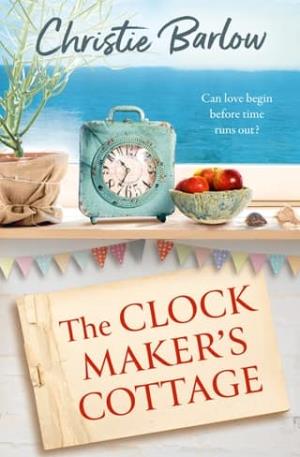
The Clockmaker’s Cottage (Puffin Island #6)
Prologue
There was an old saying everyone on Puffin Island knew, though whether they believed it was another matter.
If it rains on St Swithin’s Day,
It will rain for forty days more.
If St Swithin’s Day be fair and bright,
Forty days will bring delight.
It was one of those bits of folklore passed down without anyone quite remembering where it had started, only that it mattered. Farmers watched the sky more closely on the fifteenth of July, fishermen muttered about it under their breath, and if rain appeared that morning, people noticed.
That year, St Swithin’s Day arrived and brought warm summer rain. It pattered against the windows of Clockmaker’s Cottage, blurring the view of the garden. Agatha Vale, seated at her writing desk in the parlour, gave her ink bottle a shake. It was completely empty.
‘Of course,’ she muttered to herself, rising from the desk. ‘Everything runs out eventually.’
Except the rain. That, apparently, was limitless today.
It had been falling for hours now, light at first, then huge, heavy drops; the type of rain that would soak you to the skin within seconds.
She’d watched the causeway vanish mid-afternoon, swallowed by the rising tide, and if the rain carried on, she knew the island would be sealed off from the mainland for a matter of days.
She refilled the ink from the store in the cupboard under the stairs, then lingered there a moment longer than necessary, listening to the tick and whir of her husband’s clocks.
There must’ve been at least fifty of them in the cottage now, on shelves, on mantels, and on hooks hammered into odd corners.
Some were made of polished walnut, some brass, and one was even shaped like a cathedral and completely bonkers.
All handmade. All alive in their own mechanical way.
And all whispering different times.
Walter claimed it was on purpose.
‘They each mark something different, Aggie,’ he’d say, twiddling a cog like some romantic watchmaker out of a novel. ‘One tells Greenwich Mean, one tells lunar, and one – if you listen properly – knows your heart.’
For the past twenty-four hours, her heart had been ticking nothing but guilt.
Her hand hovered for a moment as the events from earlier replayed in her mind.
The row between Walter and Horace had been the worst one ever.
It had been dreadful. Final. Words had been spoken that couldn’t be taken back.
Today had shaken everything, and now it felt as though something had been broken that wouldn’t ever mend.
Agatha’s gaze drifted to the desk drawer on the right.
Inside was the large leather-bound commission ledger.
She hesitated for a moment before going over and pulling it out, opening it to the summer entries.
It was her job to record everything and keep the accounts up to date.
She flipped through the numbered commissions – forty-six in total so far.
She dipped her pen in the refreshed ink then started a new line.
Commission #47 – Stolen watch component – classified. Lost value: £12,000 / check A.V.
She closed the ledger and slid it back into the drawer, her hands shaking. That money was gone forever.
If only clocks could be turned back a second or two. If only mistakes could be undone.
The grandfather clock began to chime and she listened to it ring thirteen times; an eccentricity that was apparently just part of its personality.
Walter called it ‘rebellion against time itself’.
Agatha understood the concept of rebellion far more intimately than she would like to admit.
She knew that one small decision, made in a rush, could echo far further and longer than expected.
It was funny how lies – neat little things at first – could stretch themselves out until they filled every corner of every room you entered.
A knock landed on the open door, causing Agatha to turn with a start. Walter was back. He’d been walking in the rain.
He leaned against the frame, his expression unreadable except for that faint furrow he always wore when trying to pretend he hadn’t been worrying.
‘We only have this money to last to the end of the month.’ He placed the weekly cash float on her desk. She’d use it to take care of their bills and food. ‘There could have been so much more if…’
Agatha knew exactly what he was thinking. He was still wondering what had happened – and how. He blamed Horace, and Horace blamed him. Walter didn’t say another word though, and disappeared to hang up his sodden coat.
Agatha could do nothing but let it all be. She couldn’t change things now. She knew the scandal might one day come to light, and for that she was sorry, but she also knew that secrets keep time, too, and hers was ticking ever louder as her clock began to run out.
She heard Walter call from the kitchen, ‘I’ve made tea.
While I was out, I saw signs all over the island warning that, with the tide so high and all this rain, the causeway may close for a few days.
They’re advising any visitors who don’t want to be stranded to leave by tomorrow afternoon at the latest.’ She cast a glance behind her, making sure Walter was still in the kitchen, then she locked the desk and slid the key into a shadowed gap between the floorboards.
She then placed a pair of shoes over it, the gap and the secret it carried vanishing from sight.
There was always the chance that one day after her death her desk might be sold and someone would stumble across her diary, the letters, and the ledger, dust them off and finally discover the truth tucked between the pages.
Until then, her secret would stay safely hidden, waiting for the right moment and the right person.
Agatha had always believed that time had a sense of humour, and so if those pages ever did end up in someone else’s hands, she hoped it would be someone who believed in second chances; someone who understood love in all its messy shapes; someone kind enough to see her heart in the choices she’d made.