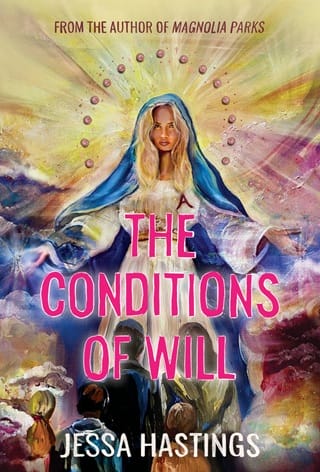
The Conditions of Will
1
Is there a good way to find out bad news? I guess, probably yes? Just…regular, I suppose—nothing scarring or dramatic.
My sister has been calling me around the clock for about a day and a half, and I haven’t been answering her calls because I never answer Maryanne’s calls because she has an undiagnosed narcissistic personality disorder and also, she’s a bitch, and also, I just don’t answer her calls. Not that she calls particularly often, but if and when she does, they mostly always go unanswered.
Now, admittedly, half of the reason I don’t answer them is because I know that it gnaws away at her—every time the phone rings out, her eyebrows would lower, her eyes would pinch a little, and her jaw would jut forward as her bottom teeth touch her top ones, quietly seething. If she was trying to call me in front of anyone else, she’d just flick her eyes with a demure little roll and tell them I’m impossible sometimes, but if she were by herself, a puff of air would escape her flared nostrils. She’d give her head a slight shake and her chest would go tight because Maryanne Joy Carter cannot not be in control of a situation.
Me, my brothers, and my sister are victims of that God-awful trend Pentecostal parents all seemed to fall into the trap of in the nineties. You know—the naming their children after Christian-adjacent words? I never tell anyone my full name because my middle name feels like a smear on my forehead that tells the world where I’m from, and I don’t want to think about where I’m from, but here it is:
Georgia True Carter.
Oh my God, I know. True . It’s painful.
My oldest brother is Tennyson Honor Carter.
Maryanne Joy Carter (a year and a half younger than Tennyson) is whose calls I avoid, but that’s not entirely her-specific (while also absolutely being entirely her-specific). Admittedly, I avoid almost all calls from my family except those coming from Oliver Just Carter. My youngest older brother—one year older than me, two years younger than Maryanne.
It was one hundred percent our mom who picked out our middle names, no doubt about it.
To be fair, it was probably pretty edgy of her for Beaufort County back in the late nineties—I’m sure she felt cool doing it, but I’ve never felt cool having it.
I’ve always wondered whether she meant to do it too…
Tenny and Maryanne, the Nouns… Me and Oliver, the Adjectives.
Even by the pure function of what a noun is as opposed to what an adjective is, she likes nouns more, I know she does…
A noun is specific.
Adjectives? Their main syntactic role is to modify a noun, and that just isn’t something you do in South Carolina.
There are lots of things you don’t do if you’re from South Carolina, though.
You don’t disobey your parents.
You don’t skip church.
You don’t be gay.
You don’t look like a blond Stephanie Seymour from the nineties. Which I do, apparently.
Always have, even when I was far too young to look like Axl Rose’s troublesome girlfriend, that’s for sure.
I get it all the time. And it’s nice, because she’s a bombshell and I guess I can see it… The way my hair tends to fall, the milky skin, the rosebud lips, the big blue eyes. I have all those things, so sure—I can see what people mean. But don’t you think her eyes look sad? I’ve always thought that maybe it was the way her eyebrows were shaped or how she holds her mouth in photographs. I can’t say for certain without seeing her in real life, which I never have, and even if I did, I look like her then , not now (or so I’m told)—but it was back then that I looked like her, and back then she looked sad.
So then, sometimes I wonder whether that means I look sad too.
Maybe I do. Maybe sometimes I am.
Not consciously though, and there’s a difference.
Conscious feelings are present on the surface, and you make decisions around them, but subconscious feelings exist under the surface, and they dictate your decisions too, arguably even more so, but often you only realize that in retrospect.
Befriending Hattie and Bianca? Retrospect.
Staying in London? Retrospect.
My sexual choices between the ages of fifteen and twenty-two? Retrospect.
What I study? Retrospect.
Anyway.
I’ve gotten about fifty calls from my sister on this very regular Saturday night in April, and I’ve ignored them all. Primarily because I thought that if there was something I actually needed to hear, they all would have the good sense to get someone else to give me a buzz after the first five calls went unanswered.
I don’t know why it wasn’t Violet who called me. Besides Oliver, my aunt Violet and her husband, Clay, are the only ones I talk to if I can help it, but she didn’t call.
I think maybe she didn’t want to hear the indifference in my voice if she told me.
Or maybe Maryanne just plain old didn’t let her.
My phone rings again and my housemate, Hattie Ramsey, glares at it on the breakfast counter.
“Fucking answer it, would you?”
I give her a steep look. “You answer it.”
“I can’t listen to the CTU ringtone one more time, Georgia—it’s been ringing since last night—”
“I know,” I sigh. “You think she’d get the hint.”
She lifts her eyebrows. “Maybe it’s important.”
I shake my head. “It’s never important.”
Hattie doesn’t believe me, but she’s never met my family.
There’s a certain brand of crazy that’s reserved special for the American South, and people who aren’t from there just won’t get it.
There’s no doubt in my mind that my sister thinks what she’s calling me about is important, but it wouldn’t be beyond her to have seen me write something anti-Trump on social media and feel like it was a personal attack, which is a thing that’s uniquely American, in case you didn’t know. The way people there conflate their political alignment with their personal identity. Being a Republican or being a Democrat in America is for so many people akin to racial identity. Now that I don’t live in America anymore, that strikes me as so weird. Because—honestly—neither party is great these days, and when you personalize something to the extent many people do in politics, any time anyone questions something the party does, it can feel like they’re questioning you, and that’s just plain unhealthy. I’m saying all that to Hattie for the millionth time when my phone pings with a text message. Finally.
I stare at my phone for a few seconds, just sitting there before I eventually reach for it, and in that space of time, Hattie—so over it, so desperate for the ringing to stop, apparently—she grabs my phone and checks the message.
Her hand that isn’t holding the phone clenches a little, just quickly, half a second. At the same time, her bottom lip pulls and her brows knit together in unison before they quickly shoot up, eyes dragging behind them a fraction of a second later.
Quick inhale of air.
Sadness and surprise.
Something bad’s coming.
She hands me my phone, brows still low, chest rising and falling quickly.
Maryanne:
Dad’s dead.
I stare at the screen for a long time, blinking.
It whistles around my clinically inclined brain that it’s not a positive sign that all I felt was a twinge of sadness. Not much more or less than a feeling of inconvenience.
I know how you’re supposed to feel when a parent dies.
People often experience a loss of identity, a crisis of self. They question who they are and their place in the world as though their parent themselves anchored them on to the planet.
Georgia:
What?
Nothing.
I don’t feel anything.
That could be shock, I know. I could be going into shock.
But why would I be going into shock at the loss of a parent I lost so many years ago already?
Maryanne:
Dad died.
I tried to call you.
Heart attack.
Georgia:
When?
Maryanne:
Yesterday.
“Are you okay?” Hattie asks. She hasn’t stopped looking at me since she handed me my phone.
She’s frozen up the way some people do around death.
It’s a natural fear, I get it. All humans, whether they know it or not, are profoundly impacted by their imminent deaths. Mortality is unbearably confronting, so much so that lots of people spend their whole lives trying to live as though it doesn’t chain them like it does the rest of us.
We do all these things to avoid the ephemeralness of ourselves and the people we form attachment bonds with around us, but there’s nothing any of us can do about it…
One day I’ll die. One day you will.
Hattie Ramsey and I met about four years ago but have only been roommates for a bit more than a year, when her best friend moved out of their Blandford Street flat to live with her boyfriend. Now it’s our Blandford Street flat.
Hats comes from a wealthy family, born and raised in London. Her mother is a successful artist and her father is an environmental lawyer. They are very in love, a rare and bizarrely functional parental unit who are highly supportive and passionate about the rights surrounding their daughter’s sexual orientation, which is bisexual.
She has one sister, whom she shares a close and delightful relationship with, and the expected frictions that life affords us all, which are essential for tenacity and personal growth, have been provided exclusively from sources outside her immediate consanguinity.
Hattie Ramsey is sheltered. Sheltered as fuck, one might almost put it.
Death is confronting for sheltered people because it fractures realities.
To be fair, death is confronting for all people, probably. Sudden deaths, anyway. But the idea of death, when we look at it square in the eye, it unsettles us all.
The idea that it ends—that it all ends—that everything you spend your life doing and building toward one day amounts to actually nothing the second you take your last breath.
It’s why people have children. To exist beyond their existence.
So here’s Hattie, standing in front of me, jaw agape, eyes round with horror, projecting the eventual looming death of her own very good father onto the death of my very shit one.
She’s devastated for me; She is more devastated for her though; she just doesn’t realize it.
“I’m okay.” I give her a reassuring smile.
It’s not a Duchenne smile. My orbicularis oculi muscle doesn’t move at all—there’s no eye crinkle, no crow’s feet in the corners of my eyes that shows it’s genuine, but she won’t notice it because most people don’t and I don’t want her to anyway. On a different day I would have thought to crinkle my eyes to make it more believable, but my father just died so I give myself a break.
She nods quickly; it’s a nervous nod.
She’s going to call her parents within the next ten minutes and tell them how much she loves them. She’ll stay here with me until I give her a signal that I want to be alone, and then she’ll excuse herself. I know she doesn’t like it when I read her how I do, and I try my best to placate her, go the long way around with things normally… Pretend I don’t notice when she’s attracted to someone or when she’s had a fight with her best friend.
I talk to her about those kinds of things in the slow, boring, drawn-out way that allows her and all other people to feel like they’re a mystery, because feeling like you’re mysterious seems to be something humans value, maybe because people don’t like to feel exposed, but I don’t have it in me to appease her in this way today.
“You can go,” I tell her.
She frowns a little more. Bottom lip sucks in a little. I’ve offended her a tiny bit. “Are you sure?”
I give her another smile again, but this time I think of the Dachshund puppy that the owner of the café down the street just bought, so my smile looks more genuine, and then I tell her that I just want to be alone, but I touch her arm as I do because I know it’ll put her at ease. It does.
She nods, relieved, and goes to her room.
Maryanne:
His funeral’s next Friday.
Georgia:
Okay.
Maryanne:
Can you tell Oliver?
Georgia:
Why haven’t you told Oliver?
Maryanne:
None of us have his number.
I glare at my screen.
How is that possible?
How do none of them have Oliver’s number?
Violet has his number, but she probably doesn’t want to call him for the same reason she wouldn’t want to call me.
Georgia:
I’ll call him.
Maryanne:
Good.
Thanks.
When will you fly in?
God, I hate South Carolina.