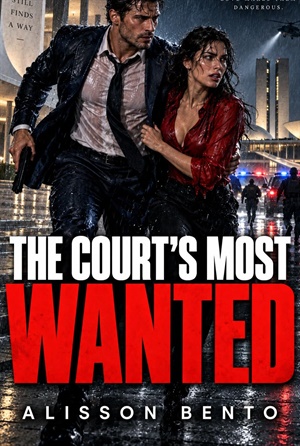
The Court's Most Wanted (Billionaires & Tycoons #17)
CHAPTER 1
HELENA
◆
He did it with eleven calm words and one tap of his thumb against the polished bench.
“The publication is suspended pending verification of its threat to national stability.”
On the monitors above the press gallery, the headline I had spent nine months bleeding over vanished from The Beacon’s home page.
BANCO MERIDIAN SOLD BILLIONS IN QUESTIONABLE CREDIT TO STATE BANK.
Blank white replaced it.
At thirty-two, I had been sued by ministers, threatened by bankers, and called reckless by people who confused obedience with wisdom. I had never watched nine months of work vanish with one tap of a thumb.
The woman beside me gasped. Three rows below, a television correspondent started whispering into her microphone as if the court might punish volume as well as content. My phone vibrated against my thigh, once, twice, then so hard it crawled inside my coat pocket.
SOFIA: Site is down.
SOFIA: Accounts frozen.
SOFIA: Helena, get out.
At the center of the high chamber, Vale folded his hands. He wore his black judicial robe like a priest wore certainty. A bald head polished by the chamber lights, six feet of narrow frame the robe hung from rather than filled, a face made famous by emergency addresses and midnight warrants.
He had never raised his voice in public. He didn’t need to.
“Freedom of the press,” he continued, “cannot become freedom to manufacture panic.”
I stood before common sense could stop me.
The gallery guard moved at once. “Ma’am.”
“My sources are verified,” I said.
Every camera in the room turned toward me. Vale’s gaze followed more slowly.
For one dangerous second, the chamber went silent enough for me to hear the old air-conditioning hum inside the marble walls.
“Ms. Duarte,” Vale said.
He knew my name.
The last time a court official used it, I was twenty-five and standing outside the detention wing where my father had died. A clerk had handed me a clear plastic bag containing his watch, his belt, and one shoe.
No explanation for the missing shoe. No answer about the nine hours between his first chest-pain complaint and the ambulance call. Only my name printed correctly across the receipt, as if administrative precision could make neglect clean.
Since then, locked rooms had become physical memories. My lungs remembered before I did. My hands counted handles, windows, hinges, and the distance to open air.
That should not have shocked me. My father’s name had once occupied these same screens, accompanied by the words traitor, saboteur, and enemy of the republic.
Vale had signed the sealed order that put him in a detention cell. Three weeks later, Mateus Duarte was dead.
Still, hearing my name in Vale’s mouth felt like finding a stranger’s hand on the back of my neck.
“You have been given the protection of this court,” he said.
“I didn’t ask for protection.”
A murmur spread through the gallery.
Vale’s expression barely changed. “Most people who need it don’t.”
The guard reached for my elbow.
A man in a navy suit rose near the rear doors.
He was taller than the officers around him and still in a way that made everyone else look nervous. Dark hair, severe mouth, shoulders that had no business fitting beneath a civilized jacket. I knew him from finance pages and grainy photographs taken outside government buildings.
Gabriel Salles.
Founder of Bastion Security. Former Air Force intelligence.
Billionaire son of the late Justice Beatriz Salles. The man whose company executed half the court’s digital orders.
The man I had spent six weeks trying to interview and twelve hours trying not to think about after he finally answered my call with a low, amused, “You ask questions like you’re breaking into a house.”
I had replied that powerful men usually kept the evidence indoors. He had laughed once, quietly, then refused every question that mattered.
The call should have made him less interesting. Instead I had spent the night replaying the rough edge in his voice and hating myself for noticing that arrogance sounded better when it came with restraint.
Now he stood inside Vale’s court with one hand loose at his side and all his attention on the fingers touching me.
He met my eyes across the chamber.
His gaze dropped to the guard’s hand on me.
The guard let go.
Vale noticed. Of course he did.
“Remove Ms. Duarte from the chamber,” the justice said.
Gabriel moved before the officers reached me, but a court clerk intercepted him. I didn’t wait to see which kind of power won. I grabbed my bag, ignored the cameras, and walked out under my own control.
The corridor beyond the chamber smelled of lemon polish and old paper. Reporters spilled after me. Questions hit my back.
“Helena, did Meridian pay your source?”
“Are you under investigation?”
“Did your father supply the documents?”
That one stopped me.
I turned so fast my heel slipped on the marble.
“Say his name again,” I told the young man holding the microphone, “and at least have the courage to know what he died proving.”
His mouth opened.
A hand closed around my wrist.
I jerked free and swung.
The man who caught my forearm wasn’t Gabriel. Elias Mota, Meridian’s deputy compliance director, stared at me with bloodshot eyes. Sweat darkened the collar of his expensive shirt.
“Bathroom,” he whispered.
“You look terrible.”
“I’m dying.”
The cameras surged closer.
Elias shoved through a staff door marked AUTHORIZED PERSONNEL. I followed because nine months of reporting had taught me that people only used the word dying when they wanted you to listen or forgive them.
The service hall beyond was narrow and badly lit. Elias staggered against a metal cart.
“Where are your security people?” I asked.
“Bought.”
“By Meridian?”
His laugh came out wet. “Meridian can’t afford them anymore.”
He pulled a black cord from under his shirt. A piece of red glass hung from it, flat and smooth, no larger than my thumb.
It looked like jewelry until he pressed the edge. A tiny gold contact slid out.
A hardware key.
He pushed it into my palm and folded my fingers around it.
“The portfolios aren’t loans,” he said. “They’re mirrors.”
“I know some of the borrowers were duplicated.”
“No. You know the reflection. Find who owns the glass.”
Footsteps sounded behind the staff door.
Elias flinched.
“What does the key open?” I asked.
“The first signature.”
“Whose?”
His fingers dug into mine. “The first signature owns the country.”
The door handle moved.
Elias looked past me, terror widening his pupils. “Don’t give it to Salles.”
The door burst inward.
Gabriel filled the opening.
Elias tried to run. His knees folded before he made two steps.
I caught him badly. We went down together. His forehead struck my shoulder, and the sharp chemical smell on his breath turned my stomach.
Gabriel knelt on Elias’s other side and checked his pulse.
“What did he take?” he asked.
“I don’t know.”
Elias’s hand fluttered at my coat, then fell.
Gabriel pressed two fingers beneath his jaw. His face changed by one degree.
That was enough.
“No,” I said.
“He’s alive.” Gabriel pulled a small radio from inside his jacket. “Medical team, east service corridor. Possible poisoning. Lock the floor.”
“Don’t lock anything.”
His eyes cut to mine.
The fear had escaped before I could hide it. I hated locked doors.
Hated narrow rooms. Hated air that belonged to someone else.
Gabriel didn’t ask why.
“Keep the east exit open,” he told the radio. “No sealed perimeter around Ms. Duarte.”
The order was smooth, immediate, and far too intimate for a man I barely knew.
“What are you doing here?” I asked.
“Saving you from your own timing.”
“I had the story.”
“You had enough of it to frighten the wrong man.”
“Vale?”
His gaze flicked toward Elias. “Put whatever he gave you in your bra.”
I stared at him.
“It’s the only place the first search will pretend not to see.”
“You’ve met federal officers with better manners than mine?”
“I’ve met federal officers.”
The footsteps in the main corridor multiplied. Gabriel stood and pulled me up with him. His hand landed at my waist, hard and warm through my coat.
“Take it off me.”
“When we’re outside.”
“You don’t get to—”
Glass exploded at the end of the hall.
Gabriel drove me to the floor.
The crack of the shot arrived after the impact. Stone dust sprayed over my hair. Another round punched into the wall where my head had been.
Gabriel covered me with his body, one arm locked over the back of my neck. He smelled like rain and cedar and the faint bitter edge of gun oil.
“Are you hit?” he demanded.
“No.”
“Check.”
“I would know.”
“People don’t always.” His hand swept down my side, efficient and impersonal until his palm crossed my ribs. Heat tore through me in a place terror had no right to reach. “Helena.”
“No blood.”
He looked at my face as if he needed to see the truth there.
A third shot shattered the emergency light.
Darkness dropped around us.
Gabriel hauled me up and pushed us through a utility door. We ran down two flights of concrete stairs while alarms began screaming above.
“Elias,” I said.
“Medical has him.”
“You don’t know that.”
“I know where my people are.”
“Your people work for the court.”
“Today they work for me.”
At the parking level, a black armored sedan was already moving toward us. Gabriel opened the rear door and practically threw me inside.
I twisted back before he could follow. “I am not disappearing into your car.”
A bullet sparked off the pillar beside his head.
Gabriel didn’t flinch. He climbed in, dragged me across his lap, and slammed the door.
The sedan accelerated before I found the seat.
His arm stayed banded around my waist. The city outside blurred through reinforced glass. Sirens rose behind us, but none came close enough to help.
“Get off me,” I said.
“Gladly.” He set me beside him and checked the windows. “When I know which branch of government is trying to kill you.”
“You assume it’s the government?”
He took out his phone. A secure notice glowed on the screen beneath the seal of the Federal Constitutional Tribunal.
My photograph occupied the center.
HELENA DUARTE. DETAIN ON SIGHT.
ARMED. EXTREME FLIGHT RISK.
A timestamp sat beneath the order.
9:42 a.m.
Twenty-five minutes before Vale erased my story.
Twenty-eight minutes before anyone fired a shot.
Gabriel turned the screen toward me.
“This warrant,” he said, “was waiting for you before the crime existed.”