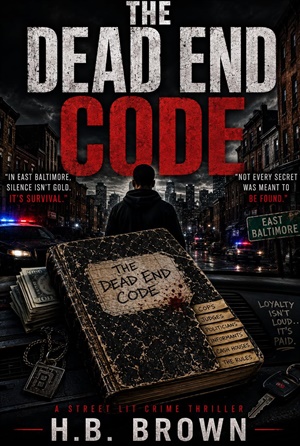
THE DEAD END CODE
Chapter One Lot 47
The auction started at nine, but Rome had been standing in the gravel lot since seven-thirty, watching his breath fog up in the cold and doing math he already knew the answer to.
Six hundred and forty dollars in the envelope in his jacket pocket.
Rent was eleven hundred, due in nine days.
Tookie’s asthma inhaler was thirty-two dollars at the pharmacy on North Avenue, and the boy went through one every three weeks whether Rome could afford it or not.
The tow truck needed a water pump. The tow truck was how Rome paid for everything else, which meant the water pump wasn’t optional, it was the whole equation.
So six hundred and forty dollars had to turn into something. That was the plan, such as it was.
“You gonna stand there mean-mugging the Impala all day, or you gonna bid?” Nuck said, coming up beside him with two coffees from the gas station, handing one over without being asked.
Nuck had a garage on Biddle Street and a nose for auctions that Rome trusted more than his own, mostly because Nuck had been doing this since before Rome was born.
“Water pump’s four hundred if I do it myself. Six if I pay somebody.”
“So don’t buy no Impala.”
“I ain’t buying the Impala.” Rome nodded toward the far row, past the sedans with the hail damage and the pickup with no engine at all, to a beat-to-hell Chevy Tahoe sitting crooked on two flat tires, a City of Baltimore impound sticker peeling off the windshield. “I’m buying that.”
Nuck squinted at it like it had personally offended him. “That’s been sitting since summer. Look at the tag on it — impound hold released, no owner claim. That means somebody either died or went to prison and didn’t care enough to come get it.”
“Or couldn’t afford the tow fees and just let it go.
” Rome had seen it plenty, working the truck.
People lost cars to the city over four hundred dollars in fines all the time.
It wasn’t always a mystery. Sometimes it was just Baltimore being Baltimore, squeezing blood from people who didn’t have any left to give.
“Parts truck,” Nuck said. “That’s all that is. You strip it for parts, maybe get your water pump out the deal if you’re lucky, and you still spent money you ain’t have.”
“I got a buyer for the frame already. Dude down on Ashburton wants it for a rebuild.” That part was true.
It just wasn’t the whole plan. The whole plan was that Rome liked buying things nobody else wanted, because nobody else wanted them meant nobody else would bid, and the city needed the lot cleared more than it needed top dollar.
He’d done this four times now. Twice he’d broken even.
Once he’d made three hundred dollars flipping a work van.
Once he’d lost the whole six hundred and eaten ramen for two weeks and never told his brother why.
The auctioneer, a heavyset man named Pruitt who ran these things out of a fold-up card table with a bullhorn duct-taped to a music stand, started working the row around nine-fifteen.
Rome watched three vehicles go — a Honda with rust through the floor panel, a work van, a Crown Victoria that somebody’s grandmother had probably driven to church for fifteen years — before Pruitt’s people rolled the dolly jack under the Tahoe’s back bumper and dragged it into position.
“Lot forty-seven,” Pruitt called out, not even looking up from his clipboard. “2011 Chevy Tahoe, impound release, no title complications, sold as-is where-is, city don’t warranty nothing, you tow it off this lot today or it’s back in the system. Who’s opening me at two hundred?”
Nobody moved. A older man in a Ravens cap near the front raised two fingers, unbothered, like he did this every Saturday. He probably did.
“Two-fifty,” said a woman Rome recognized from the scrapyard on Erdman.
“Three,” Rome said.
It went like that, slow and lazy, the way these things always did for vehicles nobody was excited about.
Three-fifty. Four hundred. The Ravens cap man dropped out at four-fifty, shaking his head like the whole thing had personally disappointed him.
By five-twenty-five it was Rome and the scrapyard woman, and she was doing the thing scrapyard people did where she watched Rome’s face instead of the auctioneer, trying to read how bad he wanted it.
Rome didn’t let his face do anything. He’d learned that from his mother, watching her negotiate rent extensions with landlords who wanted to see her sweat before they gave her the extra week.
“Five-fifty,” the woman said.
Rome did the math one more time. Five-seventy-five left him sixty-five dollars for gas and food until his next job payout hit Thursday.
It was stupid. It was the kind of stupid his mother used to call him out for, the kind of stupid that came from wanting something to work out so bad you talked yourself into believing it would.
“Five-seventy-five,” Rome said.
The woman looked at him a second longer, did her own math, and shook her head. “It’s yours, baby. Water pump on that year Tahoe is a nightmare anyway. Engine’s practically sitting on top of it.”
“Going once at five-seventy-five,” Pruitt said, already sounding bored. “Going twice. Sold, lot forty-seven, to the number nine paddle.”
Rome felt the small, stupid lift in his chest that he felt every time he won one of these, before the reality of towing it, cleaning it out, and figuring out what it was actually worth set back in.
Nuck clapped him on the shoulder once, hard, like a consolation and a congratulations at the same time.
“You out here gambling with grocery money,” Nuck said. “Your mama would’ve whooped you.”
“My mama gambled with grocery money her whole life. How you think I learned it.”
That shut Nuck up, the way any mention of Rome’s mother tended to shut people up lately, ten months out from the funeral, the wound still raw enough that people stepped around it instead of through it.
Rome didn’t mind. He’d rather people step around it.
He had enough on his plate keeping Tookie fed and in school without managing everybody else’s grief on top of his own.
He signed the paperwork at Pruitt’s table — as-is, where-is, city assumes no liability, buyer forfeits right to claim vehicle was misrepresented — and paid the release fee in cash, which left him with a number in his head he didn’t want to look at directly.
Then he hooked the Tahoe up to his truck himself, because paying somebody else to do it defeated half the purpose of owning a tow truck in the first place, and pulled it back to the garage on Biddle Street where Nuck let him work for cheap rent on the bay.
The Tahoe smelled like mildew and something worse underneath it, cigarette smoke baked so deep into the upholstery it had become part of the car’s actual structure.
Rome popped the hood first, out of habit, and found the water pump exactly where he expected it, corroded and seized, confirming what Nuck had said and what Rome had already priced out in his head.
Four hundred dollars if he did the labor himself.
Maybe three-fifty if he could source the part used.
He worked through the afternoon with the garage radio on, some sports talk show arguing about whether the Ravens’ secondary could hold up, the kind of background noise that let his hands work without his mind having to be fully present for it.
He vacuumed out the interior — fast food wrappers, a broken phone charger, a single child’s shoe that made him think of Tookie at five years old and feel briefly, uselessly sad for whoever used to own this truck — and pulled the seats to check for anything valuable wedged underneath, which was also a habit, also something that had paid off exactly twice in four years of doing this.
Under the driver’s seat: nothing but crumbs and a expired parking pass for a garage downtown, dated three years back.
Under the passenger’s seat: a lighter, a few crumpled dollar bills that felt like a small joke from God, and a phone number written on the back of a receipt in handwriting too careful to be casual, the kind of handwriting people used when they were writing something down they needed to remember exactly right.
Rome pocketed the four dollars, tossed the receipt in the trash bag with the wrappers, and kept working, because none of it changed the math.
He still needed the water pump. He still needed rent money.
He still needed to pick Tookie up from his cousin’s by six, because Tookie had a math test tomorrow and Rome had promised to quiz him even though Rome’s own math stopped mattering somewhere around ninth grade and he was mostly just running through the answer key his brother’s teacher had sent home.
By five o’clock the light in the garage bay had gone that particular gray-orange that meant Baltimore winter evenings, and Rome was on his back on the creeper under the dash, tracing wire harnesses to see if anything else on the truck was as far gone as the water pump, when his hand found a seam in the plastic paneling under the steering column that didn’t sit right.
A gap where there shouldn’t have been a gap.
A panel that had been popped and reset by somebody who wasn’t a factory technician, judging by how the clips didn’t quite catch.
Rome frowned at it, the particular frown of a man who fixed cars for a living and noticed when something had been touched by hands that didn’t know what they were doing, or hands that knew exactly what they were doing and didn’t care about putting it back right.
He reached for his flathead screwdriver, wedged it into the gap, and popped the panel loose.
Something shifted inside the cavity behind it. Something that wasn’t wiring, wasn’t a fuse box, wasn’t anything that belonged in the guts of a Chevy Tahoe’s dashboard.
Rome went still on the creeper, one hand still braced against the steering column, and for a second — just a second, before curiosity beat out whatever quieter instinct was trying to tell him to leave it alone — he let himself wonder what kind of person hides something behind a dashboard panel badly enough that it doesn’t sit flush anymore.
Then he reached in and pulled it out.