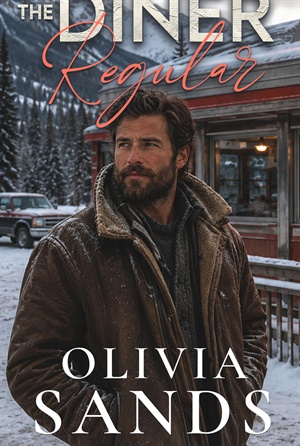
The Diner Regular (Sweet Mountain Men #1)
Chapter 1
JOELLE
"No," I say. "That's not food."
Rosie removes the sock, examines it, and puts it back where it came from.
For about ten minutes, before anyone comes, the diner is mine and quiet and the only sound is the coffee machine working itself up to its tasks.
I like this part more than I let on. It's the one stretch of the day where nobody needs anything from me, and I've noticed that's also the only stretch where I let myself notice what I need.
I don't keep a long list. A full night's sleep.
A back that doesn't ache. And one other thing I've gotten very good at not finishing the sentence about.
Marie arrives at 5:45 with her own coffee from home because she doesn't like the diner's machine, which is fair.
The machine is from 2006 and makes a sound like a cat being strangled.
We split the opening routine without talking about it: me on griddle and coffeemaker, Marie on tables and register.
Years of the same morning have worn a groove.
By 6:00 the regulars start coming in. Earl, who orders two eggs over easy and reads his phone on the table.
Donna, who gets rye toast and grapefruit juice and is working through a word search book she's been carrying since November.
Rick and Terri, who sit on the same side of the booth and split a short stack and feed each other bites like they didn't wake up next to each other this morning.
I bring them their food and I do not think anything about the side-by-side of them.
I have trained myself out of thinking about it. Mostly.
Old Hank arrives at 6:05 and takes his seat at the counter without saying good morning, because he hasn't said good morning in all the years I've worked here and I assume at this point it's a lost cause.
"You put the wrong lights on the east window," he says, not looking up from his paper.
"Those are the festive ones, Hank."
"They're blinking like a distress signal."
"Maybe they are." I refill his coffee. He folds the top corner of the paper down and looks at me over the crease.
"Meatloaf's better this week."
"I didn't change the meatloaf."
"Must be the ambiance." He unfolds the paper and goes back to it.
And then it's 6:14, and I do the thing I do every morning and would deny under oath.
I wipe down the four-top by the window even though it's clean.
I move the napkin dispenser a half inch.
I top off the coffeepot so it's full and hot and not three minutes old.
I tell myself this is service. I tell myself I'd do it for anybody.
The 6:15 regular comes in at 6:15.
Colt. Thirty-five, runs a timber operation out past Henderson's Ridge.
He's been eating breakfast here since he moved to town.
It's the only breakfast spot within forty minutes, so there's nothing to read into it.
There's a whole list of things to not read into and I keep it the way some people keep a budget, itemized, totaled, and never spent.
Same booth, the four-top by the window, which I stopped trying to seat other people in fast enough because he doesn't like to sit anywhere else.
The one time I put the Garcias there he stood by the door for three full minutes before taking the counter, which was painful for everyone, and which I think about more than the situation warrants.
Same order. Black coffee, egg plate, side of toast. Same tip folded under the mug, cash, a five and two ones. Two years of mornings and I've poured his coffee a gazillion times and I've never once heard him say anything that wasn't his order.
I know his hands, though. Big, rough-knuckled, always faintly smelling like pine resin and cold saw oil when I reach across to refill his mug.
I have reached across that booth in front of half this town and felt the back of my neck go warm for no professional reason at all.
I know he reads the actual paper, the kind that leaves smudges on his fingers, and I know the exact crease he folds it to when he's listening to something across the room instead of reading.
I know his truck is a blue Ford with a toolbox bolted to the bed and a crack in the passenger-side mirror, and I know which window of this diner you have to stand at to watch him pull in, because I have stood at it.
Here is the part I do not put on the list. When the door opens at 6:15 something in me settles that has been unsettled since 4:30.
It is not a thought. It's lower than a thought, it's in my chest and the soles of my feet, the same dumb animal relief as the heater finally catching in the truck.
For about four seconds every morning I am a woman who is glad, plainly and without conditions, that a particular man has walked into a room.
Then I pick up the coffeepot, because the coffeepot is what I do with my hands when I would otherwise have to do something about my face.
I know, too, that I lean across that booth a little farther than I lean across the others.
I have a word for it now. I've had it for a while. I just don't take it out where anyone, including me, can see it in good light.
He sits down. I pour his coffee. For a second his eyes are on my hands and then they're on the window, and I will spend an embarrassing amount of the afternoon wondering which of those I'd rather it had been.
"Morning," I say.
He looks up, looks back down. "Morning."
That's the longest conversation we've ever had. I have replayed shorter ones for less.
The community Christmas dinner was my idea, which means it's my problem. I volunteered in October when Father Pete mentioned the church didn't have the budget this year and the senior center was already booked.
"I'll do it at the diner," I said, in front of everyone, because that's what I do.
I talk before I truly think things through, and what I was thinking, though I'd have died before saying it, was about a particular Christmas when I was nine, and how nobody should have to eat that meal, and that if I built the room I'd needed back then maybe it would stop following me around.
Marie gave me a look from behind the register. I smiled back. A hundred people. I'll make it work.
Fifty pounds of potatoes. Twenty pies. And the turkeys, which are the part I've been calling about for three weeks.
I make the call at 7:15, standing in the hallway by the walk-in with my back against the wall and the phone wedged between my shoulder and my ear.
Dave at the supplier wants payment upfront.
I knew he would. I've been working the budget on receipt paper for two weeks, moving numbers around like furniture in a room that's too small, and there's no arrangement of them that doesn't leave something against a wall.
"I can do half now and half on delivery," I say.
He can't do that.
"I understand. I'm organizing this for the community and we're trying to ...”
He's sorry.
There's a thing that happens in my throat right then, and I feel it coming the way you feel a step that isn't there. For one second I am so tired of being the only person holding the rope that I could sit down on the floor of this hallway and not get up.
"Please," I say.
One word. Small. It comes out with all of it underneath, the budget and the doubles and the nine-year-old and the rope, and my voice cracks straight down the middle of it. I hear it happen. I hate that I do.
I catch it fast, mid-syllable, and keep moving, because the alternative is letting it sit there in the open where it can be true.
"I'll figure it out, Dave, thanks, let me call you back." Already bright again. Already fine. Fine is a muscle and I have built it the way others build muscle to pick up heave loads.
The diner heard it. Three hundred square feet and acoustics like a gymnasium.
Marie glances over from the register. Old Hank sets down his paper.
I shake my head once, I'm fine, and pick up the coffeepot, because the coffeepot is always there and it always needs to go somewhere, and right now I need somewhere to go more than the coffee needs pouring.
The breakfast rush ends. People pay, leave, thank me or don't. The diner empties out in its usual order: Donna first, then Earl, then Rick and Terri, then the rest. Hank stays. Hank always stays.
And Colt, who usually leaves by 7:00, is still in the booth at 7:20.
I notice like I would notice a sound that's stopped. Here it’s the absence of him standing up.
I don't let myself do anything with it. I have the phone call and the turkeys and the budget and the pies, and all of it is mine to carry and I am going to carry it, because I made a decision a long time ago about what I'd rather: be the one pouring the coffee, never the one asking for it.
He leaves at 7:25. I bus his table. Same plates, same mug, same newspaper folded and left on the seat.
Under the mug, where the cash usually is: a check. Made out to me. Five hundred dollars.
I stand there holding it with both hands, staring at his handwriting, blocky and slanted left, the handwriting of a man who probably only writes on the back of lumber invoices.
My first feeling is not gratitude. My first feeling is the back of my neck going warm again, and then, hard on its heels, something that isn't warm at all, because a check is a thing you give someone you've decided not to talk to.
I know. I've been on the giving end of that my whole life.
Through the window, his truck hasn't left the lot.