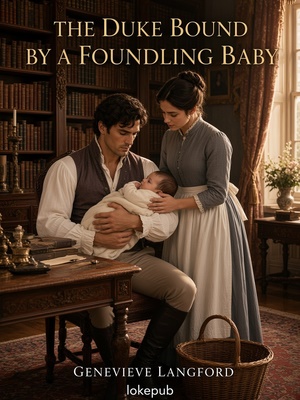
The Duke Bound by a Foundling Baby
Chapter 1
Leopold Harcourt had been awake since dawn. The morning had begun with letters, as most mornings for the Duke of Belgrave did.
Then there were the estate accounts, a note from the steward about the west field fence, a reply to the tenant in Northbridge over the drainage on his land, and a short list from Mrs. Prentiss in the kitchen about what would be needed for the week because the new cook disliked ordering for a house she did not yet understand.
Leopold had answered each one with the same steady care.
His father used to say that a man with a title did not have the luxury of being tired.
Leopold had once believed that was nonsense. Then his father died, the title of duke fell to him, and the nonsense became the shape of his days.
He sat at the desk in the study with his shirtsleeves rolled up, a stack of correspondence on his left, the household ledger open in front of him, and a cup of tea gone cold at his elbow.
The room smelled faintly of ink, fire ash, and old paper. The clocks in the hall had already chimed nine, but the light through the window still had a pale, early quality to it.
Leopold dipped his pen again, read the line once more, and made a note in the margin.
“No, and also no,” he said aloud to nobody in particular.
Behind him, the door opened.
He did not look up at once. “If this is about the hayward accounts, I have already written to—”
“My lord.”
The voice was Wilfred’s. Usually calm. Usually dry. But it lacked those qualities so much that Leopold looked up, curious.
Wilfred stood in the doorway with an expression Leopold had never once seen on him in eight years of service. It was not alarm exactly—the butler was too disciplined for that—but certainly not his normal, almost bored composure.
Leopold set down his pen. “What is it?”
Wilfred did not move. “There is a matter on the front steps.”
Leopold frowned. “A matter.”
“Yes, my lord.”
“A person?”
Wilfred’s mouth twitched. “More or less.”
Leopold stared at him, then looked back down at the ledger. “I am in no mood for riddles.”
“Yes, my lord.”
“So tell me what is on my front steps.”
Wilfred’s eyes shifted once, in a direction that suggested he would vastly prefer not to answer the question in words. “A basket.”
Leopold blinked. “A basket?”
“Yes, my lord.”
He waited for the rest, but Wilfred only stood there, hands folded behind his back, the picture of a man determined not to be the one who announced something absurd and had to defend it afterward.
Leopold set his pen down carefully. “What sort of basket?”
“That,” said Wilfred, with the faintest emphasis, “is best seen.”
Leopold leaned back in his chair and exhaled through his nose. The headache that had been circling his temples since before breakfast pressed a little harder.
“Very well,” he said. “Bring it in.”
Wilfred did not move.
Leopold narrowed his eyes. “Or do I need to go outside and inspect the basket myself?”
“That would be preferable, my lord.”
Leopold gave him a look.
Wilfred gave none back. That in itself was answer enough.
Leopold stood, shut the ledger with one hand, and came around the desk.
As he did, the sleeve of his right wrist caught the inkwell.
It tipped, slid, and then spread the dark liquid quickly across the page he had been reading, soaking into the numbers and blooming over the corner of his father’s neat script.
Leopold swore under his breath.
Wilfred’s eyebrows rose a fraction. “Shall I fetch another ledger?”
“No,” Leopold said, already irritated at the page, the ink, the morning, and the air itself. “Just show me this basket before I decide to set something on fire.”
Wilfred inclined his head. “As you wish, my lord.”
He turned and led the way out.
The front hall was still, the sort of polished, cold stillness that belonged to great houses before the rest of the household had fully woken.
Leopold crossed it with Wilfred at his shoulder and wondered, not for the first time, whether his father had ever noticed how empty Belgrave could feel when the servants moved like shadows, and the walls stood listening.
That thought was not one he cared to keep.
He stepped through the front door.
The morning air was brisk enough to sting. A thin layer of frost still clung in the shade near the steps, and the grounds beyond were silvered with cold. Leopold glanced down automatically, expecting some parcel, some forgotten delivery, some fool’s mistake.
Instead he saw a basket large enough to be set beside the front step as if it had always belonged there.
For one absurd second, he thought it had been left by a farmer.
Then he looked closer.
There was a baby in it.
Leopold stared.
The child was wrapped in a pale wool shawl, tucked so tightly that only her face and one small hand were visible. She was perhaps a year old, maybe a little more. Dark hair.
Gray eyes, wide and alert. Pink cheeks from the cold. A mouth that had the unimpressed set of someone who had not yet been informed that she had been abandoned on a duke’s doorstep.
Leopold did not move.
The baby looked back at him with mild interest, as though he were the one who had arrived unannounced.
“This,” Leopold said slowly, “is not what I expected.”
“No, my lord,” said Wilfred from behind him.
“Why did you not bring it in straightaway?”
Wilfred shook his head.
“I do nothing until I receive word from you.”
When Leopold gave him a quizzical look, he cleared his throat.
“Had you been terribly occupied and not come at once, I would have brought it in and given it to Mrs. Pritchard.”
Leopold glanced down again, because apparently his life had become the sort in which he now had to verify the baby’s existence with his own eyes. There was a second layer of blanket in the basket, and tucked into the lining near the child’s feet was a pair of tiny, knitted booties.
He crouched, took one careful bootie between his fingers, and turned it over.
On the sole, in neat embroidery, was a name.
Cecily.
Leopold read it twice.
“Cecily,” he said.
The baby, hearing her name or hearing his voice, gave a little kick and made a sound somewhere between a hum and a protest.
Leopold looked at Wilfred. “Someone named her.”
“Yes, my lord.”
“Before leaving her here.”
“Yes, my lord.”
Leopold held the bootie for a moment longer, then set it back in the basket.
The shawl was next. He touched the edge of it and found the weave finer than ordinary wool, old in a way that was not obvious at first glance but became clear once handled. The corners were embroidered with the Belgrave emblem.
His fingers stopped on the edge of the shawl.
Behind him, Wilfred said nothing.
Leopold stood, slowly, and looked at the child again. The baby had one fist curled in the shawl and was studying him with grave interest. She did not appear afraid. If anything, she appeared as though she expected him to sort matters out.
Leopold’s first instinct was absurdly practical. Someone had made a mistake. Someone would come. Someone had dropped the child here by accident, and he would be forced to hand her over to a nurse, a constable, a parish clerk, or any other person better suited to the task.
That was what he told himself.
Then the baby sneezed.
It was a tiny, sharp sound. Her eyes blinked once. She looked briefly offended by the experience and then resumed staring at him.
Leopold reached down before he made the conscious choice to do so.
He lifted her from the basket.
She was warmer than he expected. Smaller, too, though not fragile. She made a little noise as he brought her against his chest and immediately seized the lapel of his coat with both fists.
Leopold stopped breathing for one second.
The child held on with the confidence of someone who had made a judgment and found it sound.
“Did she just,” Leopold said, “grab me?”
Wilfred, who appeared to have recovered his entire composure by force of will, said, “Yes, my lord.”
Leopold looked down at the baby in his arms. “And she does not seem inclined to let go.”
“No, my lord.”
Leopold glanced at the basket, then back at the child, then at the open door behind him. “This is ridiculous.”
The baby tightened her grip.
Leopold huffed a laugh despite himself, though it sounded thin even to his own ears. “You see? Ridiculous.”
Wilfred’s expression remained carefully neutral. “Shall I send for Mrs. Pritchard?”
“No, not yet.”
“She will want to know.”
“I am aware of that.”
“And the nursery—”
“I said not yet.”
Wilfred bowed his head slightly. “Very good, my lord.”
Leopold looked down again. The baby was still watching him. Her lashes were dark against her cheeks, and one of her tiny hands had found the button at his collar and was now exploring it with single-minded purpose.
He had no idea what to do with children. None. That had never been part of his education, and his mother had certainly not spent any time teaching him to manage infants. His father would have considered such knowledge beneath the dignity of a duke.
His father had also, Leopold thought grimly, considered affection a weakness and silence a virtue. It had not made either of them happier.
The baby gave a little babble and patted his shirtfront as though she found him to be satisfactory.
Leopold stared down at her. “You have the advantage of me.”
She yawned.
Then, with complete trust in the world, she tucked her face against his shoulder.
Leopold stood motionless, abruptly aware of every fragile ounce of the child against his shoulder.
Something strange and unwelcome moved in his chest, more irritating than fear because it had a human shape to it.
He said, very quietly, “Well, this is inconvenient.”
“She does not seem to agree,” Wilfred said.
Leopold glanced at him. “You are enjoying this.”
“No, my lord.”
“You are.”
Wilfred’s face remained calm, but his eyes had that faint, dangerous shine they got when he was trying not to show amusement. “I would not presume.”