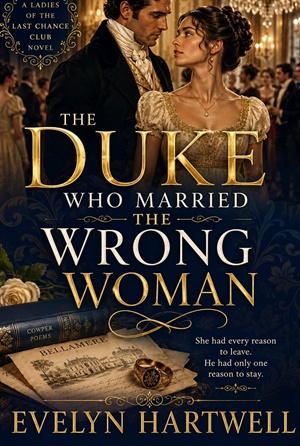
The Duke Who Married The Wrong Woman (The Ladies of the Last Chance Club #1)
Chapter One The Bride Who Wasn’t
By half past three, Lady Davenham’s drawing room had become so crowded with pale muslin, nodding feathers and carefully arranged indifference that Clara Whitcombe suspected nobody present could possibly be enjoying the music.
The pianist, a serious young gentleman from Vienna whose name Clara had already forgotten, was doing something clever and elaborate with a piece by Mozart, though very few of Lady Davenham’s guests appeared to regard listening as an essential part of attending a musicale.
The older ladies occupied the gilt chairs nearest the windows and observed the room over the rims of porcelain cups, while their daughters sat in promising arrangements of white, blue and primrose, each looking as though she had dressed that morning with no greater ambition than to contemplate music and spring weather.
Meanwhile the gentlemen drifted between the pianoforte and the tea table in dark coats and polished boots, conducting the business of courtship with such studied casualness that Clara almost admired the effort.
Almost. Beside her, Lucy Whitcombe was pretending not to watch Mr. Theodore Bellamy across the room.
“You will give yourself a headache if you continue looking sideways in that fashion,” Clara murmured.
Lucy’s attention snapped back to the sheet music she had been holding upside down for the better part of five minutes.
“I was not looking at anyone.”
“Of course not.”
“I was looking at the painting.”
“The landscape?”
“Yes.”
“Mr. Bellamy is standing in front of it.”
Lucy lowered the music and regarded Clara with the particular reproach of a nineteen-year-old whose elder cousin had committed the unforgivable offense of noticing exactly what she had intended to conceal.
“He moved there after I looked.”
“An extraordinary coincidence.”
“You are dreadful.”
“I am useful. It is why your mother brought me.”
Clara reached across and turned the music the correct way up.
At twenty-nine, she had discovered usefulness to be a remarkably durable social position.
Beauty might fade, novelty certainly did, and eligibility could disappear in the course of a single disastrous week, but a woman who remembered which calls must be returned, whether Lady Davenham took lemon or milk in her tea, and which gentleman had already danced twice with which young lady could remain valuable almost indefinitely. Clara had become very valuable indeed.
She had shepherded Lucy through the first six weeks of her London Season without permitting her to lose a glove, insult a duchess, accept an unsuitable carriage ride or become privately engaged to a handsome second son with more charm than income.
This represented, in Clara’s opinion, a considerable achievement, though Aunt Marianne seemed to regard it as merely confirmation that unmarried female relations were provided by Providence for the convenience of everybody else.
Not that Clara minded very much. There were worse things than usefulness.
She knew because she had once been interesting.
That condition had proved considerably more dangerous.
A servant passed with a silver tray of ratafia glasses, and Clara declined with a small movement of her head.
Beyond him, sunlight struggled through tall windows streaked with the uncertain brightness of an English April, catching on the crystal drops of a chandelier and turning the drawing room briefly golden.
Lady Davenham had opened the doors between two reception rooms so that the crowd could spread, although it merely resulted in more people occupying the spaces between the chairs, each one determined to appear unaware that they were being observed by everyone else.
The air smelled faintly of beeswax, tea, perfume and the narcissus arranged in enormous bowls beneath the windows.
Somewhere behind Clara, a woman whispered that Lady Caroline Beresford had worn the same bonnet twice in one week.
Near the fireplace, two gentlemen discussed a horse loudly enough to demonstrate that they were men of sport but quietly enough not to disturb the illusion of refinement.
Lucy’s friend Miss Anne Cresswell had spent the past quarter hour appearing not to notice that the young baronet beside the bookcase had been finding increasingly feeble reasons to remain within ten feet of her.
It was all very familiar. Clara knew which mothers were ambitious, which daughters were terrified, which gentlemen were sincerely searching for wives and which enjoyed the search considerably more than they intended ever to enjoy the result.
She knew how long a young unmarried woman might speak privately to a gentleman before somebody noticed, when a dance became a declaration, when a compliment became dangerous and precisely how little factual information was required before London could manufacture an entire scandal.
The last skill had been learned at considerable cost.
“Clara.”
Lucy’s voice had altered. Clara knew why before she turned her head. Two girls stood near the far end of the sofa, both younger than Lucy and evidently new enough to London that they had not yet mastered the art of gossiping without moving their mouths. One was looking directly at Clara.
“Is that her?”
The whisper was not quite as quiet as its owner imagined. Her companion gave a tiny, urgent nod. Clara reached for the cup on the table beside her, discovered that the tea had gone cold and drank it anyway. The first girl leaned closer.
“The one Lord Ashcombe—”
Her friend caught her wrist. That was enough.
Lucy went rigid. Clara did not. Eleven years was sufficient time to become skilled at stillness.
There had been variations, of course. London possessed too much imagination to repeat precisely the same story for more than a decade.
Sometimes Clara had been abandoned because Lord Adrian Harcourt discovered another man leaving her bedroom.
Sometimes she had concealed a devastating illness.
On one memorable occasion, she had supposedly confessed three days before the wedding that she could never provide an heir, although Clara had always wondered how her eighteen-year-old self might have acquired such certainty.
The most popular version remained the simplest. Adrian had discovered something wrong with her. Nobody could say precisely what it was, which only made the idea more compelling. A hidden defect was much more interesting than an ordinary one. Clara turned another page of Lucy’s music.
“Do you suppose Herr Whatever-His-Name-Is has any intention of reaching the end of this piece?”
Lucy stared at her.
“How can you sit there?”
“I was under the impression that Lady Davenham would object if I lay upon the carpet.”
“They are talking about you.”
“People frequently do. It saves me the inconvenience of supplying them with fresh subjects.”
Lucy flushed. Her complexion was unfortunately honest, which Clara had warned her would make London life unnecessarily difficult.
“I could say something.”
“You could, but then I would be obliged to stop you.”
“They should not be allowed to—”
“My darling Lucy, if London required accuracy before gossiping, half its drawing rooms would fall silent before breakfast.”
That earned the smallest unwilling twitch at the corner of Lucy’s mouth. Clara smiled.
“There. You see? We should not want that. Think how dreadful breakfast would become.”
Lucy looked down, although indignation remained visible in the stubborn set of her chin.
“I hate it.”
Clara knew that Lucy meant the story rather than London, though on certain days the distinction was narrow.
“So did I.”
The admission surprised them both. Lucy lifted her head.
Clara rarely discussed what had happened.
It had been easier, over the years, to permit the story to harden into something belonging to another woman, a foolish young creature with a wedding gown hanging in her bedchamber and orange blossoms ordered for a ceremony that would never take place.
At eighteen, Clara had believed humiliation could kill a person.
At nineteen, she had discovered that it could not.
At twenty, she had begun to wish it might have the decency to try, because surviving it was considerably more tedious.
By twenty-nine, she could sit in Lady Davenham’s drawing room while strangers inspected her and wonder whether there would be enough cold chicken at home for supper.
Time did not heal everything. It simply taught a person how many ordinary things continued happening around an injury.
The pianist reached a thundering conclusion.
Everyone applauded with relief, and conversation expanded immediately to fill the room. Lucy leaned nearer.
“Were you very much in love with him?”
Clara should have expected the question. Lucy had heard the family version, naturally, but family versions of disasters were often curiously bloodless. Dates, explanations, names and consequences survived, while feelings were carefully removed like stains from good linen.
“I believed I was.”
“That is not the same thing.”
“No.”
Lucy waited. Clara looked toward the windows.
She could still remember Adrian at twenty-one, laughing beneath the lime trees at Ashcombe, his hair bright in the sunlight and his entire attention fixed upon her.
He had possessed a talent for making attention feel like warmth.
When Adrian Harcourt looked at an eighteen-year-old girl, she did not wonder whether she was clever enough, beautiful enough or interesting enough.
She simply became so. At least for the length of the conversation.
“He was very charming,” Clara said eventually.
“That sounds like an accusation.”
“It is frequently one.”