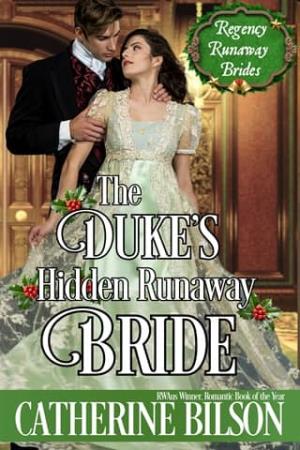
The Duke’s Hidden Runaway Bride (Regency Runaway Brides #2)
Chapter One
The snow began as they left Llangollen, and by the time the carriage swung into the last of the mountain passes it had stopped being merely weather and become a siege.
Adrian Sutton, sixth Duke of Calder, sat with his boots braced against the opposite seat and watched the blizzard.
The snow fell without mercy, blotting out the valley walls he knew were there, until the world shrank to the steaming flanks of the horses and the small yellow eye of the coach-lamp swinging on its bracket.
He had made this journey a dozen times in his life, the last of them four years ago, and he remembered it as green country: bracken and oak, the brown rush of the river beside the road, a curlew crying somewhere overhead.
He did not remember it being able to kill a man, but then, he had never been here in winter.
“We shall not make it before dark, Your Grace,” his coachman said when they changed horses at Llangollen, in the tone of a man laying down a wager he expected to lose.
“Then we shall make it after dark.” Adrian tipped him a guinea against the cold and climbed back in.
It was, he knew, exactly the sort of charming, useless thing he was forever saying.
The guinea would not melt the snow, but the man touched his hat and grinned all the same, and that was the bargain Adrian had been making the whole of his life: a gold coin and a smile set against the hard fact of the road.
He drew his greatcoat closer. It was a London coat, cut by a London tailor to be admired in a London street, and it had roughly the warmth of a wet newspaper.
He had brought nothing fit for a Welsh winter.
He had brought, if he was honest, remarkably little thought of any kind.
One grey afternoon he had looked up from his mother’s third letter in a fortnight, its demand as unyielding as ever: You will have chosen a bride by the spring, Adrian.
I have your word. He had read it twice, then a third time, and something in him had simply refused to go on.
He could not endure one more evening of being hunted across the ballrooms of the Little Season by women who smiled at his title and never once at him.
The whole Calder line had narrowed to his single unwilling self, and his mother never let him forget that bald truth.
So he had run, before his mother descended and trapped him. Clear across the kingdom, to the one house where no one had ever demanded a single thing from him.
He smiled a little, thinking of his aunt.
Elise would be cross with him for coming without warning, and pleased under the crossness, which was the only way she was ever pleased about anything.
There would be the vast fire in the great hall, some of the dreadful Welsh apple brandy she swore by, and a thorough accounting of what she thought of dukes who fled their duties, none of it meant and all of it delivered with relish.
Of everyone in his life she alone treated the title as the joke he privately believed it to be; but then she had survived two Calder dukes before him and been impressed by neither of them. Perhaps she had the right of it.
The carriage lurched, slid, found the road again as the driver shouted to the horses.
Guilt needled Adrian, sharp and sudden; he really should not have forced them all out into this weather for the sake of his own restlessness.
If one of the horses went off the narrow road into the river…
but then the dark bulk of the gatehouse loomed up on the left, and they were turning in between the stone pillars, and Plas Eira appeared out of the white.
It was a long, low, ancient house of dark grey stone, slate-roofed, its windows few and deep-set.
Tonight nearly every one of those windows showed a candle, small and warm against all that dark, and something behind Adrian’s ribs unclenched for the first time since leaving London.
Sanctuary. He had reached it. For a few weeks, no one here would ask him to be a duke.
The carriage stopped. He flung the door open himself without waiting for the step, dropped into snow to the ankle, gasped at the bite of it even through his boots, and then laughed at himself, and went up the steps two at a time to hammer on the great door with the side of his fist.
It opened sooner than he expected. There, holding a branch of candles, the light wavering up over a face he had loved since he was a small child and she was the only person who treated him like one, stood his aunt.
She did not smile.
That was the first wrong thing, but he was too cold and too glad to read it immediately. “Aunt Elise. I have come to ruin your Christmas. You may scold me directly; I have left a space for it.” He opened his arms to her.
“Adrian.” She said his name slowly, incredulously, and she did not step forward to embrace him.
Her eyes went past him to the carriage, to the snow swallowing the drive, to the coachman already leading the steaming horses round towards the stables, and what crossed her face was far from the welcome he had hoped for.
“You cannot have driven through the pass in this storm.”
“I very nearly did not. I shall want a great deal of your terrible brandy to forget it.” He stamped the snow from his boots, waiting for her to step back and let him in and become herself.
“Are you going to keep me freezing on the step, Aunt Elise? I know I am unlooked-for, but surely not unwelcome?”
For a moment she stood still in the doorway, a slight, upright woman in grey with a sharp clever face beneath a plain cap, and she looked at him not as though he were the dearest thing the winter could have brought her but as though he were the worst. Her knuckles had gone white on the candle branch, the flame guttering in the draught from the open door.
Then she seemed to realise that there was no decision to be made.
She could not send a duke back out into a blizzard, even if he were not her nephew. No one could.
“Come in, then, before you let the whole mountain in with you.” She stepped back.
The hall closed warm around him, thick with woodsmoke and beeswax, the great oak table swept bare and waiting on a season that had not yet properly begun; whatever green stuff would dress it for Christmas still stood uncut and snow-covered on the hillsides beyond the windows.
A fire burned at the far end under a hood of carved stone.
After the killing white of the road his eyes stung.
He turned, working at the sodden fingers of his gloves.
“I shall stay a fortnight and tell you all the worst gossip from town. I have been hunted, Aunt, positively coursed like a hare. My mother has wrung a promise out of me, and she means to hold me to it, I fled before she came down from Canterbury where she has been staying with…”
He stopped.
There was someone on the stairs; a woman. A young woman, he realised immediately. A stranger.
She had come down a few steps, drawn by the noise of his arrival, no doubt, and now stood arrested halfway, one hand on the banister.
She was small and absolutely still, wearing a plain dark gown a governess might have worn.
The candlelight did not reach her well, but it reached her enough: warm brown skin, large dark eyes, a quantity of black hair pinned simply back.
Ten years of London ballrooms had trained him to take inventory before he could help it: she was startlingly lovely, and his initial assessing glance caught and held. He could not look away.
She was watching him the way a fox watches the hounds.
“Ah?” said Adrian, into an oddly tense silence.
“My guest.” His aunt’s voice held a flatness he had never heard in it. “Miss Jones. The goddaughter of my late husband; you will not have heard me speak of her. Miss Jones, my nephew. The Duke of Calder.”
The girl on the stairs made a gesture that was barely a curtsey, a small downward dip of her knees, a brief lowering of those extraordinary dark eyes. She did not speak, and she made no move to come down.
“Miss Jones.” Adrian bowed, because one did, and because the braced, ready-to-bolt way she stood made him want to be gentle with her. “Forgive me. I have arrived like an avalanche. It is a failing of mine; my mother despairs of it.”
“Your Grace.” Two words, low and careful, the pronunciation clean as cut glass. Then, to his aunt and not to him: “You will wish to be private with your nephew.” She was gone before he had shaped a reply, back up into the dark of the landing above.
Adrian looked after her, then at his aunt, who was watching him with an expression he could only call grim.
“A goddaughter? You have a goddaughter. In all my life you have never once mentioned a goddaughter, and you tell me everything, Aunt; you tell me things I had infinitely rather not know.”
“Sir Rhys had a great many connexions from his India years.” Elise turned towards the fire, giving him her profile and the set line of her shoulders.
She took up the poker and did something unnecessary to the fire.
“She is shy, and she has had a hard time of it, and she is under my protection. I will ask you to leave her be.”
“Leave her be?” The warning was plain, and it caught him under the ribs, unjustified as he was certain it was. “Aunt Elise, you wound me. When have I ever not left a respectable young woman scrupulously be?”
“You are a duke, and you have your father’s face, and your father could not enter a room without half the women in it deciding to be unhappy over him.
I know you mean no harm. I am telling you that there is harm to be done here that you cannot see, and so I am asking you to do nothing at all.
” She set the poker down and looked at him fully.
For an instant the sharpness drained out of her and left a tired woman past fifty who had not been sleeping well.
“Can you do that for me? Nothing at all? You are so very good at it.”
It was an old joke between them, Adrian who never does anything, but it landed wrong, and he did not laugh.
“Yes,” he said instead, more soberly than he had said anything in months. “If you wish it. Of course.”
“I wish it.”
Above them, faintly, a door closed.
Adrian stood in the warm hall of his only sanctuary, the snow ticking against the deep-set windows, and took inventory.
His aunt was lying to him. She had never lied to him in his life.
A goddaughter who flinched from a duke, a welcome cold as the blizzard, and a whole house holding its breath.
He had come through the storm expecting peace and found instead a locked door with two frightened women behind it.
Whatever Elise feared, she feared it in earnest, and he had never known his aunt to be afraid of anything. Miss Jones had looked at him as though she expected someone else, as though she expected to be hunted, and he could not dismiss that as shyness merely because his aunt wished him to.
A wiser man might have heeded the warning, yet Elise had never lied to him, and he had never known her to be afraid.
He very much did not like to think that there was something his aunt might have to fear, and in that moment, he decided that he quite simply could not allow whatever had frightened her to continue to exist. He could leave Miss Jones entirely alone, as promised, and still discover what had put that look on his aunt’s face.
And then take steps to ensure it troubled her no more.
The distinction was narrow, but concern for Elise widened it sufficiently for his purposes.
“Well.” He smiled at his aunt, meaning the smile to reassure her, and watched it do the opposite. “I am snowed in with a secret. What a very merry Christmas this is going to be.”
Elise Maddox closed her eyes a moment, like a woman who had heard a stone come loose far up the mountain and knew there was nothing now to do but wait for the landslide that would follow it down.