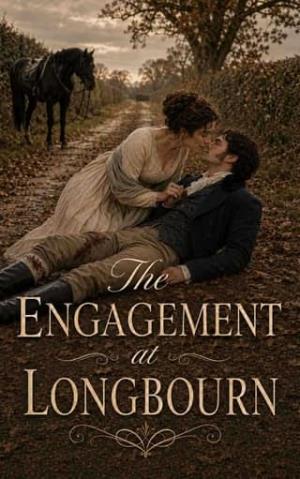
The Engagement at Longbourn (Pride and Prejudice Variation)
CHAPTER ONE
The Fox in the Lane
The morning on which Netherfield Park was shut up possessed that thin, metallic cold peculiar to late autumn, when the hedges were black with damp and the fields had surrendered nearly all their colour except the deep green of winter grass.
Smoke lay low above the cottages. The road from Netherfield to Meryton was still wet from rain in the night, and the wheels of the Hurst carriage made a solemn grinding sound as it rolled away toward London.
Miss Bingley had arranged herself against the squabs with the air of a woman who had conquered a province.
“I confess,” she said, adjusting the fur at her wrists, “I shall breathe more freely once Charles has been made to understand how absurd the whole business has become.”
Mrs. Hurst glanced through the window at the shrinking roofline of Netherfield. “Jane Bennet is very pretty.”
“That is hardly an argument.”
“No. Merely an observation.” Mr. Hurst, who had begun the journey with a flask and showed every intention of finishing it in the same company, muttered that Hertfordshire had been tolerable hunting country and fell back against the seat.
Miss Bingley’s mouth tightened. “Charles mistakes serenity for attachment. Miss Bennet smiles at everybody. She would smile at a bishop who trod on her gown.”
Mrs. Hurst smiled faintly. “And Darcy?”
“Darcy possesses more sense.” The answer came too quickly. Mrs. Hurst did not pursue it. Several miles behind them, Fitzwilliam Darcy sat his horse at the gate of Netherfield and watched the carriage disappear.
He had declined a place inside it on the argument that his horse required exercise.
This was true. It was also true that six hours in a confined carriage with Caroline Bingley, while she congratulated herself upon the successful removal of Charles from Hertfordshire, had seemed a punishment disproportionate to any crime he had committed.
Darcy had committed crimes enough against his own peace that morning.
He had walked once through the empty drawing room where Elizabeth Bennet had laughed at him over a book.
He had paused in the library and remembered her dark eyes lifting when he entered.
At breakfast he had listened, without comment, while Miss Bingley announced that Jane Bennet would soon forget Charles and that the entire neighbourhood had been “an amusing provincial interruption.” He had nearly told her she understood neither Miss Bennet nor the neighbourhood.
Instead he had said nothing. Silence was one of Darcy’s oldest habits.
It had long masqueraded as prudence. He turned his horse toward London.
The sensible road was broad and well travelled. Darcy did not take it.
He knew of a narrower lane which cut south-west around a cluster of farms before rejoining the London road beyond Meryton.
It saved perhaps twenty minutes and, more importantly, avoided any chance of overtaking the Hursts’ carriage.
His horse, Apollo, was a powerful bay gelding bred on the Pemberley estate and accustomed to uneven ground.
Darcy let him lengthen his stride once the hedges opened to pasture.
The movement cleared his head for perhaps half a mile. Then Elizabeth Bennet returned to it.
He saw again the arch of one brow when she teased him.
He heard the careless warmth with which she had spoken to her sister.
He remembered the evening at Netherfield when she had walked three miles through mud and appeared in the breakfast room with bright eyes and a hem six inches deep in dirt, and how every objection he ought to have felt had vanished before the vitality of her face.
He had been leaving because Bingley ought to leave. That was what Darcy had told himself.
Charles was too easily led by affection, Jane Bennet too composed to be read with confidence, the mother vulgar, the younger sisters uncontrolled, the connections objectionable.
Darcy had set these facts in a neat row as if arranging figures in an account book.
He had not entered his own name among the liabilities.
Pride, Elizabeth would have called it. He could almost hear her.
Apollo’s ears went forward.
Darcy straightened. Something russet exploded from the hedge.
The fox crossed the lane so close before Apollo’s forelegs that the horse shied violently sideways.
Darcy’s left boot slipped in the wet stirrup.
He corrected once, almost recovered, and then Apollo’s hind hoof skidded on the greasy edge of the track.
Horse and rider went down separately. Darcy struck the earth shoulder first. There was a white flash of pain below his knee, so absolute and instantaneous that for one astonished second he could not breathe. Apollo scrambled upright and bolted.
Darcy did not. He stared upward at a pale sky divided by bare branches. His leg lay at an angle no leg had any business making. “No,” he said through his teeth.
He tried to move. Pain slammed through him, savage enough to darken the edges of his sight.
He stopped.
The lane was empty. The fox had vanished.
Apollo’s hoofbeats faded. Somewhere beyond the hedge a rook complained from an elm.
Darcy lay alone in the cold mud and understood with humiliating clarity that wealth, consequence, ten thousand a year, and one of the finest estates in Derbyshire were all remarkably poor substitutes for a human voice when one had broken one’s leg in a deserted lane.
He shouted once. The effort made him dizzy.
He shouted again.
No answer came. By the time the church clock in Meryton struck nine, he had lost all sense of how long he had been there.
Cold crept through his coat. Pain pulsed in time with his heart.
He thought, irrationally, of Georgiana waiting for him in London.
He had promised to dine with her that evening.
Then, because misery is rarely disciplined, his thoughts turned to Elizabeth.
He wondered whether she had gone walking.
He imagined her striding over a field in that unfashionable, vigorous manner of hers, cheeks coloured by the cold.
The image was so clear that when he heard footsteps on the damp path he believed at first he had summoned her out of pain and longing.
A figure appeared around the bend. A dark pelisse.
A bonnet tied carelessly. A quick, confident step.
Darcy closed his eyes. “Of course,” he murmured. “Now I am hallucinating.”
The footsteps stopped. “Mr. Darcy?”
His eyes opened. Elizabeth Bennet stood ten yards away, staring at him. For perhaps the first time since he had known her, she had no trace of laughter in her face.
Then she ran.