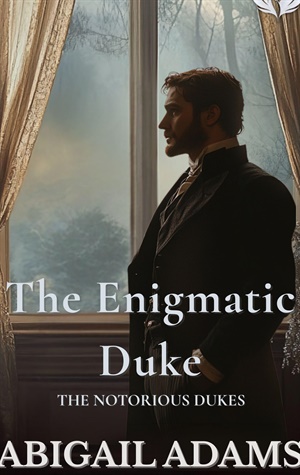
The Enigmatic Duke (The Notorious Dukes #2)
Prologue
Don't forget, your exclusive free book awaits on the previous pages. ?
The morning Alexander Harrington left England, the sky could not decide what it wished to be.
Clouds gathered and scattered in equal measure above Portsmouth Harbor, allowing pale sunlight through in fitful bursts before swallowing it again.
The harbor itself was very much alive — a churning mass of humanity that smelled of salt and tar and the particular desperation of men who made their living on the sea.
Merchants bellowed at dockhands. Rope gangs hauled cargo aboard vessels bound for every corner of the Empire.
Gulls screamed overhead as if offering warnings nobody wished to hear.
Alexander stood at the edge of it all and felt, for the first time in his twenty-five years, entirely uncertain.
He had prepared for this day. He had prepared relentlessly — years of riding and fencing and studying naval charts until the candlelight burned low and his tutors fell asleep in their chairs.
He had told himself he was ready. He had believed it entirely, right up until this moment, when HMS Valiant rose before him at the dock like something vast and indifferent, and the realization settled over him that no amount of preparation could make a man ready for the unknown.
His father stood beside him, straight-backed and formal in his coat despite the harbor wind, every inch the seventh Duke of Wexford.
They had said their important words at Harrington House that morning — duty, honor, tradition, the long line of Harrington men who had served the Crown at sea.
The speech had been as measured and deliberate as the man who delivered it, and Alexander had received it with equal composure.
But his mother had said nothing.
That was the thing he could not stop thinking about.
She had descended the front steps of Harrington House as the carriage was loaded, her silver-threaded hair neat beneath her bonnet, her face composed with the particular precision of a woman who has decided with great effort not to weep in front of others.
She had straightened his collar — needlessly, for it was already straight — and then simply held his face in both her hands and looked at him.
Not with grief, not with fear, but with something far more complicated.
As if she were memorizing him. As if some part of her understood that the son who returned would not be precisely the son now leaving.
She had kissed his cheek and stepped back without a word. Her eyes, he noticed, remained dry. It cost her everything to keep them that way.
That silent farewell unsettled him more than any words could have.
His father extended his hand now at the dock, and Alexander shook it — a firm, brief grip that contained everything neither of them would say aloud. Pride. Apprehension. The particular love of men who have been taught to express it through action rather than declaration.
"Write when you reach the Cape," his father said.
"I will, sir."
"And, Alexander." His father paused, his eyes meeting his son's with an intensity that felt like a warning he had not yet formed into words. "Trust what you know to be right. When you are uncertain — and you will be uncertain — trust that."
Alexander nodded. He wanted to ask what that meant, precisely. He did not.
The carriage that had carried his trunks was already departing. Around him, sailors and officers moved with the purposeful urgency of men for whom this departure was simply another working day. Alexander picked up his bag, adjusted the strap across his shoulder, and turned toward the gangway.
He did not look back.
He almost looked back.
◆◆◆
HMS Valiant left Portsmouth with the afternoon tide, sliding out of the harbor on grey water while the English coastline receded in her wake.
Alexander stood at the stern rail as the white cliffs diminished, then blurred, then disappeared entirely into the haze.
He remained there long after there was nothing left to see.
Long after the other officers had gone below.
Long after the last suggestion of England had dissolved into the horizon and left behind only the vast, indifferent Atlantic.
The wind had teeth this far from shore. It cut through his coat and pulled at his hair and carried with it the cold, clean smell of open water — nothing like the brackish complexity of Portsmouth Harbor. This was a different smell altogether. Older, somehow. Unsentimental.
He gripped the rail and took a slow breath.
He was afraid. The recognition arrived quietly, without drama, the way important truths often did.
Not the sharp, reactive fear of immediate danger but something deeper and more difficult to name — the fear of being tested by something larger than himself.
The fear that all his years of preparation had equipped him for the world as he imagined it, not the world as it actually was.
But beneath the fear, something else stirred.
He had felt it building since Portsmouth — since the moment the gangway lifted and the last rope was cast off and the decision became irrevocable.
It hummed beneath his ribs like a current, like the tension of a bow string drawn taut.
Anticipation. Raw, undeniable, slightly shameful in its intensity.
The world he had studied in books and maps and his tutors' careful lessons was out there, somewhere beyond this grey water.
Real and complicated and nothing like the drawings in his naval charts.
He wanted to see it. All of it. The terrible and the magnificent alike.
This is fear and excitement together, he thought. Perhaps they are always the same thing, and men simply choose which name to give them.
The evening came on quickly at sea. The sky above the Atlantic performed no modest English sunset — it burned in streaks of copper and violet that seemed almost excessive, almost theatrical, as if the horizon were making a point.
Alexander watched it from the rail, his earlier composure settling into something quieter and more honest.
He thought about his father's parting words.
Trust what you know to be right. Simple enough as instruction.
Considerably more difficult when the world ahead was entirely unmapped.
When he did not yet know what he would encounter, what he would be asked to witness, what choices would be set before him.
His education had given him principles. It had not given him certainty.
Nobody, he was beginning to understand, could give him certainty.
He thought about his mother's face. The way she had memorized him.
He wondered, with a sudden chill that had nothing to do with the wind, whether she had known something he did not.
Whether maternal instinct carried in it a kind of foresight that rational men dismissed because they lacked the courage to consider it.
He dismissed the thought. He was a naval officer now, however junior. He could not afford superstition.
And yet.
Somewhere in the ship below him, his fellow officers were eating their first meal at sea, growing acquainted, establishing the hierarchies and allegiances that would sustain them across the months ahead. He should go below. He knew he should. His absence was already conspicuous.
He did not move.
The last light died in the west, and the stars came out over the Atlantic in their thousands — more stars than he had ever seen above London, more than he had believed existed.
They were indifferent to him too, he noted.
The sea, the sky, the vast machinery of the natural world — none of it cared in the slightest what became of Alexander Harrington. None of it knew or required his name.
There was something clarifying in that. Something that stripped the Harrington legacy and the ducal expectations and the weight of every portrait in those grand hallways down to a single, simple question.
Who are you, when none of your privileges exist?
He had no answer. Not yet. He was twenty-five years old and standing at the stern of a naval frigate watching England's last light disappear, and he did not yet know who he was beneath the name and the duty and the careful preparation.
But he would find out.
Whatever lay ahead — whatever the sea and the colonies and the wider, brutal world had in store for him — he would find out.
Alexander Harrington released the rail, squared his shoulders against the Atlantic wind, and turned toward whatever came next.
Behind him, England was already gone.