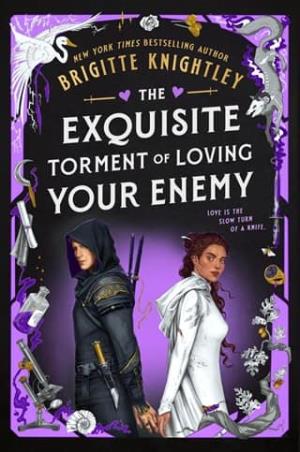
The Exquisite Torment of Loving Your Enemy (Dearly Beloathed Duology #2)
Chapter 1 Qui Dit Aimer Dit Souffrir
Qui Dit Aimer Dit Souffrir
Osric
Tall and stark stood the fortress of Swanstone. Its steep battlements, overtopped with moss and seaside centaury, tumbled towards the shore. Beyond the ramparts shivered an agitated sea. White waves crested like knife-cuts before collapsing into black water. The tide was rising.
Outside the tallest window of the tallest tower sat Osric Mordaunt. Bastard by birth, Fyren by profession, scoundrel by inclination.
Inside the tallest window of the tallest tower sat Aurienne Fairhrim. Respected Haelan, preeminent scholar, and champion of moral good.
Once upon a time, Osric had regarded Fairhrim as purely functional, as a Means to an End whose sole merit was that she was the only one who could heal his disease. He had considered her haughty and cold, insufferably high-handed, and—most damning of all—pretty at best.
He had thought he hated her.
He had been wrong. He had been wrong about many things.
Fairhrim asked, “Is something the matter?”
Osric shook his head, but it was a lie. Something was the matter. He was falling for her. Thrilling. Sickening. He held the truth unspoken. He tasted it on his tongue.
The sun rose like a lover, languid and sublime, and ambered the sea.
On the windowsill between Osric and Fairhrim sat a row of glass cloches covering medicinal plants and rare orchids.
The orchids caught the dawn on petals of apricot and white.
The shadows that protected Osric from detection by patrolling Wardens shrank.
Fairhrim—always the sensible one, Fairhrim—said, “Shouldn’t you be going?”
Osric said, “I ought to. I’ll send my deofol to you in a few days to make arrangements for the Faerwundor.”
“Thank you, again, for everything.” Fairhrim lifted a cloche and picked a bloom from one of the orchids. “Take this.”
He asked, “Why?”
She said, “You’re an appreciator of beautiful things.”
She gave him the flower. He contrived to brush his fingers against hers as he took it.
Home he floated.
At Rosefell Hall, the Mordaunt family seat, Osric placed the orchid upon the mantelpiece among jewelled music boxes and a collection of Germanic daggers. Bereft of water and heated by the hearth, the flower lasted a few days before fading.
The timeline matched Osric’s feelings exactly. Fresh and vital to begin, by the third night, they had withered into shame. He studied the flower’s remains with a drink in one hand and a whetstone in the other.
A Fyren in love with a Haelan. Absurd. Farcical. Impossible.
He was a fool. He was a cretin. He was the author of his own misery. Gods save him.
Gods save him, please, he added as an afterthought.
The gods were unresponsive. Which was fair; Osric did little to please them as a general rule, and oft took their names in vain, frequently in conjunction with asides about their tits.
A Fyren in love with a Haelan. Lucky he hadn’t told her. What would she have done? Collapsed into shrieks of ungovernable laughter, probably. Or thrown herself out the window.
Osric reached for the desiccated orchid.
He caught sight of the tācn on his open palm as he did so—the red hellhound skull that branded him a member of the Fyren Order.
The skull grinned at him. Normally he wielded his tācn with pride; it had been earned through decades of sweat and blood, and gave him his power.
Tonight, however, the fanged grin mocked him.
It reminded him that, upon her palm, Fairhrim bore a white swan—the tācn of the Haelan Order—and that the two could never meet.
Osric was not used to dealing with impossibility. Prior to Aurienne Fairhrim, he hadn’t been confronted by impossibilities in life. Difficulties, yes, but they were always surmountable through the judicious application of money or of a blade at someone’s throat.
This problem was not so readily solved. The blade was intriguing, but Osric was not certain whose neck it would best be applied to, to rectify the issue. His? Hers?
The fire flickered sullenly in the hearth. He threw the orchid into it. So delicate were its petals that they ignited before touching the flames. They fluttered into the chimney’s updraught, unquiet embers amid black ash. Then they vanished, much like Osric’s will to live.
Days passed. Osric moped. He was generally depressed.
He cast himself onto several divans in several tragic poses.
He was meant to send his deofol to Fairhrim to organise their break-in of the Druidic enclave known as the Faerwundor, but he didn’t, because everything was her fault, and he had no wish to contact her or see her ever again.
Mrs. Parson, his steward, asked what was the matter, because he wasn’t eating, “Only moping and oozing about, sir.”
Osric instructed her, crossly, to let him suffer his Agonies in peace.
Mrs. Parson, with annoying perceptiveness, asked whether it was about Haelan Fairhrim.
Osric said he wished he had never been born.
“I’m going to nip out to the shops,” said Mrs. Parson. “Do you want anything?”
“To die and be devoured by worms.”
“Right,” said Mrs. Parson. “Just the milk, then.”
Osric’s dogs whined and pushed wet noses into his hand.
Rigor Mortis the Great Dane sat on him, which made it difficult to breathe, but Osric, unfortunately, did not die.
He suffered his Agonies. Mrs. Parson brought him soup.
Mr. Parson, the groundsman, poured him a stiff drink.
Osric slumped off the sofa until his head was on the floor.
Mrs. Parson asked whether she should send for mourners.
Osric said he wished to become one with the mud.
He lay face-down upon the carpet and marinated in self-pity.
Fairhrim’s deofol prickled his tācn several times, but he ignored it.
The critique cricket, an annoying insect whose raison d’être was directing rude remarks towards Osric, called him a wanker.
He said nothing, because he could not deny it.
The critique cricket, shocked, retreated into silence.
Thus passed the great Torment of Osric Mordaunt.
Fairhrim might have been an outstanding healer, but Time was the greatest healer of all, and with the passage of days, the memory of Fairhrim’s touch and her barely there smile and her bright eyes faded, and the spell was lifted from Osric.
He emerged from his marinade. He deserved better than this, he told himself when he caught sight of his reflection in the looking glass. His hair deserved better.
He showered. He made himself pretty. He ordered clothes that he did not need from his couturier. He plunged himself into his usual pursuits—thefts, assassinations, general hedonism.
He talked himself into sense. Love was meant to be beautiful.
This was a kind of dying. Ergo, it was not love.
It was the same fit of desire he fell into when he discovered a particularly lovely painting that he didn’t own.
It was a Flight of Fancy. And it was normal: he always wanted, he always coveted.
It was why he collected art and instruments and rare weapons.
Fairhrim was precious to him because she was helping him and necessary to him—and was, admittedly, lovely, and he had never encountered this specific triumvirate of qualities before in his life, and had leapt to the panicky conclusion that these feelings were love.
They were not. He needed her to cure his seith rot.
She was a rare, exceptional Haelan, and so he coveted her.
He conceded that he was attracted to her. That was all this was.
As far as conclusions go, it was perfect. It sidestepped the impossibility altogether. He did not love her. He was relieved. He could go back to normal.
He took on extra jobs because whenever he was feeling poorly, a bit of murder sorted him out.
Having recovered his will to live, Osric joined his Fyren colleagues at their preferred pub, the Dog’s Bollocks in London. He was asked where he’d been and why he looked like he’d lost a stone or two of weight, and he said something vague about a few days of conduct unbecoming of a gentleman.
“Twinkle your way over here, darling,” said Sacramore, making room at the table. With respect to Osric’s smoking jacket, he asked, “Real gold in the brocade?”
“Obviously,” said Osric.
Sacramore was the Fyren Order’s second-in-command and an outstanding fencer and fence.
Also present were Leofric, general gobshite and Osric’s occasional partner in crime; Lirain, a copper-haired, green-eyed femme fatale, in the most literal sense of fatale; and Beaufort, the Fyren blaecsmith, also the possessor of a marvellous streak of white through otherwise black hair, of which Osric was jealous.
Osric plonked a bottle of Launceston’s Finest onto the table.
“Did you just nick that from the bar?” asked Beaufort.
“At those prices, the crime has already been committed,” said Osric.
“Hello, infants,” said a new voice.
Every Fyren at the table sat up straighter. Tristane had arrived. She carried herself magnificently, queenlike even in her dusty travelling cloak. Her green eyes surveyed the table. Her black hair fell in a perfect glossy triangle.
Tristane was a legendary shadow-walker, a killer unrivalled, and the Fyren warchief.
Every Fyren present owed their substantial fortunes to her.
She had pulled the Fyren Order from obscurity decades ago and built it into what it was now: a guild of the most highly paid assassins in the Tīendoms. She ran it with an iron fist.
Accompanying Tristane was Lady Windermere, a willowy, whip-wielding Fyren whose specialty was strangulation.
She had a fevered look about her. Her cheeks were hollow, her eyes red and swollen.
There were general questions posed round the table pertaining to her health, and whether she had made any headway in investigating Brythe’s disappearance.
(Brythe was a fellow Fyren; he and Lady Windermere had been long-term lovers until Brythe vanished a few weeks ago.)