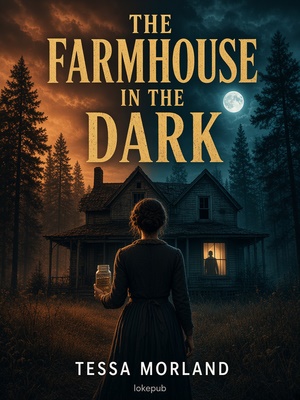
The Farmhouse in the Dark
Chapter One
Not all hauntings begin with a bump in the night.
In the isolated farmhouse, Helen could hear every bump the forest produced. Every owl, every coyote, every leaf brushing against
the eaves in the darkness.
Helen had never believed in hauntings before, but tragedy changes people. Two years earlier, one night in the city had ruined
her life—and the aftermath had turned her into a hopeless insomniac. That’s why she often found herself awake at strange hours,
like she was now at half past three. She drifted into the kitchen of the farmhouse while her husband, Wade, slept soundly
in their bedroom at the end of the hall. He hadn’t even stirred when she’d carefully peeled back the covers and left his side.
If all the trees in the forest suddenly toppled over in the night, Helen suspected Wade would sleep through the crash.
She was glad he could find sleep so easily.
Well, sometimes.
Last week, Wade had said, “Just drink some lavender tea before bed.” He’d said it in a pleased tone, like he’d expertly cracked the case. It had taken a lot of willpower for Helen to not break the dinner plate she was holding at the time.
As she aimlessly crossed the quiet kitchen now, a floorboard groaned beneath her foot. For a moment, she wondered if the sound
was the aging wood or if it was actually the sound of her soul. Because even though she was just shy of thirty-four, she already
felt like an old house with floorboards that speak when no one is looking. It wasn’t that her body was old. It was her heart,
her mind. In the middle of the night, sometimes she imagined she was becoming the house. With each passing season, they were
merging into each other a little bit more. She never told Wade any of this. There are some things you can’t say out loud.
And she certainly didn’t have many people to talk to anymore. The seclusion here had been a choice, but it felt different
than Helen had imagined when she’d chosen to leave Seattle behind eighteen months ago and live off the grid with Wade. But
then, things rarely turn out how one imagines. She certainly hadn’t imagined when she’d married her first husband, Tyler,
that she’d lose him to such a horrible act of violence in a city they’d both loved.
No one plans for acts of violence.
And no one plans for hauntings.
Unless they do.
But these were not the things Helen wanted to think about on this October night. She filled a glass of water from the sink
and sipped it slowly.
That’s when the coyotes started howling.
She set the glass on the wooden countertop as she felt her breath quicken. She wanted to go outside and see them. She often
had that fleeting thought when she was sleepless and alone with the howls, but this time it was a real urge.
In the back of her mind, she knew paying a visit to a pack of wild animals could be dangerous.
But this was the ninth night in a row that Helen was awake, and it was the ninth night in a row she’d heard the coyotes in the forests.
If she still had her cell phone, she could have looked up the statistics: Have coyotes ever killed humans?
She had posed the question to Wade once many weeks ago, and he’d said that coyotes usually just killed dogs, but there had
been a couple of rare instances where they’d killed humans. Helen knew all about rare instances. Her life was one.
She went from the kitchen into the living room to get her thick, button-up sweater from the reading chair, determined now
to find out if the coyotes howled in unison because they were feeling an understood solidarity, like a choir of voices, or
if it was sorrow in their high-pitched wails. She needed to know if they were running in frenzied circles or sitting serenely.
That way, in the future, she could picture it in her mind correctly.
She put the sweater on over her long cream nightgown. She would take a lantern and walk in moonlight just close enough to
see them in the distance. If she heard snarls, signs they were fighting or tearing apart prey, she would turn back. She would
never tell Wade about it. The memories of the coyotes would be something she could think about when he was away working in
the woods and she was home alone as the day stretched out to the tick tock of the clock.
The more nights Helen spent awake, the more she felt like a creature of the night herself, and she’d rather be a creature
of the night than a house falling into disrepair. Besides, coyotes were nothing compared to masked men who broke into city
apartments. Some events are so shattering they reset all context and proportion, and everything thereafter is perceived in
comparison. In the context of her life, coyotes were weeping night dogs, and anyone who was afraid of that had never known
true fear.
She spotted her boots by the fireplace. Her entire book collection sat there atop the mantel: Edgar Allan Poe, Sylvia Plath, Emily Dickinson, John Keats, W.
B. Yeats. Maybe instead of roaming the dark, she should push out her nagging thoughts with lines of poetry.
The inside of the house was cool—the day’s fires in the living room fireplace and the kitchen wood stove long burned out—but under the starry sky it would be much colder.
She didn’t know how far she’d have to go to find the coyotes.
A nightgown, sweater, and boots might not be near enough clothes, but if she went to their bedroom in the back of the house to get more layers, she might wake Wade.
The dresser drawer had a terrible catch on it and screeched every time, and then he’d tell her, Stop it. Come to bed.
Perhaps Helen wasn’t a creature of the night after all. Creatures of the night didn’t ponder these details. They smelled a
whiff of danger and ran toward it, not away.
If Helen had any sighs left in her body, this would have been the moment when she would have sighed, but all of her sighs
had long ago been depleted. Instead, she drifted to the fireplace and ran her fingers over the books that lined the mantel.
Down the spine of each, soothing little letters in serif fonts. Her cathedral. Sometimes, in the middle of the night, she
didn’t even read them. She just stood in front of them, taking in the sight, listening to the sounds outside.
The forest was a quiet place, and yet that quiet magnified everything. In the spring, it was the frogs. In the summer, it
was the crickets. And always, it was the coyotes. Now that it was autumn, leaves were beginning to rustle, and some nights
the rain dripped on the eaves.
But in that moment, Helen heard something else.
A thud. Outside the farmhouse. It came from the direction of the storage shed, and it was not the sound of wild animals but
human-created. Her immediate judgment: a break-in. The shed door kicked in perhaps.
The nearest neighbor lived a few miles away, so if Helen and Wade were attacked, no one would hear their cries for help. She
thought of that often.
But crying out for help in the city hadn’t done her or Tyler any good either.
Now she was smarter, though. Now she had other protection. Behind all those books of poetry on the mantel, there was a small wooden box, and inside that box, there was a gun.
Helen pulled the revolver from the box and quickly opened the chamber. Unless Wade had removed the bullets, there would be
no reason for the chamber to be empty, and as she spun it, she found it full, as expected. She wanted to be sure that if she
pulled the trigger the person she was pointing the gun at was going to die.
Wearing only her nightgown, sweater, and stockings on her feet, her long hair tumbling down her back, Helen crept into the
kitchen. She peered out the window next to the front door, but all she saw was darkness.
She listened. Hearing nothing, not even the coyotes anymore, she opened the door and stepped from the safety of the kitchen
into the inky stillness outside. With the adrenaline coursing through her, she didn’t feel the coldness of the air.
She lifted the gun and shouted.