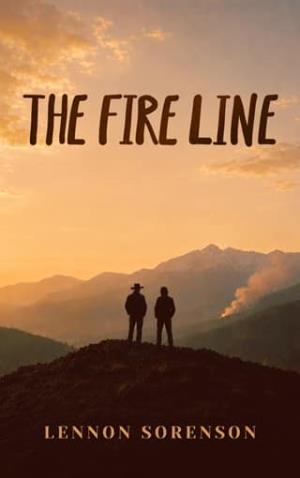
The Fire Line (The High Country Trilogy #1)
1. Learning the Geography
Learning the Geography
The GPS gave up three miles after the pavement did, erasing the blue route line from the dashboard while Jay kept driving.
“This is still the road,” Priya said.
It was not a question. She had the production packet open across her lap, one finger marking their place on a printed map.
The line representing the road looked straight, deliberate, and entirely legitimate.
Outside the truck, it had dwindled to two pale tire marks through grass dry enough to crackle beneath the wheels.
From the narrow rear seat, Eli leaned forward between a cooler and two hard equipment cases. He had spent most of the drive bracing them whenever the truck lurched, as though the lenses inside might seize the first opportunity to escape.
“The road or a road?” he asked.
“The road. Eighty-five percent.”
“I don’t love those odds.”
Jay glanced at him in the mirror. “You’ve worked with worse odds.”
“Not while carrying lenses this valuable.”
Behind them, the production van appeared and disappeared inside its own dust cloud, carrying two assistants, the rest of the equipment, and enough groceries to sustain them until everyone properly understood how far they were from a real store.
Jay’s phone began vibrating against the cup holder, stopped, then started again with renewed conviction. Priya reached over and turned it facedown.
“Your mother thinks you’re dead again.”
“She thinks Montana is farther from New York than Mongolia.”
“It might be, emotionally.”
His family had sent thirty-seven messages since Bozeman, most arriving simultaneously whenever the truck caught a pocket of service.
His mother had asked whether he landed safely despite watching the flight tracker all the way to the gate.
His father had sent a photograph of the basil plant Jay abandoned in their Astoria kitchen the previous spring; under his care, it had become a small Mediterranean tree.
Aunt Eleni had contributed a three-minute voice note, his cousin wanted to know whether cowboys still wore spurs, and two relatives were arguing in Spanish about whether Montana touched Canada while somebody else joined in Greek without understanding the question.
His mother had ended the matter by telling Jay to wear sunscreen.
Jay let the phone buzz itself tired, but made a note to check in once they settled in at the ranch.
The packet on Priya’s lap contained eighteen pages of instructions from the Shaw family, most practical and several emphatic.
Gates had to be left as they were found.
Equipment could not block the lane between the foaling barn and south pasture.
No drones near livestock without approval.
No filming inside the private house. No one approached a horse without ranch personnel.
The final instruction had been added in all caps: HORSES ARE NOT PROPS.
Jay had read it twice, not because he disagreed but because he could already hear the man who wrote it.
Someone at Shaw Ranch had apparently formed a vivid picture of documentary filmmakers as deranged coastal idiots who arrived in black clothing, pointed cameras at suffering, and strapped GoPros to livestock for texture.
Jay suspected Harrison Shaw. They had exchanged exactly two emails, and that had been enough.
The road climbed, and the valley revealed itself in pieces between stands of pine before appearing all at once: tawny fields laid against dark seams of cottonwood, low buildings gathered beneath older trees, mountains rising beyond them in blue-gray layers.
It was the kind of reveal an editor would be accused of manufacturing if the camera happened to catch it properly.
A wildfire had been burning west of the valley for nine days. It was moving north and remained, according to every update Priya had saved, too far away to threaten Shaw Ranch. No evacuation warnings. No immediate concern. Only smoke thinning the sunlight until the land appeared varnished in brass.
Jay lowered the window. Heat came in first, followed by dust and the dry, resinous smell of pine.
Nothing like August in New York, where heat climbed off pavement, trapped itself between buildings, and collected every odor on the block.
This heat came clean off the land, dry enough to roughen his throat before he had taken a full breath.
“You’re letting the dust in,” Eli complained.
“We’ll all be covered in it soon enough, anyway.”
They crossed three cattle guards before a weathered sign appeared between stone posts.
SHAW RANCH - EST. 1912
A newer board hung below it.
GUEST LODGE · TRAIL RIDES · WEDDINGS · PRIVATE EVENTS
Jay looked at the two signs as they passed: inherited land and modern tourism sharing the same posts. Almost offensively useful. He had learned to distrust anything that presented the argument of a film that neatly.
The ranch came into view beneath a stand of cottonwoods.
A long timber lodge anchored the guest side, while barns and working sheds spread behind it as though each generation had added whatever the ranch needed next.
Farther back, a low private house sat among mature trees.
Fences crossed the grass until distance erased them.
Nothing had been arranged for charm, yet charm had apparently happened anyway.
The lodge had a broad porch, timber columns, stone along the lower walls, and upstairs guest-room windows catching the afternoon light.
Jay, Priya, and Eli would be staying in the east wing.
The detached cabins were reserved for paying visitors and a wedding party due later in the week, which suited him.
Separate cabins made film crews believe they were on vacation, and then suddenly someone was opening wine at four while claiming to review footage.
A little girl in pink rubber boots stood in the middle of the lane.
Jay hit the brakes.
She remained exactly where she was, holding a yellow plastic shovel and regarding the truck with the calm authority of a very small traffic officer. A woman came running from the lodge.
“Willa!”
She lifted the child against one hip as an identical girl in green boots appeared behind her.
“You cannot stand in front of cars to make them stop.”
“But it worked,” Willa said.
Jay lowered his window. “She has a point.”
The woman laughed, slightly breathless. “You must be the film people.”
“Is it that obvious?”
“You have rental plates and a truck packed to the windows with black cases.”
Priya leaned across the console. “Priya Mehta. This is Jay Navarro. Eli is being slowly crushed by the equipment in the back.”
Eli raised one hand between the cases.
“Elise Shaw. You already met Willa.” She gestured to the girl peering out from behind her leg. “And this is June.”
June watched Jay from behind her mother’s leg without committing herself to an opinion. Reasonable. They had only just arrived.
A man came down the lodge steps carrying a cardboard box. Evan Shaw was younger than Jay had expected from months of scheduling calls: early thirties, sandy-haired, open-faced, and approaching them while visibly keeping track of at least six other problems.
“You found us.”
“Technically Priya found you,” Jay said as he climbed out. “I mostly followed the road and complained.”
“Against the odds, that’s how most people arrive.”
His handshake was brief, and Jay liked him immediately for not making their arrival ceremonial.
They had already spent months discussing contracts, releases, filming boundaries, liability, children, livestock, private family areas, weather contingencies, and approximately eleven thousand other things required when a film crew wanted to point cameras at somebody else’s life.
“We’ve got you three upstairs in the east wing,” Evan said. “Assistants downstairs near the conference room. We cleared that for charging and equipment storage.”
Priya’s attention moved toward the lodge. “How many circuits?”
“Two. Electrician checked them yesterday. Wi-Fi reaches most of the building. Won’t impress you, but it exists.” He shifted the box against his side. “My mother, Della, runs the kitchen and has already decided none of you eat enough.”
“Has she met us?” Jay asked.
“No. She considers it a universal condition.”
A truck door slammed near the equipment shed. Evan glanced toward the sound, and Jay followed his attention.
A man rounded the corner with a cedar fence post balanced across one shoulder.
Harrison Shaw. It had to be.
He looked enough like Evan for the relationship to register, but the similarities ended quickly.
Harris was taller by several inches and carried more weight through his chest and shoulders, the kind of strength shaped by years of physical labor rather than any deliberate interest in acquiring it.
His shirt was dark with sweat between the shoulder blades, and dust covered his boots and the lower legs of his jeans.
He moved with an economy that made everyone else in the yard seem vaguely overcommitted.
As he crossed toward them, the details resolved—short dark-blond hair, scruff along a hard jaw, a thin scar over the bridge of a straight nose, deep-set blue eyes, and a mouth unexpectedly full at the lower lip.
Well. That was inconvenient.
The camera was going to love him, and Harris would almost certainly consider that an accusation. Jay watched him cover the yard (not staring, just assessing—which a director was professionally obligated to do).
Harris slid the post into the bed of a work truck and joined them. He shook Priya’s hand first, her name apparently earning recognition after months of logistical emails, then Eli’s. When he reached Jay, his gaze settled directly on Jay’s face.
“Navarro.”
His voice was low and roughened by the day.
“Call me Jay.”
Harris took his hand. His palm was callused, his grip firm without the competitive crushing Jay sometimes got from men who met him and immediately developed concerns about their own masculinity.
“You planning to leave the truck in the middle of the drive?”