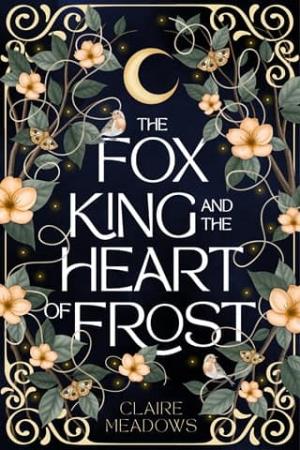
The Fox King and the Heart of Frost
PROLOGUE
A wicked place, the Ravenwoods.
Iwas little more than a babe when I first met death.
He followed the thorn-veiled path that night, from the village in the vale up to the hillcrest, where our cabin hid amid black firs. He came just after dark, rustling the fallen leaves near the gate, and he came as a black-cloaked man whose knife sought to spill a mad woman’s blood.
My mother must have heard him, for she cradled me tightly and made for the kitchen window.
I remembered little of that night save this: that the frost gnawed at the soles of my feet, that I pricked my finger on the rusted window frame before I tumbled into the briar, and that my mother wept quietly as we cowered beneath the ribbon-hung elm.
The ribbons repelled evil, my mother claimed, but she was not quite right in the head.
I remembered that she pleaded beneath trembling breaths—I did not know with whom or to what end.
I did not remember that the black-cloaked man found us.
I remembered only his scream and the bitter cold in my veins as a terrible magic spilled from my small, frozen hands.
Above all, I remembered his lifeless eyes.
I was eleven winters old when death found me again.
I sat beside my mother on the fur-lined stove bed where we slept in winter and kept our sick, and I clasped her shivering hand in mine. The blight-fever had long passed me and it had spared my father, but my mother’s sallow skin still burned with it.
Only a matter of time now, my father had slurred, and left me alone with her. She was mad as they came, always had been, and the fever made her worse.
I sat and spoonfed her leftover cabbage soup, clumsily for the thick bandage swathing my hand. The broth dribbled like blood from her lips, staining her best blouse. I did not know then why she’d insisted I clothe her frail and feverish body in her finest garments that eve, but I knew now.
Outside, winter had come with a vengeance, and the snow had grown so tall on the sill I could scarcely see from the drafty window.
I flinched when my mother rose from her sweat-soaked cushions.
The spoon fell from my numb fingers and landed with a clatter on frigid tiles.
She drew breath, a horribly rasping thing, and perched in bed as if awake and well.
Her glazed eyes darted from door to window and came to rest upon me with such urgency, I trembled.
“Listen, Evana,” she said. “Listen.”
I did so to please her, but there was nothing out there save the howl of the winter wind and the terrible groan of the old oaks, huddling branch-to-branch to conceal our cabin from the village’s scornful eyes.
As strange as a hag and twice as mad.
I indulged her with a shaking smile, for in her gaze was suddenly such life and such vigor, I dared hope for a heartbeat that the fever had passed her, too. That she might live and prove my father wrong.
“The spirits whisper tonight.” She clasped my arm, brittle nails drawing blood, and she looked at me with dark, dark terror. “Run, they say. Run, Evana.”
Then, she died.
I did not run that night, though I should have, for my father returned before I could muster the courage to set forth into the winter storm.
He stumbled through the door with a burnt loaf of bread and liquor-drenched breath, and he scarcely paid me a glance before he passed out over the kitchen table.
I stayed with my mother on the stove bed until death turned her fingers cold and stiff.
Then, lured by the mouth-watering scent of the blackened bread, I climbed nimbly from the stove and filled my churning stomach.
I left enough for my father. He would be hungry when he woke, and in a lousy mood.
I noticed by the stiff silence and by the chill in the house that the flame in the hearth had died.
Quietly, I gathered an armful of wood from the basket and stoked the fire—but the fire cared not for my efforts.
The sickly flame vanished with a hiss, as if I’d offended it somehow with my prodding and pleading.
I knew in my heart that further efforts would be in vain.
That the spirit who dwelled in the hearth and protected the fire had abandoned us that night.
I’d never felt its presence as my mother had, never heard its voice beyond a merry crackle, but I felt its absence in the hollowness of the house, in the terrible cold that crept like frost over my bones.
I cowered in the warmest corner of the cabin, under the bench beside the hearth, and I wept.
I missed my mother achingly, and I was terribly afraid, and I did not know how to bear the loneliness of my grief.
My father would barely notice her absence—he’d only ever noticed her in anger—and the villagers would whisper and murmur, and I knew already that I’d catch a touch of relief in their eyes when I next came to the baker alone.
As strange as a hag and twice as mad.
I trembled, suddenly angry. There was no spirit in the hearth. There had never been one. There lived no spirits in the bath either, none in the brambles near the creek, nor in the knotted oak by the glade.
As strange as a hag and twice as mad.
As vile as the rot and better off dead.
She had not been right in the head for a while, my mother—but I was nothing like her. I did not hear the whispers of the unseen. I did not carry the stain of her madness.
Like mother like daughter, they said.
I’d prove them wrong.
I made with renewed vigor for the wood basket and stuffed the hearth’s cold belly to the brim.
I set the kindling with utmost care and I brought a candle to it.
When the fire refused to catch, I tried again.
I tried again and again, until my hands wore blisters from dripping wax and the candle’s flame licked at my fingers.
I tried until I fainted from the strain of sorrow and fear.
The cold remained.
For six long winters, the fire in our hearth did not return—but death did.
He became a midnight visitor, draped in rotten leaves, broken bones, black mud.
He knocked in the dark hours on our crooked door and he did not bother to conceal his sinister, striking face.
He had no need to hide his wicked deeds.
We all knew him as the lordling of the swamp and as the vilest faerie to live on this side of the Sunken River.
He came to our threshold, and he whispered into my father’s ear, and my father allowed him, for a copper piece, to help himself to the cursed magic my mother had so recklessly asked the spirits to bestow on me, that night beneath the ribbon-hung elm.
Hello, little bird, the lordling would sing and take me to the forest to poison the berries, to parch the creek, to speak death into the roots and into the wind.
He coveted the thorn-wrought crown on his sister’s head, the one queen among kings, and since he could not have it, he contented himself instead with bringing ruin upon her lands, her people.
He was the sculptor of decay and I, under the weight of his glamour magic, his ever-willing tool.
I was seventeen when I escaped; terrified and disturbed, and with nothing on me but the tattered clothes that hung from my spindly frame.
I leaped from the broken window of the blackstone castle in the swamp, mouth foul with a taste of the lordling’s blood, and I ran with the wind—swifter even than his hounds.
I laughed all the way down to the moonlit riverbank.
Perhaps I was a little mad after all.