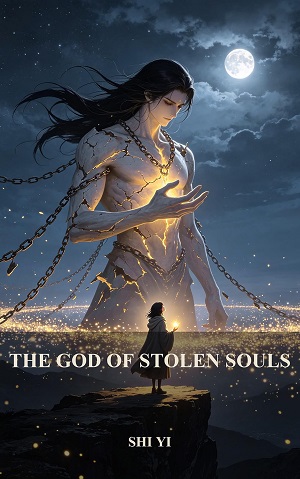
The God of Stolen Souls (The Fallen God Trilogy #2)
Chapter 1 The Ash Grove
The skiff slipped between the first pale trunks, and the water gave up its running.
The channel widened into a basin ringed with ash, the current spreading thin until it lay flat and dark, holding the white winter sky.
The oar's leather stopped creaking. In the close air the hull's tar-smell came up strong, and under it the green smell of standing water and cold bark.
An ash key turned on the current beside the bow, spun twice, and carried past the stern without hurrying. Elowen watched it until the trunks took it.
She shipped the oar. The skiff carried a little way and came to rest where the water had nothing left to push against, and the silence closed in around them like a held breath.
Around them the trunks stood packed and bare, black against the white sky, and the channel ran north between them and could not be seen until it was on you.
The last cover before Northwater. Etta had said the grove held, and the grove held.
Elowen sat with her hands on the oar and listened.
Behind them, down the whole length of the channel, nothing moved on the water and nothing spoke.
She listened until the silence took a shape she could price.
No oar against a pin. No horse on a bank.
The hunt had not found the water yet, or had found it and lost it.
Either way, for the length of the afternoon, the grove was a column of cover that had not closed.
In the stern, Seren woke. Not as she had woken on the water, half in it. She sat up with the blanket falling to her lap and looked around the grove with eyes that were her own, clear of the fever's bright edge.
"Ellie," she said. The in-between name. "Where are we?"
"The ash grove. North of the mill."
Seren looked at the trunks, the flat water, Elowen's hands on the oar. "Did we get away?"
"We got the water."
She considered that. "Is she gone? The one at the candle?"
"She's denied. The working took the crest and she didn't get the candle. She won't come again."
Seren nodded slowly, and then, as if a door had opened, she was fully there. She looked down at her own hands and said, in a voice with no fever in it at all, "Elowen. You paid for that."
That shift, Ellie to Elowen, was the fever's last mark going out. The child was clear. The oath was answered. The blank line at the bottom of the count stood where it stood, and it did not need checking.
She took the oilcloth bundle from under the thwart, Etta's bread and the skin of water, and set it on the stern seat. "Eat."
Seren ate like someone remembering hunger, small bites at first, then steadily. A bird called once over the water, and for a moment Elowen nearly had the name of the lost sound, and she let it go rather than price the fifth column, which stayed open.
While Seren ate, the count kept itself, a ledger running under tired hands.
Wheel-marks: closed. The road Aldric drew had ended at a real wheel, and that column owed nothing further.
Memory: five closed, one open. Her mother's face, her father's voice, a year of her own reflection, the smell of the winter kitchen. The daily sound she could not name stayed open.
The sixth was the road home, landed and named and paid, and she reached for it now and found the shape of it gone.
The bend where the road crossed the stream, the second gate, the hill that put the house in view, she could not say which of them had been last. The working had taken the road out of her whole, and when she went to walk it back in her head, from the mill to the house that had been its other end, the memory ended at a blank, and the blank was the price, and the price did not close.
Persons: two. Aldric, asked in the chapterhouse at the end of the road he had drawn. The keeper, at the mill, holding the water door from inside. Neither paid. Both open.
The withering: three finger-widths past the elbow, fifty-two days to the name-day.
The oath: the entry that needed no number. The child breathed. The column stayed open anyway, because an oath that balances is an oath done, and she had never believed this one done. Answered, yes. Done, no. They were two different columns, and the second was not hers to close.
Elowen put two fingers to Seren's wrist and counted ten against the pulse. The pulse came up steady. The grey at Seren's wrist held where the fever had left it, neither higher nor lower.
Seren looked at Elowen's fingers on her wrist, then up at her face. "What did you pay? For the crest."
"The road home," Elowen said. "I can't walk it back. I paid that column."
Seren's mouth worked. "For me."
"For the oath. I made it to the dead of the house. The last child doesn't die in my hands."
Seren looked away at the flat water. "Does it balance?" she asked, the question from the channel, the one Elowen had carried unanswered since morning.
"No," Elowen said. "It doesn't balance. It's kept anyway. That's what a count is for when it doesn't balance. You keep it, so you know what's owed."
"What's owed?" Seren asked.
"The old man. The keeper. The road I can't walk." Elowen said it flat, as if quoting a price.
Seren was quiet a long moment. "Can you get it back? The road?"
Elowen did not answer. She took her fingers from Seren's wrist and put her hand back on the oar, and the question sat in the skiff, and after a while Seren stopped waiting for it.
On the flat water the far end of the thread made itself known, faint and unhurried.
The binding at her wrist sat slack, set down, not torn, the same as it had been since the mill.
She had been reading it wrong since the mill.
Slack was not let go. The far end was not free; someone held it without pulling, a closed hand on a rope it did not want to snap, and that was a difference she had never once thought to price.
She filed it without naming it, a column she had not opened. The mill door had held against the hunt with no hand at the bar, the working had cost her the road home, and the count said nothing about what the far end paid. She left that column open rather than price it wrong.
"We need a name," Seren said. She had been quiet since the question that got no answer, watching the water with her own eyes.
Elowen looked at her.
"A lie needs a name," Seren said. "The keeper gave you the road and the lie. She didn't give it a name to walk under."
The lie had been whole in Elowen's head since the mill, the miller's widow and the sick child and the healer's lamp. Whole except for the name. She had not priced the gap until the child did.
"Marta," Seren said. "You look like a Marta. Marta the miller's widow."
Elowen filed it without an entry and did not correct it. "Marta," she said. "Good. Marta and her child."
Seren nodded, pleased in a small way, and lay back in the stern with the blanket up to her chin. The grey afternoon deepened over the grove without hurry. Seren's breath went even, clear sleep this time, and Elowen let the skiff rest on the flat water and watched the light fail between the trunks.
Northwater lay ahead, past the grove's far edge.
She had never been. The healer's lamp was a promise Etta had given her on the water, a promise she had not yet seen kept, and a promise was not a column.
It was a debt without a ledger, and the only way to close it was to walk into the town and see the lamp over the door.
The last finger of Wrenth wax had burned toward the channel when she pushed off, and the keeper held it.
The mirror stayed face-in against her ribs, where she had put it before she pushed off, and she did not turn it.
Through the ash trunks, where the channel narrowed north, a low light showed once over the water and went out.
It lasted the length of two oar-strokes.
Low, as a lamp hangs over a door. Or a lantern waiting on a bank.
Or a reader's glass catching what it had been sent to find.
She had nothing to price it against. She had never seen Northwater's lamp, and the water was the only road the seal had not closed, and if a reader had found the water the reader would come quiet and low, and the light would show once and go out.
This one had.
The water ran north, slow and dark between the pale trunks. The light did not come again.
In full dark the skiff would slip through the last trees and be nothing on the water, and Northwater would be a shape of lamps on a bank she had never walked. One of them, or none of them, was the light she had seen.
Elowen did not move.