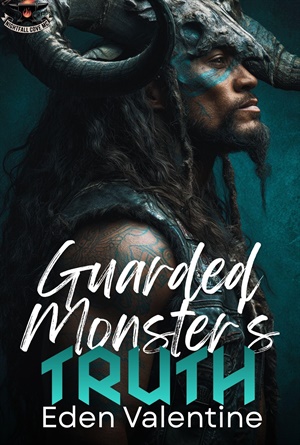
The Guarded Monster's Truth (Feral Sons MC #6)
Chapter 1
Ava
Three pages of notes and a six-hour drive, and I still don't have my opening line.
The rental crosses the bridge into Nightfall Cove at ten past nine on a Wednesday morning, and I've burned through two coffees and half a legal pad trying to nail the hook for a six-thousand-word integration profile nobody outside the Pacific Northwest will read. My recorder sits in the passenger seat.
The harbor opens up past the bridge rail.
Boats lined at the docks, a row of salt-bleached storefronts, Founder's Day banners strung between lampposts in red and gold.
Workers on a ladder rig one to the hardware store awning while a woman below yells directions they ignore. I grab the recorder and press record.
"Nightfall Cove, take two. Population eight thousand, give or take. The town that introduced the world to the idea that monsters could be neighbors." I pause. "In October it was hay bales and cider. Now it's bunting. This town never met a holiday it couldn't decorate for."
The B&B sits on a side street off Main, a blue clapboard house with a porch that sags toward the garden.
The woman who opens the door introduces herself as June, mid-sixties, reading glasses on a chain.
She hands me a key attached to a driftwood keychain heavy enough to anchor a small boat.
I booked three nights to get my bearings.
Long-form assignments, I find the accommodation after I find the story.
The room upstairs has lace curtains and a view of the harbor and a Wi-Fi password written on a notecard in neat handwriting.
I drop my bags on the bed, plug in my phone, and stand at the window long enough to watch the street below.
Foot traffic. A few tourists with cameras.
Two orcs in work coveralls outside the hardware store, loading lumber into a flatbed.
I grab my notebook and walk.
Betty's Diner smells like bacon grease and strong coffee.
The pie case does the advertising. The walls handle the rest—awards in frames, a ribbon-cutting photo with a much younger Betty flanked by two orcs in work shirts.
I slide onto a counter stool and order coffee and the Tuesday special even though it's Wednesday because Betty tells me it's better.
"That photo," I say, nodding toward the ribbon cutting. "How long ago was that?"
"Twenty-two years next month." Betty doesn't look up from the pie she's slicing. "You a tourist or a reporter?"
"Is it that obvious?"
"Tourists take pictures of the photo. Reporters ask about it." She slides a plate into the case. "Which magazine?"
I set the recorder on the counter. "Pacific Northwest Monthly. I'm doing a piece on the integration—how the town got from that photo to now. I'd love a few minutes if you're willing."
Betty fills my mug without looking at the rim. She hits the line perfect. Fifty-five years of practice. "The Emergence. You want the short version or the long one?"
"Whichever one's true."
She smiles at that.
"Both. The fire came through in late summer, twenty-two years back.
Took out three hundred acres of old growth before it turned toward town.
We had two engines and a volunteer crew that couldn't fill a softball roster.
" She sets the pot down. "Then the orcs came out of the forest. And the minotaurs.
And a few others we didn't have names for yet.
They dug firebreaks with their bare hands.
They carried people out of houses the road crews couldn't reach.
By the time the state crews arrived, the fire line held and the whole world knew what lived in those woods. "
"And after?"
"After is the part that probably takes twenty years to tell.
" She leans her hip against the counter.
"We fought about it. Lord, did we fight.
Town halls that went past midnight. Folks who'd lived here their whole lives packed up and left.
Folks who'd never been here showed up to protest. Five years of that before the Supernatural Rights Act passed, and even then, the real work started the morning after the signatures dried. "
I write: Betty tells the integration story the way a pastor delivers a sermon she's given four hundred times—from memory, with warmth, and with the hard parts she avoids.
The man at the end of the counter watches me write.
Gerald Winters, according to Betty's quick introduction.
Seventies, thin-shouldered, coffee-colored corduroys and a flannel shirt buttoned to the collar.
He runs the general store and post office.
He also runs a tab at this counter that suggests he spends more time here than anywhere else.
"The monster folks," Gerald says, turning his mug in a slow circle on the saucer, "they didn't ask permission to save the town.
They just did it. That part's easy to admire.
" He pauses. The mug stops turning. "Living next door to someone who can put his fist through your front wall, that part takes longer. "
"How long did it take you?"
His eyes meet mine. Sharp, under the white eyebrows.
"Couple years before I stopped locking the front door at night." He takes a sip. "Couple more before I felt stupid about it."
Betty touches his shoulder as she passes. His hand lifts an inch off the counter toward hers.
I spend an hour at the diner. Betty gives me the highlight reel and Gerald gives me the footnotes. I fill four pages. The coffee strips paint and the Tuesday special turns out to be a meat loaf sandwich I could write a separate article about.
The parking lot gravel pops under my boots as I push through the diner's front door. I'm fishing for my recorder in my bag when the back of my neck prickles.
Across the lot, in the shadow of the building on the opposite side of the street, someone stands with his arms folded against his chest.
Not someone. A minotaur.
Six-ten, maybe more. Broad through the shoulders and chest in a way that makes the doorframe behind him look like it belongs in a dollhouse.
Long dark hair, tied back. And his horns.
Thick at the base, curving up and back, carved with symbols I can't read from fifty feet away.
Raised marks that throw tiny shadows across the bone.
He watches me. Not the idle glance and slide of passing attention you give a stranger on the street. His gaze locks on me, fixed and unblinking, taking it all in and giving nothing back.
And the itch of recognition lands. October. The festival. The same shape at the end of the parking lot, arms folded exactly like this. I wrote him off as event security and forgot to forget him.
I raise my hand.
He doesn't wave back. Doesn't nod, doesn't shift his weight. He stands there like he's been standing there for hours.
I hold the wave until it gets embarrassing, then drop it. He stays where he stands.
The Rusty Anchor hunches on the waterfront between a bait shop and a gift store selling driftwood art. Neon beer signs glow in the front window despite the daylight. The door sticks, and the gargoyle on the other side catches it with one hand before it swings into me.
The bouncer. Stone skin, grey-brown, cracked along the forearms the way old wood splits with age. He holds the door open and steps aside.
"Thanks."
He nods once.
The bar smells like salt and old pine and the ghost of a thousand spilled beers ground into hardwood. I find a stool and order a ginger ale because it's one in the afternoon and I have two more interviews today.
A large female troll comes out from the back. Grey-green skin, silver-shot hair catching the red neon from the Scales & Ales sign. She pours my ginger ale, sets it down, and studies me with eyes that hold more years than the building we're sitting in.
"Ava White, Pacific Northwest Monthly." I slide a card across the bar top. "I'm doing a piece on Nightfall Cove's integration model. I'd love ten minutes."
"Fine, I'm Sal, by the way. You've got ten minutes." She picks up the card and reads it front and back, then sets it beside the register.
I press record. "How long have you been in Nightfall Cove?"
"Longer than the name."
"The town's name?"
"The country's."
My research mentioned trolls could live centuries, but the number hits harder when you're sitting across from a woman who predates the Oregon Territory.
"So you've seen integration before. Other places, other times."
"I've seen people figure out how to live next to people they're afraid of." She wipes the bar in a slow arc. "Sometimes it works. Sometimes it doesn't. Here, it works because the ones who stayed gave a damn. Still do."
"That sounds like work, not harmony."
"Harmony's for church choirs." She finishes the arc and folds the cloth. "This is a town. Towns run on decisions."
I flip my notebook open. My ginger ale sweats a ring onto the wood.
"You've got two minutes left," she says.
I use them. Sal answers my last questions and I don't push for more when the ten minutes end. Some sources you press. Some you earn.
The bouncer opens the door for me on the way out. I thank him again. He nods again.
The harbor air hits me outside as I stand on the sidewalk writing.
My hand moves fast, catching everything before it cools: The Anchor isn't a bar.
It's an embassy. Sal runs it like one. The integration in this town isn't soft—it's built.
Reinforced. Load-bearing walls and people who know which ones hold the weight.
The Feral Sons MC compound sits on the north edge of town, a cluster of timber buildings on what the map calls the old shipyard. I park my rental outside the gate and walk to the porch because nobody invited me inside and I know a boundary when I see one.
Knox Stone meets me at the top step. He's enormous, even for an orc. Green-grey skin, tusks, arms thicker than the porch railing he's leaning on. He wears a leather cut with PRESIDENT stitched across the back and offers a handshake that swallows my whole hand.