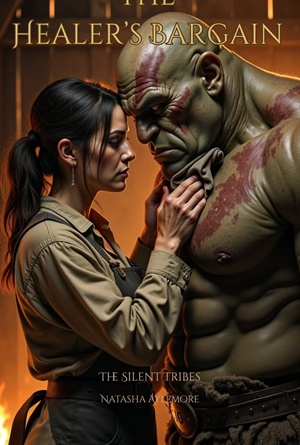
The Healer's Bargain (The Silent Tribes #5)
Chapter One
THE PATH TO Stonehollow was a thin, unpromising line scored through the high pine forest. Lirra Voss walked it with the steady, ground-eating stride of someone who had spent more of her thirty-six years on foot than not.
Her field kit—a leather satchel worn smooth and dark at the edges—rode against her hip, a familiar counterweight.
In her pocket, a folded piece of paper carried a single name: Signe Aldric.
A letter of introduction from a Greyfen contact she had never met, sent by a courier who had looked at her with something like pity.
Try Stonehollow, the note had said. They are listening now.
The air shifted as she descended into the valley.
The clean, resinous scent of pine gave way to the damp, mineral smell of wet stone and cold earth.
And beneath that, something else: the quiet.
It was not the quiet of peace. It was the dense, waiting silence of a place holding its breath.
A place where children had been sick for a long time.
The camp revealed itself in increments through the trees.
Not a fortress, but a settlement grown into the mountainside, its longhouses built from the same grey stone that thrust from the soil.
Smoke rose from chimneys, thin and straight in the windless air.
No children played in the cleared space between the buildings.
No voices carried. The only movement was a woman hanging laundry, her motions slow, her head bent.
A man stood at the gate—a simple timber frame lashed together. He was young, his face sharp with worry and lack of sleep. He watched her approach, his hand resting on the haft of an axe driven into a stump beside him.
“Healer,” he said. It wasn’t a question.
“Lirra Voss.” She stopped a respectful pace away, her boots dusted with the fine, pale grit of the path. She did not offer her hand. “I’m here about the children.”
His gaze flicked over her, assessing the kit, the worn but serviceable wool of her coat, the calm set of her face. “We didn’t send for you.”
“No.” She drew the paper from her pocket, unfolded it, held it out. “Signe Aldric sent word.”
The man’s eyes dropped to the name. A subtle tension bled from the line of his shoulders, a slow release of readiness. He took the paper, his fingers brushing hers. His skin was cold. He stared at the name for a long moment, then gave a short, sharp nod. “Wait here.”
He disappeared between the longhouses. Lirra stood still, her hand finding the strap of her kit.
The familiar weight of it, the smooth leather, the solid shapes of bottles and instruments within.
She did not hold it anxiously. She rested her palm against it, a touchstone.
The silence pooled around her. From one of the nearer buildings, she heard a low, rhythmic cough.
The sound was dry, tired. It went on for a long time.
The man returned with another. This one was not young.
He was large—not merely tall, but broad, with a thickness through the shoulders and chest that spoke of a lifetime of labour and war.
He wore a simple tunic and trousers of undyed wool, no ornament, no sigil of rank.
His hair, the colour of iron ore, was tied back from a face that was all stark planes and angles, weathered by wind and care.
Exhaustion hung on him like a second skin, etched in the bruised hollows beneath his eyes, in the tight line of his mouth.
But his gaze, when it found hers, was not dull.
It was a clear, penetrating grey, the colour of winter sky through ice.
He looked at her, and she saw the thing she had come to find: a man who had refused to stop hoping.
“I am Rauth,” he said. His voice was low, roughened by lack of sleep, but it carried easily in the quiet. “You have Signe’s name.”
“I have her word,” Lirra corrected, gently. “That I might be of use.”
He considered her, his eyes moving from her face to her kit and back. Credentials were not requested. Nor did he inquire where she had trained. “Come,” was all he said.
Turning, he walked into the camp. Lirra fell into step beside him, her shorter strides matching his slower, deliberate pace.
He led her past the longhouses, toward a smaller structure set apart, its walls made of tightly woven wattle.
The smell here was stronger—herbs, yes, but undercut by the sour-sweet odour of sickness, of fever-sweat and phlegm.
“How many?” she asked, her voice low.
“Twelve. In the last moon. Three before that.” He did not look at her. “They are between five and twelve years. The fever comes first. Then the cough. Then the bleeding from the gums, the nose. Weakness. They sleep, but it is not restful. They fade.”
He said the last word without inflection, but Lirra heard the cost of it. The clinical part of her mind began arranging the symptoms into possible patterns. The rest of her listened to the spaces between his words.
He pushed the door open. The interior was dim, lit by a single high window. Pallets lined the walls, each occupied by a small, still form. A woman sat on a stool beside one, sponging a brow. She looked up as they entered, her eyes red-rimmed. She saw Rauth and stood, moving aside without a word.
Rauth stopped beside the pallet. The child was a boy, perhaps seven, his face pale as wax, his lips cracked. A faint, rust-coloured stain marked the linen at his nostril. His chest rose and fell in shallow, rapid flutters.
“This is Kael,” Rauth said. His hand, large and scarred, came to rest lightly on the boy’s forehead. The gesture was so tender it made Lirra’s own throat tighten. “He was the first of this wave.”
Lirra set her kit down on the packed earth floor.
She did not ask for permission. Kneeling, she felt the cold of the ground seep through her trousers.
From the satchel, she drew out a clean cloth, a small bottle of distilled spirits, a wooden tongue depressor, her movements efficient and quiet.
Behind her, Rauth’s presence was a solid, watchful weight.
The mother’s gaze felt desperate and brittle upon her.
For twenty minutes, she worked.
The boy’s eyes, the inside of his mouth, the colour of his gums—she examined them all.
With a hollowed horn pressed to his chest, she listened, her own breath held.
At the joints of his thin wrists and ankles, she pressed gently, noting the slight, puffy swelling.
To the mother, she asked quiet questions about the onset, the pattern of the fever, the colour of the phlegm.
The truth arrived in ragged fragments, carried on a breath.
He was playing near the burial ground. He came home with dirt on his knees. The fever started that night.
Lirra sat back on her heels. She wiped her hands on the cloth, folded it, placed it aside.
The pieces clicked into place, not with a flash of revelation, but with the solid, inevitable certainty of a lock turning.
She had seen variations of this before, in the damp lowlands of the south, in the flooded tombs of the River Clans.
Never here, in the dry stone mountains. But the geography was wrong, not the pathology.
She looked up at Rauth. He had not moved. His eyes were fixed on her face, reading it.
“It’s a soil-borne pathogen,” she said. Her voice was calm, clear.
It cut through the thick, medicinal air.
“A bacterium. It lives in the damp, anaerobic layer beneath the topsoil. It enters through breaks in the skin—scrapes, cuts. Or it’s inhaled as dust when the ground is disturbed.
” She gestured toward the boy. “The burial ground. Your clan inters the dead in stone shelves above the ground, yes? With a drainage channel around the perimeter.”
Rauth gave a single, slow nod. “The channel was re-cut this spring. After the snowmelt.”
“There you have it. The disturbance aerosolised the pathogen. The children playing there breathed it in, or it entered through minor abrasions.” She met his gaze. “It’s not contagious from person to person. It’s a location sickness. The source is the ground itself.”
For a long moment, he was utterly still. The only sound was the boy’s ragged breathing. Then Rauth’s shoulders dropped, a fractional release of a tension so profound Lirra felt its echo in her own bones. He closed his eyes. When he opened them, the grey was brighter, sharper. “Can you treat it?”
“Yes.”
“How long?”
“For the acute cases?” She glanced at the boy, calculating.
“Three days to break the fever and stop the bleeding. A week for strength to begin returning. Two weeks to clear the source—the contaminated soil needs to be treated, the drainage redirected. Until then, no one goes near the burial ground.”
He absorbed this, his eyes never leaving her face.
She waited for the next question. The inevitable are you sure?
The request for a second opinion, for proof, for a demonstration on a less critical patient.
She had her arguments prepared. She had her evidence lined up in her mind, her voice already settling into the patient, unyielding tone she used with officials who valued their own authority over her expertise.
He did not ask.
He looked at her for a long, silent moment, his gaze tracing the line of her jaw, the focused stillness of her hands in her lap. The diagnosis registered, and then the woman who had delivered it.
“What do you need?” he said.
It was not a question. It was a statement, complete and whole. Four words, delivered without flourish, without qualification. What. Do. You. Need.