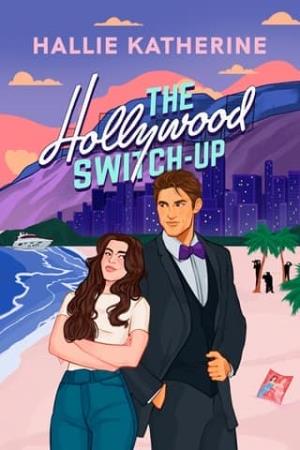
The Hollywood Switch-up (The Hollywood Fairytales #1)
1. Erika
ERIKA
Bzzt. Bzzt. Bzzt.
It began with the phone. Always the phone.
Sunlight breached the glass walls, slicing the room at a diagonal. In the months since she’d moved in, Erika had tried to catalog the ways Los Angeles was different from her old life in Wichita.
Even the guest wing was staged. Someone had chosen the “wellness nook,” stocked the tub with Annie's signature bath oil, hung towels in the exact taupe from her Verve spread. It was bigger than Erika’s old apartment, and it still wasn’t a room—it was one more surface the Anneliese Morgan brand needed maintained.
She’d had a job once. Production artist at a marketing firm that called itself disruptive, which meant she spent eight hours a day making other people’s bad ideas look expensive.
She was good at it. Trivia night champion.
Undefeated in deadpan. Then the firm folded, and nobody needed her particular skill set for making garbage look premium and she was back to being an artist with unrealized potential.
She lay in the bed for a few minutes, scrolling through the notifications with a numb thumb, until her stomach gurgled in protest.
She padded across the marble floor to the closet.
The clothes here were communal, sort of—Anneliese’s castoffs and sample-sale scores.
Erika bypassed the racks of pastel athleisure and went for her own suitcase, extracting a faded Radiohead T-shirt, the cotton worn thin at the collar from a hundred laundromat turns, the last relic of her pre-Beverly Hills self.
Stuffed under her bed in a cardboard box, her real work waited.
Last night she’d stayed up until three, sketching an unhoused man she’d seen on Sunset Boulevard, his weathered face rendered in charcoal with such care that his eyes followed her around the room.
That was the portfolio she wished she dared to show.
She slipped on the shirt, paired it with mesh shorts, and caught her reflection in the mirror: a little bloated, hair a tangle, brown eyes Annie had edited out of her brand years ago.
Downstairs, the house was already moving. Staff buzzing through their routines, somebody running water in the kitchen. Over all of it, her sister’s laughter.
“Oh my God, he didn’t!” Anneliese trilled. “No, Liv, you’re kidding—he really said that?” A pause, then: “I know! It’s like, sweetie, call me when you’ve got a shelf for your Temmy. Until then, stay pressed.”
Of course, she was on a call. Olivia Grey’s voice carried over the speakerphone—Anneliese’s agent and crisis manager. There was always a crisis, always a new viral moment to contain, a new headline to spin.
Erika hovered in the doorway, listening.
“He’s just jealous because Martin actually wants someone with a pulse,” Olivia said. “And Annie, darling, the numbers are insane. You’re trending over Dua Lipa and NASA. There’s a literal HiveMind thread titled ‘Anneliese: Our Queen.’ Just . . . don’t read past page one.”
Anneliese’s giggle was more controlled now, but the tremor underneath it carried. “I won’t. Promise. Anyway, what’s the move for today? Martin’s got me at the gym at eight, then I have the interview with LaMode . . .”
Olivia’s voice went from plush to steel. “And you’re not to comment on the Blackwell thing. At all. Not to journalists, not to randoms at the juicery, not even to Bradley, got it? If anyone asks, you say you’re just grateful for the opportunity, and everyone is working hard together.”
Erika tiptoed around the corner. The kitchen was a study in surfaces—brushed stainless, white marble, everything gleaming and untouchable.
At the island, Anneliese was a vision: perfect hair, hip-hugging yoga shorts, a sweatshirt that looked like it cost more than Erika’s rent.
She didn’t even look tired, though Erika knew she hadn’t slept more than three hours.
Across the room, Chef Antoine shuffled pans quietly, cracked an egg, and poured syrup onto pristinely stacked pancakes. Antoine never commented on Erika’s odd hours or her tendency to eat standing up. Erika liked him for that.
“Honestly, Olivia, the optics on this are terrible,” Anneliese said, her voice a low, exasperated hum. On the tablet screen: a LaVoz headline about her new role and Director Martin Blackwell’s alleged disdain for her casting. “He basically called me a pretty face with no talent!”
Olivia’s voice came back from the speaker. “Annie, darling, it’s LaVoz. Designed to stir the pot. Don’t take the bait. You need to be the picture of professionalism.”
“‘Temperamental’ is an understatement. The man is a terror.” Anneliese’s thumb swiped through comments on her latest post. “Still, ‘pretty face with no talent’? Bold of him. My StyleSnap followers should riot.”
“Let them,” Olivia said. “Your loyal army is your best weapon. Now, are you still going to the Terry Von Plump opening tonight? It’s the perfect place to look unbothered.”
There was a slight pause. “Is . . . is Stefan Cruz slated to be there?” Anneliese asked. Too neutral.
“His name is on the list,” Olivia said. “All the more reason for you to be there, looking fabulous. Let him be the one to cause a scene.”
Stefan Cruz. Erika had heard the name so many times it had become shorthand for everything Anneliese despised: arrogant, reckless, impossible.
But she’d seen clips of his interviews—had maybe watched one twice—the way he refused to play the game everyone else seemed to accept.
She wondered if he was really the villain Annie made him out to be, or someone who didn’t know how to pretend.
Anneliese absorbed Olivia’s words, her expression solidifying into something more complex, more resolute. She squared her shoulders, and just like that, the flatness was gone, replaced by the smile Erika had seen close a hundred brand deals.
Anneliese caught sight of her and grinned, muting the phone with a tap. “Hey, Bean. Want anything? Antoine can do pancakes, eggs, whatever. Or there’s the vegan stuff, if you feel like detoxing.”
Erika shrugged, aware of the grease in her hair and the way her T-shirt sagged. “Pancakes are good.” She kept her eyes on the counter. “Extra syrup?”
“Of course.”
“Olivia, gotta go. Erika’s here.” Anneliese slid a cappuccino across the island. “Big day, right? The interview?”
Erika nodded, her hands wrapping around the warm cup. “It’s the one,” she said, and forced herself to hold her sister’s gaze. She couldn’t keep living like this—borrowing her sister’s guest room, her sister’s Wi-Fi, her sister’s leftovers.
“Your portfolio is incredible, Bean,” Anneliese said. “They’d be crazy not to hire you.”
Erika tugged at a loose thread on her faded concert T-shirt. “You haven’t actually seen it in a while,” she said, aiming for light. Landing somewhere flatter.
It wasn’t that Erika didn’t appreciate her sister’s sunny optimism—it was like standing in the shadow of a human spotlight.
Erika traced a finger along the rim of her mug.
When Anneliese’s first viral post hit a million views, Erika had been hunched over her sketchbook, rendering the play of light on a wheat field at dusk.
Now her sister’s face beamed from billboards while Erika’s collected polite rejections.
Anneliese waved a dismissive hand, her eyes flicking back to her tablet. “If they don’t hire you, I’ll have Olivia make a call. One mention on my feed and they’ll be begging you to take the job.”
“I want to get hired on my own merit, Annie. You know that.” The words came out harder than she meant.
Anneliese’s expression softened, proud and distracted. “That’s my stubborn twin,” she said, squeezing Erika’s hand—then her phone buzzed, and she was gone. “Now, enough stress. Get dressed for your interview. Chef Antoine can make those blueberry pancakes you love.”
Twenty minutes later, dressed in her one decent blazer, she took the bus: forty minutes of stale air and strangers’ earbuds bleeding bass.
Erika stood before the marketing agency’s glass tower, scuffed white sneakers on polished pavement. She adjusted the leather case, worn at the corners from being dragged to interview after interview. Inside lay the evidence of her compromise: sleek logos and corporate color schemes.
The revolving door spun her into the lobby’s artificial chill, then up an elevator to the forty-third floor.
“So tell me about your experience with client-centered design thinking,” the interviewer asked.
Erika recited the buzzwords she’d memorized, watching the woman’s expression shift from interest to polite detachment. When asked about her “design philosophy,” she heard herself mumble about “user engagement metrics” and “conversion optimization.”
The interviewer’s manicured hand closed the leather case. “We’ll be in touch.”
Erika gathered it and pulled her lips into what she hoped resembled a smile.