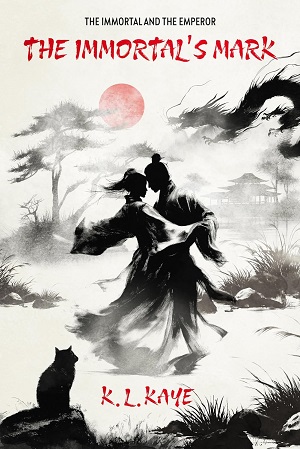
The Immortal’s Mark (The Immortal and the Emperor #1)
The Emperor Who Wouldn’t Die
The Emperor Who Wouldn’t Die
The palace smells like incense and money.
I hate both.
Incense because it reminds me of temples, and temples remind me of the century I spent pretending to be a nun.
Money because it reminds me why I’m here—clinging to a rooftop in the dark, fingers raw from cold stone, about to kill a man I’ve never met for a sum that would make a lesser assassin weep with joy.
I’m not weeping. I stopped doing that around century three. The tear ducts still work; I just can’t remember why I’d bother.
My ribs ache from the climb. The eastern wall has fewer handholds than my contact promised, and whoever built this palace apparently never considered that assassins might appreciate a bit of decorative stonework at convenient intervals.
I’m going to have words with my contact later.
Pointed words. Possibly accompanied by pointed objects.
Below me, seventeen guards patrol the outer perimeter.
Twelve visible, five rotating through the shadows in patterns so predictable I could set a water clock by them.
The closest one scratches his nose every thirty seconds.
The one by the garden gate is half asleep on his feet.
Amateur arrangements. The kind of security that looks impressive to visiting dignitaries and dies easily when tested.
I’ve tested a lot of security in eight hundred years. This won’t be the worst I’ve cracked.
Won’t be the best either.
The Autumn Moon Festival unfurls across the palace grounds like silk spilling from a merchant’s cart—banners catching lantern light, music threading through the cold autumn air, the particular hum of an empire pretending it isn’t rotting from the inside.
Sweet osmanthus incense drifts up from the bronze braziers stationed along the walkways.
Somewhere, someone’s playing a pipa, something mournful and beautiful about lost love or dead heroes or whatever else court musicians think will make nobles feel cultured.
The kind of song that makes people feel things.
This is the part where a normal person would get emotional. I count exits instead.
I shift my weight on the roof tile. Gently. These tiles are older than three of my deaths. I count the shadows between me and the servant’s passage. Eight good ones. Plenty. The moon’s full enough to be inconvenient, but the lanterns create deeper pockets of darkness between them.
Someone’s paid handsomely for tonight’s work. Emperor-killing rates aren’t cheap—I should know, I’ve been setting them for longer than most dynasties last—and whoever wants this particular emperor dead wants him very dead. The kind of dead that costs more than most provinces earn in a decade.
The contract came through three intermediaries, each more paranoid than the last. Anonymous. Untraceable. The payment already waiting in a temple three hundred miles from here, enough silver to buy a small estate and disappear for a few decades.
Not that I’ll stay anywhere for decades. Never do.
Not my business why they want him dead. Never is. Just my business to deliver the corpse.
I check my knives. Four. Should be enough for one man, even an emperor. The watered steel one for close work—good edge, holds well, feels right in my palm. The ceramic for throwing. Two plain iron for backup, because sometimes quantity matters more than quality.
If the knives fail, I brought poison.
Always bring poison.
It’s the professional’s fallback. Any amateur with a grudge can stab someone. It takes real experience to kill them quietly, from across a room, with a cup of wine they never thought to question.
The guards rotate again. Gap opening in the southeastern corner, just like the pattern promised.
I move.
The servant’s passage is where I remember it.
Three hundred years ago, give or take a decade, I infiltrated this palace for a different emperor.
Different dynasty, different name I’ve long since forgotten, different reasons that stopped mattering the moment the payment cleared.
The architecture’s the same. The arrogance is the same.
The bones of power don’t change—just the faces wearing them, just the names they carve into the history books before the next set of faces tears them down.
Empires rise. Empires fall. I keep climbing walls.
I slip behind the silk hangings—dusty, neglected, the kind of thing nobody looks at twice—and into the gap between walls. Dust and old wood and the skitter of mice who’ve made their home in the space between grandeur and rot.
The panel opens exactly where it should.
The Grand Celebration Hall hits me in waves.
Noise first—laughter, music, the particular hum of five hundred people pretending to enjoy each other’s company while counting the knife handles hidden in each other’s sleeves.
Crystal chimes swaying in a breeze that smells like roasted duck and jasmine wine.
Silk rustling against silk, that expensive whisper that only exists when people wear more than most families earn in a year.
The clink of cups I’ll be poisoning shortly.
Three exits: main doors to the north, massive and ornate and absolutely useless for escape. Servants’ corridor to the east, narrow and practical and exactly what I need. Garden passage to the west, pretty but exposed.
Seven guards visible in formal positions, standing at attention in armor polished bright enough to blind.
Four more in the alcoves pretending to be decorative columns with swords.
Those are the dangerous ones—the ones who think they’re hidden, who watch without seeming to watch.
I mark their positions automatically. Force of habit. Eight centuries of habits.
Servant routes running east-west, north-south, a constant flow of bodies carrying trays and decanters and delicacies I’ll never taste. Most of them invisible to the nobles they serve, which means they’re invisible to the guards too.
Convenient.
And at the center of everything, raised on a dais that puts him exactly at eye level with standing courtiers, on a throne that looks about as comfortable as a bed of nails wrapped in gold leaf—
The emperor.
Younger than I expected. Early thirties, maybe.
Strong jaw, high cheekbones, the kind of face that belongs on coins.
Shoulders that suggest he’s actually held a sword rather than just waved one around for ceremony.
Hands that rest on the throne’s arms like they know how to do real work.
A mouth that looks like it’s forgotten how to smile somewhere around the second decade of ruling.
But none of that’s what catches me.
He doesn’t move.
The court swirls around him like water around stone.
Ministers laughing too loud at each other’s terrible jokes.
Courtiers jockeying for position, angling their bodies to be seen, adjusting their expressions for maximum political advantage.
Silk-draped women trying to catch his eye with fans and practiced glances, the careful choreography of ambition dressed up as romance.
Servants flowing with their endless trays of wine and delicacies. Music playing. Candles flickering. The whole grinding machinery of celebration churning around him in its endless, exhausting cycle.
And he just—sits. Hands folded. Perfectly still. Watching everything with dark eyes that miss nothing.
I’ve seen a lot of powerful men in eight hundred years. Most of them fidget. Scratch their noses. Shift in their seats. Tap their fingers. Betray their boredom or their hunger or their fear in a thousand tiny ways they don’t even know they’re showing.
This one is still the way mountains are still.
I know that kind of stillness. Worn it myself, in the centuries when I was too tired to pretend to be alive. It’s not peace.
It’s a wall.
My assessment should be complete. His position relative to the exits—good line of sight, bad for quick removal. The cup he’ll drink from—silver, half full, within easy reach. The timing of the servant rotations—predictable, blessedly predictable. I have everything I need.
I keep watching.
A servant approaches his dais—young, nervous, probably new to palace service. She’s carrying a tray wrong, holding it too high, and her hands are trembling enough to make the cups rattle. Obviously terrified of being this close to the divine mandate made flesh.
I wait for the snap. The irritation. The dismissal that powerful men always give to people who don’t matter.
The emperor doesn’t snap at her. Doesn’t ignore her. Doesn’t look through her like she’s furniture.
He leans forward slightly and speaks. Low.
Patient. I can’t hear the words from here, but I can see the servant’s shoulders drop.
See her hands steady. See her relax, just a fraction, some knot of terror loosening in her spine because the most powerful man in the empire just treated her like a person.
He waits until she’s steady before taking the cup she’s offering.
Interesting.
She bows too deep when she leaves. Flustered by the attention in a way that has nothing to do with fear. Her face is red. She’ll be thinking about this moment for months. Maybe her whole life.
He notices. His mouth twitches—not quite a smile, but something. The ghost of amusement, maybe. The memory of what smiling used to feel like.
Then the wall goes back up, and he’s stone again.
He eats last, I notice. Waits until the ministers around him have been served, until the courtiers have started their second courses, until everyone else has begun the business of filling their bellies with the empire’s wealth.
Then he picks at something small—a dumpling, maybe, or a slice of pear. Barely touches his wine.
Careful. Controlled. The kind of man who’s learned that everything he does is watched, weighed, recorded, remembered. The kind of man who can’t even eat dinner without considering the political implications.
The kind of man who’s very, very tired of being observed.
We have that in common, I think, and then push the thought away because that’s not useful.