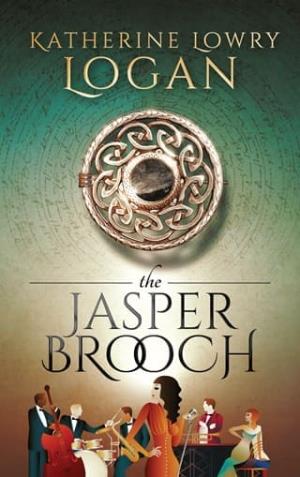
The Jasper Brooch (The Celtic Brooch #14)
Chapter 1
Chicago—Marcelle
Because love, like history, never truly ends.
Glitz, glamour, and galas—they were the shimmering facade Marcelle LeBlanc had built.
From the outside, her life appeared seamless: Chicago Symphony, university halls, polished brass under stage lights.
A world away from the crack-crack of crawfish shells and the murmur of Louisiana Creole that had once been the soundtrack of her life.
The Symphony’s annual fundraiser was only hours away, and her stomach fluttered with anticipation—and nerves.
Her brother, Bastien, had agreed to be her plus-one, a fact that steadied her more than she liked to admit.
She’d checked his flight tracker twice. Then three times. Then enough times to feel ridiculous.
His plane had landed safely at O’Hare.
That should have helped. It didn’t.
After losing their parents so suddenly—and after Bastien came back from Afghanistan carrying scars she still couldn’t name—worry had become reflexive. Immediate. A tight coil beneath her ribs that flared whenever he was late or unreachable.
Her fingers hovered over her phone again.
Still nothing.
Downtown traffic crawled, the Uber’s ETA creeping higher with every refresh.
But Bastien’s last text—Moments away—kept her grounded.
Any second now, his silver Honda Civic would pull up in front of her townhouse.
Then the evening could finally begin, preparations bursting to life, a cymbal crash in her chest.
He was her only sibling, her reliable escort at more fundraisers than she could count.
Not because she lacked options—she didn’t—but because most of the men she met bored her senseless.
She preferred Bastien’s company, and that of his friends, despite the looks her doctorate still earned her.
They never quite reconciled the electric, jazz-souled woman with the formidable initials trailing her name.
Needing air, she stepped onto the front porch. Across the street, children shrieked with laughter as a ball thudded over concrete. Their carefree joy eased the weight on her shoulders.
If Bastien didn’t get pulled away by calls, he might even go shopping with her this afternoon. But his security and surveillance firm—a global operation with demanding clients—rarely respected personal plans. Calls came first. They always did.
And then, of course, there was his jazz gig in New Orleans.
The thought of the city tugged at her like an old lullaby. With a rare gap in her schedule, she hadn’t hesitated. Mardi Gras had always called to her bones.
A silver Honda Civic finally rolled to the curb, sunlight flashing off the windshield.
Relief rushed through her, sharp and dizzy.
Bastien climbed out—broad-shouldered, effortlessly stylish, juggling bags like a man who’d perfected travel under pressure.
A weekender hung from one shoulder, a garment bag over his arm, his Selmer alto saxophone cradled in hand.
His phone stayed in his palm, an extension of a habit he never quite set down.
Marcelle hurried to him, steps light with long-held affection. She relieved him of the garment bag and the sax case, then hip-checked the car door shut with sibling precision.
“How was the flight?”
“On time. A novelty for me.” He headed for the porch with his usual purpose. Bastien had only two gears—saunter and hustle—and even his saunter looked like a man clocking exits and shadows.
Inside, he exhaled low. “It’s good to be here, sis. I always feel at home.”
She smiled—the kind that warmed from the inside.
He glanced around. “It’s not the antiques that make this place home. It’s how you’ve woven the old with the new.” His gaze drifted to her gallery wall. “I like seeing your new photographs.”
A quiet lump rose in her throat. “One of these days, I’m coming to Richmond to unpack your boxes and decorate your place.”
He slid his sunglasses into their crocodile-embossed case. “Anytime you want to visit, shop away. I’ll write the checks.”
She took the garment bag from him. “I’ll hang this in the guest closet. Where do you want your sax?”
“The bedroom’s fine. I won’t have much time to play before we head to New Orleans in the morning.”
She returned moments later with her arms wide. “Now give me a proper hug.”
He stepped into her embrace, and she squeezed him tight, taking in his strength, the faint scent of citrus and cedarwood—the grounding presence she’d missed more than she cared to admit. He was stronger than the last time she’d seen him, leaner in some places, broader in others.
She stepped back, giving him a measured once-over. “What have you been doing—working out eight hours a day?”
He flexed lightly. “I can’t be the weak link on any team I put together. If my people lift five days a week, I lift six.” He pinched her biceps. “Looks like you’re keeping up with your training, too.”
“Lifting, running, target practice. I’ll be ready if you ever drag me into the field.”
He shook his head. “I won’t. But I want you prepared.”
She snapped a salute. “Yes, sir. So—this afternoon? Jewelry shopping?”
“I’ve got about two hours of calls and emails. Then we can grab a late lunch. The fundraiser appetizers won’t fill anyone.”
She kept her face neutral. She’d waited all day to see him, and already he was slipping back into his shadowy world of global security.
“Fine,” she said briskly. “You settle in. I’ll go shopping while you put your ego in your pocket and operate in a true service capacity for your clients.”
He squinted, considering. A beat later, he nodded. “That sounds like something I’d say.”
“You did. It’s on your website.” She brushed imaginary lint from the shoulders of his tailored navy blazer—his unofficial uniform.
The entire outfit radiated effortless elegance.
She didn’t need to look down to know he was wearing Italian leather loafers.
Bastien—and his friend Remy—were the best-dressed men she knew.
“Don’t you already have half of Mom’s jewelry?” he asked. “Or are you hunting for something specific?”
“Specific.” She disappeared, then reappeared with a tassel-hem peacock dress bursting with beads and sequins. “I need a necklace that sings.”
He propped his elbow in his palm, stroking his stubbled chin. “Didn’t flappers wear long strands of pearls they twirled when they danced?”
“Yes—but I want something with pizzazz.”
“Get a beaded headband. Add a feather.”
“I have one. I want a piece that makes the dress pop.”
He slipped an arm around her waist and pulled her in. “You’ll make the dress pop, sis. You don’t need jewelry.”
“I appreciate that.” She eased back, pressing her hands to his chest in a pair of light pats. “It’s a girl thing, Bastien. I’ll see you later.”
“Wait.” He reached for his wallet. “Let me buy it.”
“Not unless you go with me. If you don’t, you’ll tease me about paying for something you think is gaudy.”
His jaw dropped. “I wouldn’t do that.”
She rolled her eyes. “Call me if you need anything while I’m out.”
She left her townhouse on Wolcott Avenue and headed toward Ankle-Deep Vintage on North Milwaukee Avenue.
Racks of mismatched eras beckoned—most of it early 2000s, some of it truly rare, especially the jewelry.
Vintage shops always pulled her in. They were treasure hunts, places where memories clung to sequins and tarnished silver.
But first—coffee.
The Great Coffee Hole was packed, the warm scent of roasted beans wrapping around Marcelle like a hug. A barista with striking green eyes spotted her and smiled.
“Morning, Marcelle. The usual?”
She scanned the chalkboard, its flourishes dancing across the surface. “Not today. I’m branching out. Number two—the Meanest Oat Milk Latte.”
The barista grinned. “Living dangerously.”
“Only until tonight.” Marcelle leaned on the counter. “Then it’s champagne and tiny food.”
“Another fundraiser?”
“The orchestra’s spring gala.”
“Ooh. Fancy-schmancy.” The latte slid across the counter. “Hangover cure tomorrow?”
“Tempting, but I’m flying to New Orleans in the morning. Mardi Gras.”
“Worth it,” the barista said, already turning to the next order.
Outside, the chill nipped at Marcelle’s cheeks. Chicago in March always felt like winter refusing to unclench its jaw. The sky glowed pearl-gray—bright, cold, and deceptive. She tugged her coat closer and headed down Milwaukee Avenue, breath ghosting the air.
Her fingers lifted, fluttering through invisible trumpet valves as Louis Armstrong’s “Struttin’ With Some Barbecue” played in her head. She could hear Satchmo’s playful growl, that swaggering tone that felt like a wink to the world. No one else could hear it—but she could.
She finished her coffee and dropped the cup into a trash can outside Ankle-Deep Vintage.
She pushed the door open. A bell chimed softly overhead as warmth and the scent of old leather, lavender sachets, and cedar closed around her.
Rachel, the shop’s owner, popped her head up from behind a rack of sequined jackets. “Hi, Marcelle! Weren’t you heading to New Orleans?”
“In the morning.” Marcelle slipped off her gloves, rubbing life back into her fingers.
“Perfect. Plenty of time to shop.” Rachel waggled her eyebrows. “I put out some spring scarves with your name on them.”
Marcelle laughed—easy, bright. “You’ve got my weaknesses on speed dial.”
She wandered deeper into the shop, pausing at the scarf display. “I’m going to a Roaring Twenties gala tonight at the Four Seasons. Theme’s Chicago jazz in the 1920s. I need something distinctive to go with a dark green, tassel-hem peacock flapper dress.”
Rachel’s eyes lit with a treasure hunter’s zeal.
“I’ve got just the thing.” She ducked under the counter and emerged with a velvet-covered jewelry box.
“Estate sale out of Dallas. One of those Ross Avenue mansions—gilded mirrors, dusty chandeliers. You could almost feel the century still hanging in the air.”
“What’s happening to the house?”
“The estate administrator expects someone to buy it whole—everything the deceased didn’t want separated.” Rachel peeled back layers of tissue. “Let’s see…”
She lifted the first piece. “Silver thistle tartan pin.”
“It’s lovely,” Marcelle said, checking it against her skin in the counter mirror. “But it won’t work with the dress. What else?”
Rachel revealed the second. “Victorian Scottish agate-and-silver bow brooch.”
“I like it,” Marcelle said slowly, “but not enough. What’s the third?”
Rachel unwrapped the final piece. “Celtic brooch. Black jasper, silver filigree.”
Marcelle’s breath caught. Heat rushed through her, her pulse spiking—an outsized reaction to an inanimate object. Nothing had ever hit her like this, except Louis Armstrong’s Selmer trumpet at the Smithsonian.
Her hand trembled as she pressed the brooch to her collarbone and met her own eyes in the mirror. She didn’t decide to buy it. The decision had already been made somewhere beneath thought.
“This one’s perfect. It has to be an heirloom. Why would anyone sell it?”
“The owner was an older woman with no heirs.”
“That’s heartbreaking.” Marcelle pulled up a photo of her dress and held it beside the mirror.
“The liquidators said the proceeds from selected items would cover the mansion’s taxes and upkeep.”
“And after that?”
Rachel shrugged. “No idea.”
Marcelle drifted back to the scarves, lifting a green silk one and looping it around her neck. She studied the effect, then set it aside and reached for a blue silk foulard bursting with camellias, lotus blossoms, a moon—and a dragon.
“Is this a Year of the Dragon scarf?”
Rachel checked the tag. “Opportunity. Change. Challenge. Especially for anyone standing on the edge of something big.” She gave Marcelle a knowing look. “You seeking a change?”
The question struck a nerve.
Maybe she was. The Richmond Symphony’s offer hovered at the edges of her thoughts, unresolved.
“I might be.” She hesitated only a moment. “I’ll take it.”
Rachel set the scarf beside the brooch. “How much for the jewelry?”
“One-fifty.”
Marcelle winced. “Ninety-five.”
Rachel smiled. “One fifteen—and I’ll polish it.”
Marcelle held her gaze, then nodded. “Deal.”
Ten minutes earlier, she’d planned to buy a scarf and one piece of jewelry. Now she stared at the growing pile on the counter—silk and sparkle conspiring against her better judgment. Earrings. A wrap. A purse. Shoes she swore she didn’t need.
“Do you want my entire paycheck?” Marcelle asked.
Rachel smiled, already polishing the brooch. “You say that every time.”
Marcelle rolled her shoulders. “Fine. Add them.”
Rachel rewrapped the brooch. “You’ll look ravishing. Might meet your own F. Scott Fitzgerald.”
Marcelle fake-gagged. “Hard pass.”
“Text me pictures.”
“Only if you don’t use them in ads.”
“Pinkie swear.”
They locked pinkies.
At the door, Marcelle spotted a lace garter with a tiny flask. She stopped short. “Oh. I need that.”
Rachel arched a brow. “Do you?”
Marcelle lifted it without hesitation. “I do.”
After paying, she checked the time and winced. “Yikes.” Hair, makeup, finger waves—she was already late.
She texted Bastien: I’ll bring sandwiches. What do you want?
He replied: The usual.
She hustled to her favorite deli, grabbed the order, and headed home with warm sandwiches perfuming the air. Inside her townhouse, the silence said it all—Bastien was still on calls.
“I’m home!” She hurried into the kitchen and plated their sandwiches. “Lunch is ready.” When he didn’t answer, she carried a plate and a bottle of water to the guest room. He was typing through a video call, eyes flicking up in acknowledgment before returning to the screen.
Back in the kitchen, she ate quietly while scrolling through her messages. One email sent a ripple through her chest—the Richmond Symphony checking in again. Waiting. Expecting. Offering her a life she wasn’t sure she was brave enough to step into.
After eating, she filled the flask with Woodford Reserve. Purely decorative, but charming.
Her packed suitcase sat by the door, waiting. Spending three days in New Orleans—visiting old friends, playing in Bastien’s band—promised to be a blast.
She sang an Ella Fitzgerald scat as she walked toward the bathroom.
“Pui du du dee du pui dee dey dee on da ba dey ya de bu du den yu on da de duy da du on d dap dy…”
Tonight would be dazzling. Tomorrow would be wild.
Somewhere between the gala lights and the Mardi Gras horns, she would have to decide which life she was brave enough to claim.