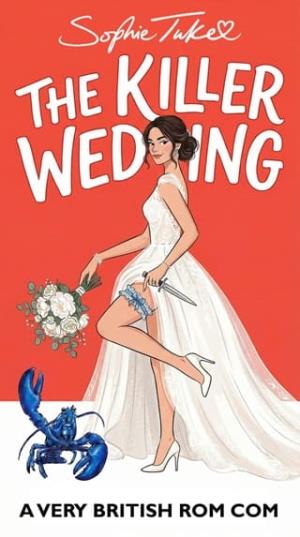
The Killer Wedding
Chapter One A Bleary-Eyed Beginning
I have, in my time, woken up in some fairly compromising situations.
There was the morning after Freddie’s twentieth, which found me in a punt on the Cherwell, with no memory of how I’d got there and a traffic cone I’d apparently named Boris.
The cone and I had, according to witnesses, conducted a lengthy conversation about the state of British politics before I passed out with my head on its orange shoulder.
I kept Boris for three years afterwards, displayed on my mantelpiece as a reminder of the dangers of mixing champagne with Pimm’s and whatever Freddie had in that unlabelled bottle he claimed was ‘a family recipe.’
There was the incident in Reykjavik that I prefer not to discuss in detail, except to say that it involved a sauna, a profound misunderstanding about local customs and a junior minister from a Scandinavian country I had better not name.
My girlfriend at the time was not pleased.
The junior minister, last I heard, had been promoted.
And there was, of course, the fateful evening of James’s twenty-first birthday, which ended with me, a string quartet and the Dean of Christ Church in circumstances that still make me wince when I pass the college gates.
The Dean has since retired. The string quartet broke up acrimoniously.
I still receive a Christmas card from the cellist, which I have never been entirely sure how to interpret.
But none of those mornings, not even Reykjavik, prepared me for waking up in the Dower House at Hartington Hall on the morning after James Ashworth-Pemberton’s wedding.
???
I opened one eye, big mistake. The light streaming through the eighteenth-century windows was doing something violent and unnecessary to my cerebral cortex, as if someone had decided to conduct a full investigation of my neural pathways using nothing but photons and malice.
I closed the eye again and attempted to take stock of my situation through other senses.
I was, as far as I could determine, horizontal.
This was good, horizontal suggested a surface beneath me, a sofa, probably, from the texture against my cheek.
Surfaces suggested stability and stability suggested that whatever had happened last night, I had at least managed to end it in a position compatible with continued existence.
I was also, somewhat surprisingly, still wearing my morning suit.
The jacket had migrated to somewhere around my knees, bunched up in a way that suggested a significant lack of respect to my tailor.
The waistcoat had fared better geographically (it was covering my eyes) but worse structurally: several buttons appeared to be missing and there was a stain on the front that I sincerely hoped was champagne.
From somewhere in the house came the sound of bagpipes.
This required explanation. Hartington Hall was in the Cotswolds, not the Highlands.
And while Uncle Peregrine was known for his eccentricities (the rare chickens, the antique firearms and the persistent belief that London had become ‘uninhabitable’ sometime around 1987), I was fairly certain bagpipes had never featured among them.
The sound stopped, started again and then thankfully stopped for good.
Someone was clearly attempting to play the bagpipes without the faintest idea how to do so.
I removed the waistcoat from my eyes and surveyed the room.
The Dower House drawing room looked like the aftermath of a strangely festive apocalypse.
Champagne bottles formed a small forest on the family’s Hepplewhite sideboard.
Someone had attempted to arrange the empties in a pyramid, lost patience or balance halfway through and left them in a formation that suggested both ambition and defeat at the same time.
A lobster and I do mean a single, living lobster, was making its way across the rather fine Persian carpet with the determined air of a creature that had seen things and was processing them slowly.
It paused at the edge of my field of vision, antennae twitching and regarded me with what I could only interpret as weary solidarity.
Through the window, I could see the main house, Hartington Hall itself, a honey-coloured Georgian pile that had been in the Earl of Cuckmere’s family for two hundred years.
The bunting, which had been so tastefully arranged yesterday under Elizabeth’s exacting supervision, now drooped from the portico like the moustache of a defeated general.
Someone had placed a top hat on one of the stone lions.
The other lion was wearing what appeared to be a feather boa.
On the lawn, the hot tub sat in solitary splendour.
James had fought for years to install that hot tub.
His mother had considered it vulgar, his uncle had been baffled by the concept and he had finally, triumphantly, got what he wanted, if only temporarily.
It sat now on the terrace like a monument to his victory, though the water looked far from clean.
Beyond the hot tub, the lake glittered in the morning sun. There was something on the surface of the far end that I didn't look at too closely. Some things are better examined after coffee.
The temple folly on its small island was adorned with what I sincerely hoped was not Elizabeth Ashworth-Pemberton’s Hermès scarf.
I squinted, peered at it intently and unfortunately confirmed my fears.
It was.
God help us all, because no one else could when she found out.
I extracted myself from beneath a young lady’s arm and made my way to the window, stepping over a discarded shoe, around a sleeping figure and past a small table littered with the debris of some fairly advanced late-night cocktail experimentation.
But where are my manners? I haven’t introduced myself, but in my defence, I have a very senior hangover.
My name is Henry Vaughn and I am James's best friend, despite, or perhaps because of the fact that we have almost nothing in common.
He's wealthy, trusting and fundamentally decent.
I'm none of those things, or at least not in the same proportions.
I work in Whitehall. I have, when pressed, described my role as 'administrative liaison in cross-departmental risk assessment,' which is technically true and has the additional virtue of causing people to change the subject immediately.
I share an open-plan office with eleven colleagues, where we work on spreadsheets, several spreadsheets, actually.
We have a kitchen on the third floor with a passive-aggressive note on the microwave about fish.
It has been there since 2019 and which no one has ever removed because no one wants to admit they've been in the office long enough to remember when it appeared. It is not, by any anybody’s view, a glamorous existence.
What it is, is useful and I have spent eight years learning to notice things: the question that doesn't quite fit the conversation, the handshake that's a fraction too controlled, the smile that arrives a beat too late. All of which is useful when one’s best friend has catastrophically poor judgment in new acquaintances.
I've spent years looking out for James, steering him away from his own good nature and the people who would exploit it. It's just what friends do.
Or it's what I do and I've had rather more practice than most.
???
Which brings me to the present, the carnage that I found myself in and the headache that is ripping through my skull.
I reached the window and looked down.
James and Anastasia were crossing the drive, arm in arm, pulling suitcases behind them.
They were dressed for travel: he in that ridiculous linen blazer he insists is ‘continental’, but which makes him look like a minor character in a 1970s Italian film, she in something simple and elegant that would look like a bin bag on most women but which on her was breathtaking.
They were laughing, against all odds and in defiance of all reasonable expectations they were radiantly happy.
I watched them for a moment, these two people I had been worrying about.
James, with his boundless trust, his generous heart and his complete inability to recognise danger when it was sitting across from him at dinner.
Anastasia, with her careful smile and watchful eyes, with the gaps in her story that I had noticed but never been able to fill.
She looked up, as if sensing my gaze and our eyes met through the window.
For a moment, neither of us moved, then she smiled in a way that suggested she understood more than she was saying and raised a hand in a wave that was unmistakably, a salute.
Then she turned back to James, said something that made him throw his head back and laugh with his whole body and they continued toward the waiting car.
They were off on honeymoon. The Maldives, diving and staying in one of those charming houses on stilts.
I watched the car disappear down the drive, into a world that had no idea what had happened here.
But what had really happened here? Not the wedding: that was obvious enough, in its own chaotic way.
The flowers and the vows, the cake and the dancing, all the normal trappings of a society wedding conducted at scale and expense.
But the other thing, the thing that has been bubbling beneath the surface. The thing that James, bless his magnificent, oblivious heart, had absolutely no idea about.
I pressed my forehead against the cool glass of the window and allowed myself a small, slightly hysterical laugh.
It came out as more of a wheeze. My lungs, it seemed, had opinions about the previous night’s cigar consumption, but it served its purpose.
Sometimes you need to acknowledge the absurdity of a situation before you can move past it.
Behind me, the young woman stirred.
‘What?’ she murmured, not quite awake.
‘Nothing,’ I said. ‘Just thinking.’
‘About what?’
I considered the question. Considered the last few months.
‘All of this,’ I said, with a small chuckle. More to myself than to her. ‘Believe it or not, that was a love story.’
She laughed sleepily, assuming I was joking.
I wasn’t.
???
But I’m getting ahead of myself again.
These things need context and as I am telling the story, you have every right to know how I know what I do.
I lived this story, so saw most of it first hand, but no one is everywhere all the time.
So what follows is topped up with what I have learned from the people involved and also some busybodies who were not involved, but who do love to gossip.
It was confusing enough being there, so for you to understand how I ended up at the most eventful wedding I’ve ever attended, we are going to have to go back to the beginning.
But first, I need some coffee a couple of aspirin and definitely, before Elizabeth discovers the state of her scarf, a very good hiding place.
The lobster had made it to the fireplace and was now investigating the ashes with what I could only interpret as existential confusion. It poked at a charred log with one claw, withdrew and sat very still, apparently contemplating the nature of its circumstances.
‘I know how you feel,’ I told it. ‘I know how you feel.’