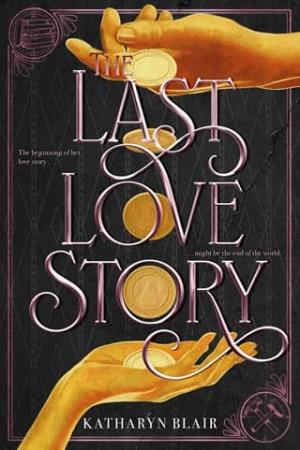
The Last Love Story
Chapter 1
Everyone expected it to be a big thing, but now that I’m living it, I can tell you, the end of the world is slow. My grandmother
used to tell me about poems, and things called books. Real paper and cracking spines. The smell—musty and sharp—and pages
that used to tell stories about happily ever after and daring adventures and the end of the world: brave heroines, a looming
apocalypse, fire and ice, a bang.
I’m not brave. And if this is the end, there’s no grand finale.
Instead, every day feels more like the slow grind of an engine winding down, and down, and down.
It’s so gradual that I can’t tell if it’s stopped moving, or pinpoint the moment.
Was it a century ago, when half of California crumbled into the San Andreas Fault, when New York was washed off the map, or when Oklahoma was ripped into the sky?
Was it years before I was born, when the Last War started, or eight years ago when my parents lost their jobs, or was it three years ago when my best friend’s older brother, the first person sent to fight overseas that I knew personally, was shipped?
Was it yesterday, when all the word processing apps disappeared from my tablet—or will it be today?
Cat.
Cat.
CAR.
Cat.
Click. Click. Click. Swipe.
The images on the massive screen in front of me flash and shift as I hit one button with my left hand and another with my
right.
It’s a cat, perfectly proportioned. Then, a cat with ears a bit too big. Left button on that one—it needs more work. Another
picture—a car. This one looks normal. Or, at least I think so. I’ve seen hovercopters and tanks and raised trucks, but I’ve
never been in a car with wheels. But sometimes my DopaMine channel shows me period pieces from the twenty-first century, and
those have cars that look like this one, so I think it’s right. Right-click.
Right-click for correct, left for incorrect.
I can’t remember when classes changed from actual learning to us teaching an AI learning model.
It’s like I can feel parts of my mind atrophying while the supercomputers scattered throughout the country hum as they soak up the education I no longer need.
History, art, science . . . all absorbed into megamachines that keep the world running.
I know I should be grateful they exist. Without them, we wouldn’t have food or medicine or transportation or the personalized shows that appear on our tablets every night, with eerily perfect AI actors and that crisp, soft-voweled dialogue that feels stilted and fake until I realize I’ve started talking like that too.
Everyone else would say humanity is getting the better end of the bargain.
I spend all day telling a computer what’s real so it can turn around and tell me what’s not.
A picture of a hot dog. The bun looks a little small, so I stop for a second. Tilt my head.
As I pause, the sound of clicks fills the air. I stifle a yawn and look around the classroom. I think today this counts as
a test for our AI Data Cleaning class, although I’m not sure how this is any different from yesterday. I shift forward, looking
to the front of the classroom. Our proctor, Ms. Astor, is zoning out as she stares at her own screen. I wonder what her DopaMine
channel is showing her today. Does she watch videos of teachers actually getting to teach?
I look back at my screen.
A hot dog in a bun.
I zoom in.
It’s weird, sitting here every day practicing feeding all this information to Alba—Artificial Liminality Beta Algorithm, Alba for short—when I don’t even know what half of the pictures are.
Many of them, like this hot dog, are from before the Streamlining.
I know it has many names—frank, wiener, weenie.
I know people used to put mustard or ketchup on them.
They were a favorite at baseball games, not like those really exist like they used to, either—unless the team managed to snag funding for an indoor stadium.
The air is too bad to play outside anymore.
But I’ve never had one.
The end of the world doesn’t have hot dogs. I doubt the authors who wrote about the end of the world saw that coming. My grandmother
would tell me I’m being ungrateful. We don’t have hot dogs, but when the Last War started, they were certain it would be just
that. The Last War. The end of everything. But humanity survived. And if the worst thing I can complain about is that I have
to guess whether or not the hot dog in this picture is real, I should be happy.
I turn slightly, looking over my right shoulder.
A girl with dark hair and narrowed eyes locked on her screen sits catty-corner to me.
Nef and I have been best friends since third year, in the class where we learned about basic coding. The E on my keyboard popped off, but she stuck it back on before Mr. Farkas found out and garnished my mom’s wages for it. It’s
not easy to buy anything these days. My entire life they’ve been telling us the rationing is going to end, but I’ll believe
it when I see it.
Words rise in my throat—the need to say something, since I realize I haven’t spoken since yesterday—but instead I listen to
the clicks and swipes as I check the time.
My gaze lands not on the clock but a pair of bright green eyes.
I jolt in my seat. Huxley Finn. When’s the last time someone looked me in the eye?
There’s a hint of something bright in them as they flit to the electronic clock on the wall and I know he’s thinking the same thing too: We’ve got ten minutes.
Without looking up, Nef shakes her head once. She knows what I am going to do. What I always do.
But, like always, I can pretend I didn’t see her disapproval. As I look at the hot dog on the screen, my mind races. I work
my jaw back and forth.
Then I click my teeth together as an idea pops in my head. There might be a way to do something more exciting than this “exam.”
And if it gets me in trouble? It will get me out of here before Hux. And that might matter more.
On the screen, I click the fine print: More information required.
My computer opens a chat with Alba, and I once again find the tiniest link, which spits me out into the search function. Most
of my classmates have probably never tried this. The trick is to make it look like I’m researching hot dogs. With the Streamlining,
everything was digitized. What baseball movie might feature hot dogs? What baseball book?
But when I type in baseball book with hot dog scene, my screen flashes red and directs me back to the test.
I frown.
“Stop it,” Nef whispers, barely moving her lips.
But when have I ever stopped? I try again, but this time I don’t even get past book before my search is flagged. Surprise makes me gasp aloud.
“What’s happening over there?” our proctor barks, shoving herself to her feet.
I had thought I’d be able to get in at least a chapter before I was flagged as inactive. But this is something different.
My heart hammers, but it’s not fear, as Ms. Astor cuts down our row, weathered skin prowling above my seated classmates, striking
dark auburn hair catching the fluorescent lights.
“This test is designed to take five hours.” Her voice is raspy—a telltale sign of spending time exposed to the air without
a mask.
Her red-rimmed, watery eyes fall on Nef.
“Adeyi?” she snaps.
Nef’s eyes widen like a cornered rabbit’s. She’ll take the blame for things even when she has nothing to do with it. I shove
my chair back.
“It was me,” I announce, standing.
Ms. Astor doesn’t seem surprised at all as she looks me up and down, annoyance clear on her features. “Something wrong, Ms.
Hart? This exam doesn’t require talking.”
Or thinking.
A male voice cuts through the room. “Ms. Hart’s allergies have been acting up.
I’d be happy to take her to the infirmary for an antihistamine.
” I don’t even need to look to know it’s Hux.
He’s hard to miss as he stands to his full height over his desk, his arms folding over his chest. His gaze bores into mine across the room, and for a moment I think I see a flicker of something like approval in it.
Like I need Hux’s approval. He’s probably just impressed I managed to get flagged in two words.
“I don’t think I need your assistance, Mr. Finn,” I shoot back. Looking to Ms. Astor, I scramble to come up with an excuse.
My eyes fall on the distorted hot dog on my screen. “I was laughing,” I blurt.
“Laughing?” Ms. Astor straightens, hands on her hips. “Who made you laugh? Conversing during a cleaning exam is prohibited.”
“I was laughing at a photo. The hot dog,” I say, raising my voice.
I look around. The room is full of faces, all these people I’ve known since I was ten. They don’t even seem to recognize me.
A few of them haven’t even looked up from their screens.
“And that made you laugh? A hot dog?” Ms. Astor asks, her voice incredulous.
If I’m doing this, I’m doing it. Still, my voice feels small when I reply, “It’s a really big wiener. Ha?”
The silence is deafening. I shoot a look at Hux, who rubs a hand over his face and looks down. I think I see the start of
a smile on his lips.
An awkward pall drapes over the room. I bet Ms. Astor is counting the days until my eighteenth birthday.
“Detention,” she growls finally. “Go.”
I fight a smile as I cut through the rows. As I pass Hux, I hold my hand out, low enough to be inconspicuous, and he drops
the poker chip into my hand.
Somehow, that’s what makes me lose against the smile pushing across my cheeks. There’s no one in the hallway to see me grinning
because I won this round.
The hinges squeak as I slip inside the detention hall. It’s massive. In the world before Streamlining, it was used as a gymnasium—I’ve
seen archive footage and the rust stains on the wall where basketball hoops used to hang. Now, the floor is covered in sparring
mats. If I squint, I can barely make out a table resting at the base of the bleachers. The chair sits empty, sagging from
phantom weight.