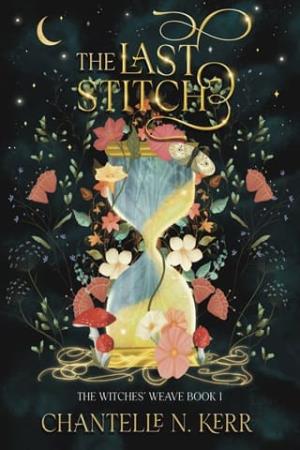
The Last Stitch (The Witches’ Weave #1)
Chapter 1
LILY
Oxford, Present Day
Everyone said it was a clerical error. My intuition knew better.
Gran’s flat appeared ahead, tucked into an ivy-strung corner of honeyed stone. Warm light glowed behind her curtains. After the day I’d had, I needed that. Needed her.
Dr. Rutherford had cornered me in the library that afternoon. “Miss Whitmore, this obsession with vanished people is becoming concerning. Perhaps you should consider a more. . . conventional dissertation topic.”
I’d smiled, tucked my fury beneath professionalism, and ignored him. Twenty-six, running on spite and a few hours of sleep, working on a PhD everyone thought was academic suicide. But I was close to something. I felt it in my bones.
Inside Gran’s flat, the familiar aromas of cinnamon and clean laundry wrapped around me.
Gran sat in her usual chair by the window, shawl around her shoulders, bright eyes peering over smudged glasses.
“You’re late.”
“Only by a minute.” I shrugged off my coat and dropped my contraband-filled bag by the door.
She’d raised me after the accident that took my family. She was more than my gran—she’d been my anchor. The one who stitched my broken pieces together when I didn’t yet know how to heal.
We settled into our usual rhythm: tea, warmth, the soft tick of the wall clock filling the space between words. She asked about my research, and I told her about missing census records, the villages where whole families vanished as if history had swallowed them whole.
“And your advisor believes?”
“Clerical error.” I snorted. “But it’s the same pattern everywhere—same years, same gaps. People who simply stopped existing. It isn’t accident. Someone wanted them forgotten.”
“You always were drawn to what’s hidden,” she said with a knowing smile. “Maybe that’s your gift, finding what others abandoned to history.”
“It’s just academic work,” I replied, though the words were hollow. Some discoveries transcended research. They were invitations—the past reaching out, asking to be remembered.
Gran set down her cup, reaching for my hand. Her fingers trembled slightly. Something I'd never noticed before. “You've always been special, my girl. Even as a child, you noticed things others missed. Made connections others couldn't explain.”
She had always believed in subtle magic—not the fairytale kind, but the quiet, bone-deep sort. Intuition. Fate. Patterns too delicate for logic to trace. I used to think it was her way of softening the world after my family's death.
Now, after three years of research, after finding pattern after impossible pattern, I was starting to wonder if she knew something I didn't.
“Things have a way of finding their place, Lily,” she said. “Even when we don’t understand why.”
“You always say that,” I murmured, patting her hand.
Tonight, she seemed tired, worn thin at the edges, like parchment left too long in the sun.
Her eyes lingered on me longer than usual, as if memorizing every detail.
The scar on my eyebrow from falling off my bike at twelve.
The way I twisted my ring when thinking, a habit she found endearing.
The stubborn set of my jaw that matched her own.
“Gran?” My voice caught. “Are you alright?”
“I'm fine, darling. Just tired.” Her smile didn't quite reach her eyes. “Promise me something?”
“Anything.”
“Whatever you find in your research, whatever doors you open. . .” She paused, seeming to choose her words with unusual care. “Trust your instincts, even when logic tells you otherwise. Especially then.”
My chest tightened. “I promise.”
When I rose to leave, she pulled me into a hug that lasted a heartbeat too long—fierce and final, like she was trying to pour a lifetime of love into that single embrace.
“Be good, my girl,” she whispered, her tone softer than usual, as if tucking something unspoken into my skin.
I almost turned back. Almost asked if something was wrong. But she smiled and waved me off, and I convinced myself it was nothing.
The next morning began like all my others, too early, and fueled by bad coffee.
I'd been awake since five, my tiny flat illuminated only by the glow of my laptop as I cross-referenced census with parish records.
The silence was the kind of heavy quiet that settles over a space meant for one person who spends most of her time elsewhere.
My flat was less a home and more a place to sleep between library sessions.
Bare walls except for bookshelves. A kitchen I barely used.
A bed I collapsed into when exhaustion finally won.
And one photograph on my nightstand. The only photo I kept out. Mum and Dad smiling, Dad's arm around Mum's shoulders. Me at eight, gap-toothed and grinning, squinting against the sun. And Maya.
Maya, who'd been six in the photo, her blonde curls wild around her face, her small hand clutching my arm, certain I could keep the world steady. She'd followed me everywhere that summer, chattering endlessly about fairies and magic and whether clouds tasted like cotton candy.
Three months later, they were gone and I became the girl who survived while her family didn't.
I turned away from the photo, the familiar ache settling in my chest. Some mornings it was worse than others. Today, for some reason, it pressed down like stone.
That's why I threw myself into work. Easier to chase the ghosts in historical records than confront the ones that lived in my own memory.
By seven a.m., I was walking through Oxford's waking streets, my breath fogging in the October chill.
The city was beautiful at this hour—all golden stone and morning mist, ancient and impossible, like something out of a fairy tale.
Tourists would flood the streets by nine, snapping photos of the Bodleian and the Bridge of Sighs.
But right now, Oxford belonged to the students and the ghosts.
I preferred the ghosts. They didn't expect conversation or explanations.
They didn't ask why I spent every waking hour buried in research or why I had no real friends beyond polite acquaintances in the library.
They didn't look at me with that mixture of pity and concern that people wore when they learned about my family.
The university library smelled of dust and old paper—knowledge and decay in equal measure. Most people found it oppressive. To me, it smelled like home.
I claimed my usual corner beneath the stained-glass window.
Morning light turned to rivers of color across the old wooden table.
My research materials spread before me like an offering: laptop humming, books stacked in precarious towers, my battered notebook covered in handwriting and Post-it notes in three different colors.
Organization was not my strong suit. Obsession was.
My screen displayed a digitized census from 1867, the handwriting cramped and faded. I’d been comparing it to one from 1861, and the gaps were impossible to ignore—twelve names present then, gone six years later.
A parish register from the same village told the same story. Twelve people, baptized and married, living full lives. Then, between 1865 and 1867, they simply stopped existing.
Rutherford’s words echoed in my head—clerical error, not conspiracy. But the evidence said otherwise.
But it wasn't just one village. I'd found seventy-three so far, scattered across England. All showing the same pattern. All between 1865 and 1892.
Hundreds of people, gone.
Families torn apart. Children who suddenly had no parents in the records. Spouses who became unmarried retroactively. Lives simply. . . deleted.
I thought of Maya sometimes, when I found children's names in the registers. Young girls who'd been six, nine, twelve when they disappeared from history. Had they been scared? Had they understood what was happening? Had anyone tried to find or save them?
I rubbed my eyes, exhaustion making them burn.
I tried to shake the sense that I wasn't just researching a mystery—I was circling it.
That these places and names weren't lost by accident, but erased deliberately.
I'd been at this for four hours already, and my third coffee was going cold beside me.
The library was filling up now. Graduate students claimed their territories, undergrads shuffled in with hangovers and regret.
I kept my head down and worked in silence; people learned not to interrupt the girl buried in dust and half-mad theories.
I pulled up another document, this one covered in symbols I'd been trying to decode for weeks.
A letter dated 1869, found in an estate archive.
It appeared to be like all the rest of the letters from that time period.
The difference was the symbols. I was convinced it was a secret language, but why?
My phone buzzed, a text from the library cafe reminding me I'd pre-ordered a sandwich for lunch two hours ago. I'd completely forgotten. Again.
I was about to get up when I noticed something in the letter I'd missed before. A symbol in the margin, partially obscured by a water stain. I zoomed in, tilting my screen, trying to make out the shape.
It looked almost like. . . an hourglass? Surrounded by circular lines, like rings or—
My phone rang. A sharp trill that shattered my concentration.
Unknown number. My stomach dropped before I even answered, some primal instinct already knowing something was wrong.
“Hello?”
“Is this Miss Whitmore?” The woman's voice was gentle, practiced.
“Yes, this is she.”
A pause that stretched too long. “I'm sorry to call with difficult news. Your grandmother passed away this morning.”
The words struck. My breath stopped, caught somewhere between my ribs and throat. “No,” The word came from somewhere far away. “No, that's not. . . she was fine.” But she hadn't been fine. I'd seen it in her eyes, in that hug that lasted too long. I'd known, and I'd walked away anyway.
“I’m so very sorry,” the woman repeated, but her words couldn’t reach through the static filling my head.
The silence stretched until something inside me snapped.
Gran was gone. All my family now dead.
The next hour blurred together. I grabbed my coat, stumbling through Oxford's winding streets, my hands shaking as I fumbled with the key to her building. I climbed the stairs on unsteady legs, each step like swimming through thick water.
The door creaked open. For one fragile heartbeat, I expected her voice: Lily, darling, is that you?
Silence answered. The kind that presses against your eardrums, that breathes.
Everything remained exactly as she'd left it. Teacup on the side table, still holding the ghost of her tea. Book turned face-down, pages splayed like broken wings. The blanket draped over her chair, still holding the shape of her.
I didn't turn on the lights. Didn't remove my coat. I simply stood there, drowning in the reality of her absence.
Then the grief hit, and I crumpled into her chair. My hands found her shawl—the one she wore every evening. It still held her warmth, her scent. Cinnamon and vanilla. Home.
I pressed my palm to my mouth, trying to contain the sob building in my chest. It broke free anyway, loud and raw and unmoored.
When I finally lifted my head, the wooden box on the mantel caught my attention. Gran had never allowed me to explore its contents, even as a curious child. “Too precious for playful hands,” she'd always said with that mysterious smile.
My hands moved without conscious thought, lifting the lid and revealing what lay inside.
Photographs, yellowed and curling at the edges. Faces I didn’t recognize stared back, distant family perhaps, ancestors whose names had faded with decades. But one picture stopped me cold.
The woman in the photograph was breathtaking, her features sharp even in grainy black and white. Though the image held no color, I could tell that she had dark hair and light eyes. But what truly drew my attention was her necklace.
The same necklace was nestled in the box before me. A necklace that resembled the hourglass symbol on the letter.
I lifted it carefully. The chain was delicate but substantial, and the pendant itself was mesmerizing—concentric rings of golden filigree that shifted and interlocked around a tiny hourglass at its heart.
Inside, the glass spheres, gold dust swirled, restless and alive, like something waiting to wake.
Faint engravings decorated the outermost ring, worn smooth by time and touch. I traced them with my thumb, feeling the grooves beneath my skin, and the dust inside quickened.
A sharp crack split the silence.
A bird struck the window. I flinched. The chain slithered through my fingers like water.
Glass shattered against the floor—the sound bright and final as a severed thread.
Energy pulsed outward from the shattered pendant. Electric. Humming. It rolled through the room like sound traveling underwater—thick, wrong, vibrating through bone and breath.
Cinnamon vanished. The air turned sharp with ozone, metallic as blood on the tongue. Every hair on my arms rose. The lightbulbs flickered once, flared white-hot, then burst in a rain of glass.
I staggered back, heart pulsing, every nerve screaming danger.
Then came the pressure—not dizziness, but displacement, like the world folding in on itself. The walls bent. Breathed. Books trembled on their shelves. Curtains rippled though no wind blew.
Light exploded around me—blinding, searing. It swallowed sound, swallowed thought, swallowed everything but the terrible brightness tearing the world apart.
My knees buckled. I tried to scream, but the light ate the sound.
Then—darkness.
Silence.
Cold that bit down to the bone.
Gran's warm flat gone. In its place, skeletal trees silver-lit by moonlight. A forest breathing with watching presence, alive with things unseen.
I was no longer alone.