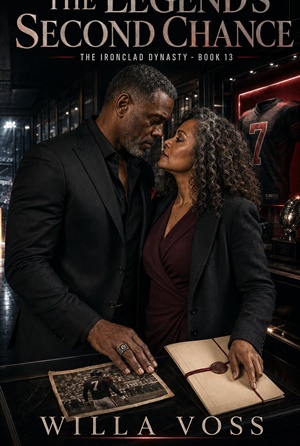
The Legend's Second Chance (The Ironclad Dynasty #13)
Chapter 1
Malcolm Hayes had spent half his life entering rooms that already believed they knew him.
The western tower believed in the retired number seven.
His jersey waited behind museum glass two floors below.
Three championship rings sat under white light in the Hall of Honor corridor.
A black-and-crimson banner on the stadium facade showed Malcolm at thirty-three, arm drawn back, face calm while two defenders closed on him.
Even the elevator used his voice for the annual Foundry Cup exhibit.
None of it prepared him for Camille Foster seated at the head of the conference table.
She wore charcoal trousers, an ivory blouse, and the same expression she had once used when a professor mistook confidence for evidence.
Silver threaded her chestnut curls at the temples.
Time had deepened rather than softened her face.
Malcolm registered all of it in one disloyal sweep before remembering that five lawyers, two trustees, and the current chief steward were watching him arrive.
"Dr. Foster," he said.
Her gaze met his. "Mr. Hayes."
Twenty years collapsed and refused to become young.
Rhea Morgan Whitaker rose from the chair beside Camille.
As co-steward and an independent board member, she carried authority without needing the room to perform it for her.
Helena Rowe remained seated with a legal pad open.
Gideon Whitaker stood by the black-glass windows, Austin winter pale beyond him.
"We can begin now," Rhea said.
Malcolm took the empty seat farthest from Camille. Not the chair beside Gideon. Not the one reserved for ownership. The choice should not have mattered.
Camille noticed.
On the screen behind her: INDEPENDENT ATHLETICS MEMORY PROJECT. Beneath it, six words in smaller type.
Authority. Access. Consent. Custody. Publication. Withdrawal.
Malcolm had expected a ceremonial kickoff. A photographer. Perhaps a few remarks about preserving the championship era before former players died and private collections disappeared into family storage.
Camille placed both hands on a crimson folder.
"Before I accept the directorship, the prior relationship must be disclosed in the minutes," she said. "Malcolm Hayes and I were engaged from 2008 until January 2011. The engagement ended before marriage. We have had no romantic relationship since."
No one moved.
The clean minute books Helena kept were open on the table. The sentence entered the institution without ornament.
Gideon glanced at Malcolm. "You confirmed that in advance?"
"I did." Malcolm kept his voice even.
Camille had not looked away. "Mr. Hayes owns five percent of the club. He is also the most significant living source for the 2008, 2011, and 2014 championship histories. Those facts create both value and conflict. I will not direct this project unless the conflict is controlled in writing."
Helena turned a page. "State the controls for the record."
Camille did.
Malcolm would hold no authority over her hiring, compensation, budget, staff, archive access, source selection, interpretation, publication, or release schedule.
He would not serve as liaison. He would not preview chapters.
He would not vote on any decision specific to the project's staffing or conclusions.
Any oral history he provided would be governed by the same written consent and withdrawal rules as every other source.
"No owner gets a private door into the archive," Camille said. "No former player gets to substitute reputation for provenance. Medical material stays segregated from institutional-safety evidence unless the patient authorizes disclosure. A witness statement is a source, not automatic proof."
Victor Whitaker sat three chairs to Gideon's left, immaculate in navy and silver. "You are proposing to write a history of an institution while treating the institution as hostile."
"I am proposing a structure that does not require trust in any single institution or historian. That protects you too."
Victor smiled without warmth. "From your bias?"
"From everybody's. Including mine."
Malcolm felt the old, dangerous pride. Camille had always refused to confuse poise with surrender.
Rhea asked, "If the board accepts the charter, do you accept the appointment?"
Camille opened the folder. "Full provenance access includes original indices, accession history, clean minute books, retired-player collections, and broadcast holdings. Restricted records remain restricted, but restriction must be documented. I will not accept curated boxes."
The words broadcast holdings moved across Malcolm's skin like a draft.
In his private archive downstairs, a locked drawer held a cream folder he had not opened in twelve years.
Everett Whitaker's original shutdown order.
Malcolm flexed his left knee beneath the table. The joint answered with its familiar dull resistance.
Gideon said, "That access can be arranged."
"Arranged is not granted."
Rhea almost smiled. "Granted, subject only to patient privacy, donor restrictions, and documented privilege reviewed by independent counsel."
Camille looked to Helena.
Helena nodded. "I will put that language in the final instrument."
"Then I accept."
The room released a breath it had pretended not to hold.
Malcolm signed his recusal acknowledgment. His hand stayed steady beside the line that removed his authority from the history built around his own name.
Afterward, Camille gathered her papers while Gideon and Rhea moved into a quiet argument with Helena about access staffing. Malcolm waited until Camille stood.
"I didn't know they had approached you," he said.
"That is one reason the structure may work."
"You think I would have stopped it?"
She slid the crimson folder into a black leather case. "I think you have spent a very long time deciding which difficult things other people should be spared."
The precision hurt more than anger would have.
"Camille."
"Not here."
She walked toward the door. Her perfume reached him only after she passed: cedar, orange blossom, something warm he remembered from an apartment with unreliable heat and books stacked on milk crates.
Malcolm stayed where he was.
The Hall of Honor chair caught him in the corridor ten minutes later. Howard Bell had once chaired the civic committee that funded the stadium district. He wore admiration like a credential.
"This is excellent timing," Howard said. "An independent scholar, a complete archive, the twentieth anniversary of your last title coming up. Camille's project will finish the case for the Hall."
Through the glass wall, Malcolm could see Camille stop before the retired number seven. She did not look reverent. She looked as if she were measuring the space between the jersey and the record beneath it.
"Her work isn't an endorsement," Malcolm said.
Howard laughed lightly. "History knows what a legend looks like."
Camille turned, and across the corridor their eyes met.
Malcolm understood then what the tower had invited inside.
Not the woman who had once loved him.
The historian who could prove what loving the legend had cost.
Gideon found Malcolm twenty minutes later in the owners' lounge, where a wall of black glass reflected the field and removed every useful expression from a man's face.
"You could have warned me," Malcolm said.
"Rhea advised against it. Camille required independent recruitment. If you had known, your reaction might have influenced the appointment before controls existed."
"So everybody got a choice except me."
Gideon turned from the window. "You are a five-percent owner and the principal living subject. The choice you were owed was whether to sign recusal. You made it."
Malcolm disliked the answer because it was correct.
On the low table sat the Hall campaign book. Heavy black cover, his number embossed in silver, three crimson tabs dividing the championship years. He opened it to the first spread. A photograph showed Odessa Hayes in the parade crowd, one gloved hand over her mouth.
"They want to announce in February," Gideon said. "Howard believes the historical project strengthens the nomination."
"It does not."
"I heard you say that."
"Did you tell him?"
Gideon was silent.
Malcolm closed the book. "This family keeps confusing not ordering a lie with telling the truth."
"You have benefited from that distinction."
The sentence should have started a fight. Instead Malcolm looked at Gideon's face and saw the fatigue of a chief steward whose institution was shedding every easy version of itself.
"Yes," Malcolm said. "I have."
Gideon poured coffee from a silver service nobody had requested. "Does she hate you?"
"Camille does not waste that much energy on a settled source."
"You don't sound settled."
"I saw her for six minutes."
"You were engaged."
"Twenty years ago."
"History may object to your use of ago."
Malcolm laughed despite himself. Gideon had become funnier after marrying Rhea, mostly because she refused to let him believe seriousness was a private asset.
"What do you want from the project?" Gideon asked.
The public answer: a complete account of the championships, the people who built them, the lessons for independent medical care. The private answer lived downstairs in a locked drawer.
"I want the good preserved accurately," Malcolm said.
"And the bad?"
"Named accurately."
"Even if it names you?"
Malcolm looked at Odessa in the parade photograph. She had never accepted a free meal without asking who paid for it. He had inherited her discipline and avoided her question.
"Even then," he said.
At home that evening, Malcolm removed his suit and left it across a chair. He heated soup prepared by his house manager, ate standing at the kitchen island, and opened Camille's most recent book on retired-player labor.
He had read it twice. Tonight, the dedication stopped him.
For those whose bodies became evidence before institutions agreed to look.
Malcolm sat.
In the margin beside a passage on delayed testimony, he had written three years earlier: What if speaking harms the person silence protected?
He added beneath it: Who decides?
The question looked simple in black ink.
Downstairs, the locked order waited with its own answer.
At home that night, Malcolm removed the championship ring before washing his hands. The habit had begun when Jordan was a baby and the heavy edge caught her blanket. He still placed it in the same shallow dish beside the sink.
The dish had no plaque. No camera had ever filmed it. In that room, the ring was metal he chose to wear.
He replayed Camille's question about the cost of legend and heard the younger woman who had once refused his version of sacrifice. Twenty years had changed her voice, not her insistence.
Malcolm opened his calendar and blocked the time she had requested for the first interview. He declined a sponsor dinner that overlapped.
When Julian asked why, Malcolm wrote: prior archival commitment.
He did not write her name.
For one night, he let anticipation belong to the man rather than the campaign.
The next morning, Malcolm found Camille's first book on the shelf behind his broadcast desk. He had read it when it appeared and never told her. The margins carried his pencil marks beside arguments about civic memory and the cost of heroic labels.
He opened to a page he had underlined twice: Commemoration is not the opposite of criticism; it is the place criticism becomes public responsibility.
At the time, Malcolm had treated the sentence as an idea about dead founders and distant institutions. Now the retired number seven stood behind glass at the stadium, and Camille had asked whether he would let her write the cost around it.
He placed the book in his work bag for the first interview, then took it out again. Bringing it would announce that he had watched her career. It would turn private attention into leverage before she chose whether the past belonged in the room.
Malcolm left the book on the shelf.
He arrived with only the access agreement and his own unfinished answers.