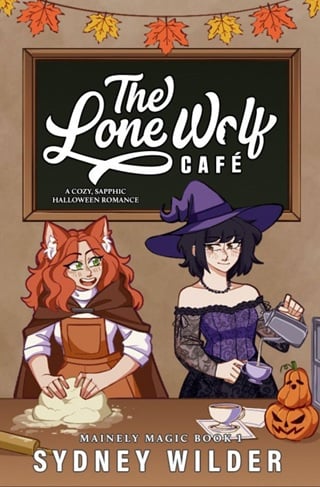
The Lone Wolf Café (Mainely Magic #1)
Chapter One
I ’d done it.
I’d actually done it.
I had been on the ferry for thirty minutes, and the remnants of my island – my whole life – had disappeared behind us, slowly consumed by the horizon until I was surrounded by nothing but ocean.
This boat, and the dark, churning water surrounding it, was my first glimpse into life beyond the remote island I called home. The real world.
The ferry was vastly different from my family’s lobster fishing boats.
It had two decks, was painted a dull shade of cream, and showed its age with chipped paint and gritty bits of rust. It had a motor – something I had only seen from a distance while visiting the human islands.
It was a strange contraption: a loud, whirring metal beast that roared like a bear, gliding us across the water faster than any rowboat.
The ferry’s frothy white wake sprawled out behind us, almost as far as I could see.
I stood on the open-air top deck, clutching the rusted metal railing as I tilted my head back and gulped lungfuls of air.
I was accustomed to Maine’s climate – the briny heat of sea salt mixed with the earthy chill of autumn and pine creating a sharp yet comforting scent.
It was what I grew up with. It was home.
But now, the salt and cold air seeping down my throat had never been so refreshing. I felt rejuvenated. I felt alive . My new world teemed with endless paths to take – endless possibilities to explore. I escaped, and I was free.
It was invigorating.
But also terrifying.
I hadn’t let myself process that second part yet.
Life on my home island, Hollenboro, had been easy but quiet.
My mother passed away when I was six – though I was too young to remember her fully – and my father ensured my sisters and I had all we could ever want.
We climbed pine trees, scoured the forest for blueberries and rabbits, then came home to whole, steaming lobsters which we shelled with our bare hands. We were wild. Free.
Or so I thought.
As a child, Hollenboro seemed like paradise.
My father told us stories of the mainland human kids, how they spent all day crammed inside a building studying for tests, just to spend their entire lives indoors chained to a desk.
We have the island, he would say. The forest. The sea.
We’re the fortunate ones in the world, Nettie. Not them.
When I was young, I believed it. But as I matured, so did my curiosity. It gnawed at my stomach like a ravenous wolf, threatening to consume me whole if I didn’t act on it.
I finally snapped when I was fifteen. I slipped out of our humble three-room cottage, stole our spare rowboat, and paddled to a neighboring human-populated island.
Once inside the closed-down schoolhouse, I saw the map which proved just how small Hollenboro was in the grand scheme of the world, and I realized everything I’d been taught was a lie.
My life had been one insignificant dot on an entire planet.
There was a whole world out there. Not only were there humans, with their advanced technology and complex societies, there was also a plethora of other magical creatures living under the humans’ noses like we did.
Faeries. Witches. Vampires. Other types of shifters from foxes to dragons.
The more I explored, digging through the contents of neighboring islands, the more I learned.
And the more I ached to see it all.
But now, on my twenty-first birthday, after years of secret day trips to nearby islands, I received news that changed everything.
The final nail in the coffin – the one that truly sealed my fate.
I knew I couldn’t stay in Hollenboro. So, I packed what meager belongings I could, snuck onto a ferry headed for the mainland, and prayed my father wouldn’t come searching for me.
Or at least, he wouldn’t find me.
Thinking about my life and what brought me to this point made those freedom-is-terrifying thoughts return. I clenched my abnormally-sharp canine teeth, shoved my memories deep into my subconscious and forced myself to admire the water with a peacefully empty mind.
I loved the ocean. It was deep, dark, and alive, as it swirled and churned and lapped against the boat. A primal beast, a vast and endless force, reminding me no matter how strong or fierce we magical beings were, nature held the most powerful magic of all.
I craned my head over my shoulder, surveying the other passengers.
A few were also admiring the water, but most were gazing empty-eyed into small rectangular devices.
It was so disconcerting, I wondered if I should tap them on the shoulder and ask if they were okay.
I shrugged it off, assuming it was some odd human behavior I was not yet accustomed to.
But I could feel it – their disinterest, their boredom, their general indifference to the majesty surrounding them.
It was perplexing, though I was familiar with detecting emotions I couldn’t quite understand.
I’d always had that skill – picking up on feelings of others, sensing them like they were my own.
My father claimed it was because I was an “old soul”. My sisters simply called me a weirdo.
“Attention all passengers!”
I jolted. The voice was tinny and garbled, nothing like I’d heard from a living being. Once I recovered from the fright, I realized it was coming from a cone-shaped device bolted to the side of the ship. Another newfangled human invention. Interesting.
“At the bow of the ship, you’ll see Bar Harbor coming up on our right. We will arrive at our destination in approximately ten minutes. Please ensure you have all your belongings and be ready to depart.”
I made my way to the bow, weaving through the few humans who also showed an interest in seeing the mainland, and hung my forearms over the metal paint-chipped railing.
The land was small at first; a thin, indistinguishable line over the horizon.
But as we got closer, and the land mass grew larger, the feeling of being an incredibly small person in a vast, wondrous world bloomed in my heart again.
The mainland.
I’d made it.
Of course, I had no idea what to do next.
All I packed were a few sentimental trinkets, a bag of pastries I’d made that morning, and a half-empty flask of water.
Plus the clothes I was wearing: a soft, maple syrup-colored dress over a long-sleeved white shirt and a pair of brown lace-up boots.
Since it was October, the air was crisp but comfortable, so for now, my clothing choice was fine.
But I knew it wouldn’t be that way in a few months once winter hit.
I needed more clothing. Shelter. Water. Food. For a human, my task would seem impossible. How could one simply barge into a society they had little knowledge of and expect to survive?
But I wasn’t human.
At least… I gazed down at my fingernails. I preferred to keep them long and sharp, perfect for utilitarian use. Almost like claws.
…not entirely.
I knew that was the main reason we werewolves couldn’t leave Hollenboro. But I’d never had trouble controlling my shifts, and the full moon was only once every few weeks. Keeping my true nature a secret – and not biting any humans in the process – wouldn’t be a problem.
The ship sailed closer to the docks, close enough that I could pick out details of the little shops and other buildings lining the sidewalks. I could see the people. Human s.
Yes, I reassured myself as I closed my hand into a fist and shoved it into my dress pocket. The freedom-is-terrifying thoughts returned, but I refused to let them win.
My secret won’t be a problem.
Back when I was visiting the human-populated islands, I’d had small glimpses into their society. There were only a few dozen people inhabiting each island, and amenities and luxuries were scarce. In many ways, they lived much like we did on Hollenboro.
But the mainland?
It was unlike anything I had seen. Or could have ever imagined.
Dumbfounded, I stood in the middle of the seaside town where the ferry dropped us off – Bar Harbor, according to a worn wooden sign near the dock – having no idea what to do next.
There was so much of everything it was hard to take it all in.
The roads were much wider than the ones on the human-populated islands, and the edges were lined with rows of empty cars.
Cars. I’d seen the beastly transportation devices only a few times; mainly weather-worn trucks and sedans scattered around the human islands. Now there were dozens of them. Possibly hundreds , judging by how dense the crowds were.
I followed the road up the pier, weaving through the herds of humans scurrying about.
I had never seen so many at once. As they brushed past me – thankfully oblivious to my presence – I kept my head down with my hands deep in my dress pockets.
As beautifully chaotic as this place was, I didn’t want to draw too much attention to myself.
On the outside, I looked human, but I still felt like I stuck out amongst the townsfolk. A true wolf in sheep’s clothing.
Beyond the pier were buildings. Dozens crammed together in one long row, each painted a different color with quaint, cottage-like architecture.
Cape Cod-style , my father called it. Every building was unique, yet all had similar features, from their colorful clapboard siding to the little attic windows hunkered under sharply peaked roofs.
Many had wraparound porches, heavily adorned with chunky orange pumpkins, maple-leaf wreaths, and old-fashioned, spindly brooms that delightfully smelled of cinnamon.
The festive fall décor was enticing. Halloween was in a few weeks, and based on the number of snarling faces carved into pumpkins and paper ghosts billowing from porch ceilings, I assumed humans celebrated the holiday like we werewolves did.