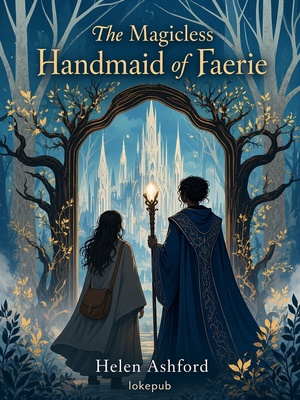
The Magicless Handmaid of Faerie
Prologue
You can’t mean it, my lady.”
The queen arched one narrow dark eyebrow. “Can I not?”
“No! To abandon your throne, your city—your own kind?”
“I do mean it, Iris.” The queen turned away from her servant, the human woman who had waited on her and cared for her since she was an infant.
She was aware of the gulf of differences between them, Iris small and plump and gray-haired, while she, like all the fae, was tall and lean, her long hair as black as night.
She was not truly young, but long years still stretched ahead of her, a fae in the White City.
Those years loomed like an endless, empty tunnel, without meaning or purpose.
“I do,” she repeated. “I am weary unto death of the self-indulgence of my kind. Their arrogance irritates me. Their idleness offends me.”
“But, my lady, what will the council do without you?”
The queen turned sharply back to her servant, her hands on her hips.
“Tell me, Iris, what they manage to do with me. They pay lip service to my status, but it makes no difference in their actions. They call me queen, and bow to me, but they do not respect my commands, or even my polite requests. Rather, they resent them.”
Her servant folded her arms in defeat. “And so, my lady,” she said. “What shall I do if you leave?”
“You have served me well, Iris,” the queen said. “You may come with me if you like, although I have not yet decided precisely where I will be. You could at least return to Lloegyr, perhaps even find work at Camulod.”
Iris shook her head. “I have no wish to leave the White City, my lady. Beyond fae country, I have no one.”
“You are certain of that?”
“As certain as anyone can be. My mother was taken as a little child. She grew up in the White City, and I, like most other servants, was born here. I know no one in Lloegyr, and certainly not in Camulod, nor does anyone know me. If I left, I would have nowhere to go.”
“The offense against your mother is an example of why I have given up on my kind, Iris. I have warned them, and threatened them, but to no avail. They will not listen.”
The knock on the door startled them both. They had left the Royal Council Chamber hours before, and the queen had not expected to see one of the delegates again today. Or ever.
Iris crossed to the door and opened it.
In the doorway stood the very person the queen had hoped to avoid on this, her day of escape. “Emerlyn,” she said resignedly.
“My lady,” the newcomer said, her deep voice resonant with feeling. She was almost as tall as the queen, but a good bit older. Threads of silver had appeared in her black hair. “My lady, tell me you have not decided to abandon your position.”
“I cannot bear it anymore,” the queen said. “I have struggled to protect Lloegyr from my own kind, without success. I must devise a new way to accomplish it.”
Emerlyn spread her hands. “You have banished them from Lloegyr, and from Camulod. Surely that is protection enough!”
“They loathe me for it.”
“You knew they would.”
“I did not understand the intensity of their attitude, though, Emerlyn. I—” She broke off and turned to the window, where the slanting rays of the setting sun had turned the city’s white walls and pale cobblestones to gold.
She would miss it, this beautiful city, but she saw no recourse.
Her voice, deeper even than Emerlyn’s, caught in her throat, almost a sob.
“I cannot tolerate it another day. Another hour. Another minute!”
Emerlyn said, “And what of the babe?”
The queen spun back to face Emerlyn, her dark eyes sparking with gold flashes. “You have been scrying me.”
“Always.”
“I am going to bear the babe,” the queen said, her chin high, her eyes sparkling with anger. “I will see to her welfare.”
“But not among her own kind.”
“No. Not among her own kind. I wish her to have a sense of honor. To possess a conscience. To learn compassion.”
“And you believe the humans will teach her these things?”
“I do.”
“Why?”
“Because of the Black Mage.”
“The Blackbird! He is hardly representative—”
The queen interrupted her. “He has always meant to be the bridge between humans and fae. No blame falls to him that too many of our kind disregard his efforts.”
“There was a time, my lady, when our people were vibrant and energetic. I have always believed with good leadership—”
“Our culture is beyond saving. It has decayed into indolence and ennui. This is a clock that cannot be turned back. You should accept that.”
“I can’t.” Emerlyn took a step forward and stretched out her hand, a hand that shook with suppressed emotion. “Please, my lady…”
The queen spoke more gently. “You have no need to call me that, Emerlyn.”
“I must. I have respect for your position even if you no longer do.”
The queen dropped her gaze for a moment and drew a long, soft sigh. “I am sorry to disappoint you, but I am called to a higher duty than sitting in long, rancorous, pointless meetings with the Royal Council. The Blackbird will be here soon. I am going away with him.”
“The Blackbird!” Emerlyn exclaimed. “He bears responsibility for this?”
“No. The responsibility lies only on my shoulders.”
“But what’s going to happen?”
“You will learn that in time. We both will.”
“My lady…”
The queen raised her eyes. Her voice dropped to its lowest pitch. “It is done. Please see that Iris has a place to be, work if she wants it, respite if she does not. I will no longer be here.”
“But where will you be?”
“That, too, we will discover one day.” She lifted her head, listening. “Ah. The Blackbird has arrived.” She walked to the door and opened it.
“But, my lady,” Emerlyn protested. “What shall I tell the council?”
The queen turned her head to speak over her shoulder. “Why tell them anything?” she said bitterly. “They will not care. Goodbye, Emerlyn. Goodbye, Iris. Wish me well.”
She went through the door and closed it, leaving them staring helplessly after her.