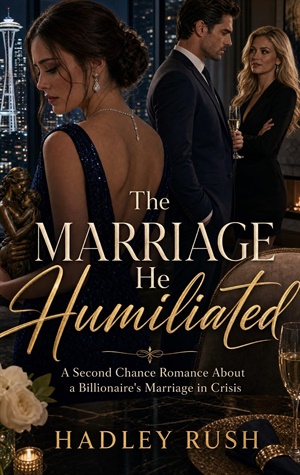
The Marriage He Humiliated (Groveling Billionaire's Redemption #9)
Chapter 1
BETH
The dress cost more than many of my family’s monthly utility bills.
Not a single thread had ever been worn, let alone even tried on by someone before I put it on that evening.
The champagne I held was so far beyond the means of most people who needed what our charity was intended to offer, the money from that one glass could’ve provided an actual family a hot dinner on their table.
I’d accepted these luxuries not because I believed in the display but because I loved the man who insisted I shine beside him in the social elite, the one who had once whispered that my authenticity made his boardroom battles worthwhile.
Chris had chosen the gown himself, his fingers brushing silk as if my appearance at his side were another business asset to be managed.
Yet beneath my practiced smile, the champagne flute felt alien in my hands, another costume piece in a role I never wanted but played because he needed me to.
“Ms. Lewis?”
I glanced up, nearly dropping the half-filled champagne glass as condensation slicked against my fingers.
A thin, older gentleman smiled warmly, his kind eyes sparkling with genuine warmth against the deep charcoal of his suit and black tie.
He motioned his hand to a private entrance, his gesture deliberate yet unhurried, as though he understood my discomfort in this gilded cage.
“We’re ready.”
I set the glass on a passing server’s tray, the crystal clinking softly against the silver, a sound swallowed immediately by the ambient murmur of the room.
I smoothed the sequined bodice of the dress, a fabric that felt as foreign as this entire world of philanthropic posturing, and walked with a grace I had adopted out of necessity into the black hole of the spotlight.
The hushed whispers of over 400 guests filled the void as I entered, their collective gaze weighing heavier than the diamond necklace Chris had insisted I wear tonight.
Each step on the plush carpet felt like a performance, my heels sinking silently into the wealth that surrounded us, a stark reminder of the disconnect between this opulent room and the struggling families our foundation claimed to serve.
There was a sharp brightness behind my closed eyelids and my body halted automatically. As I blinked back into the light and adjusted to the spotlights on the stage, I found I had already begun the walk across the raised platform, led to a podium on my left and an empty wooden table to my right.
The CEO of a huge chain of luxury hotels had just finished an address on their partnership with local women’s shelters to offer rooms, meals, and supplies to single women and their children escaping abusive partners.
It was an amazing initiative and yet another way our city had tried to chip away at the cycle of poverty and homelessness that ran so deep it felt woven into Seattle’s skyline itself.
“And now it is time to announce the winner of this year’s Compassionate Philanthropist Award for Outstanding Leadership in Community Outreach.” The emcee, a renowned journalist known for her incisive political commentary, turned toward me with a wide, rehearsed smile that never reached her eyes.
“Let’s please give a warm welcome to Ms. Bethany Lewis, Director of Outreach at Lewis Enterprises and Executive Director of The Lewis Foundation.”
A surge of polite applause swept the room, a hollow acknowledgment of a title I never earned.
It was a title bestowed upon me through circumstance rather than merit, a reality that pressed down on me with every clink of crystal and murmur of admiration.
I pasted on a smile that I had perfected over years of social engagements, a mask I wore like armor as I approached the podium.
The emcee held a gleaming bronze statue that felt cold and heavy in my hand as she handed it to me.
It depicted a mother embracing a child, both reaching toward a faintly glowing horizon, an image meant to inspire but feeling far more like a taunt against the gritty realities faced by those we were supposed to serve.
“Thank you,” I said, the microphone amplifying the sound across the cavernous ballroom.
My gaze swept over the audience, knowing I had a speech planned, but also hating the fact that I had to give one at all.
I was fine with public speaking, but I didn’t feel as if I was deserving of this award.
The recognition was hollow, because I hadn’t truly sacrificed.
The money wasn’t my own; it came from Chris’s empire.
I was merely a figurehead who distributed resources from a vast financial reservoir, one I hadn’t contributed a single dollar to myself.
The truth gnawed at me. It was the same reason I struggled with these galas and the lavish events they celebrated.
The opulence here felt like a mockery of the struggles outside this room, a glittering fa?ade that did little to address the systemic issues plaguing our city.
It was easy to stand in a room filled with wealth and pretend that gestures like these could bridge the chasm between affluence and need. But I knew better.
I wanted to turn and walk off the stage, to give the award to someone who had truly earned it through sweat and sacrifice, not through marriage and proximity to power. Instead, I smiled wider, leaned into the mic, and tried to summon a voice that didn’t feel like a betrayal of my own principles.
“I stand here tonight, humbled,” I began, the words feeling mechanical even as they left my mouth. “But the work that’s being recognized isn’t mine alone. It’s the work of so many individuals who dedicate themselves every single day to uplifting the most vulnerable among us.”
The speech rolled on, a litany of carefully chosen phrases designed to evoke emotion without stirring controversy.
I spoke of hope and progress, of community and resilience, all the while feeling like an imposter on this stage, dressed in a gown worth more than most families saw in a year.
Every sentence felt like a step further away from the person I truly was, and closer to the image I was expected to project.
But I forced myself to continue, because that’s what Chris had asked of me, and for him, I would always find a way to keep going.
I forced a deep breath, steadying my nerves.
As my speech was nearly over, I decided to end by recognizing Chris’s role as founder of The Lewis Foundation and giving credit for its successes over the past decade.
After all, I didn’t want to be rude, and I certainly couldn’t get out of this event without paying some sort of tribute.
“Before I go, I’d like to give credit where credit is truly due.
” My voice trembled slightly, and I hated that it might be misinterpreted as emotional sincerity.
I turned in the direction of where Chris was seated with his co-workers and the other company executives, knowing his table was somewhere to the right of the stage.
The spotlight followed, but as I raised my hand to gesture, it landed on an empty chair, the black leather backlit by a glaringly bright beam of light.
A cold dread swept through me, the spotlight’s glow casting an unforgiving illumination on his vacant seat.
Chris was not there. His place, a position of prominence in the front row, was occupied only by a folded napkin and an untouched water glass.
My stomach sank as I searched the crowd for him, a sense of unease growing with every passing second.
My heart raced as I scanned the ballroom, panic rising in my chest as I failed to find his familiar figure.
I could hear the gasps and whispers from the crowd, the soft murmurs growing louder as the spotlight swept across the room, searching in vain for the man who had built this empire.
A few faces turned, their expressions shifting from curiosity to concern.
I swallowed hard, my mouth dry, trying to maintain my composure under the weight of hundreds of eyes.
I forced myself to speak, desperate to fill the void left by Chris’s absence.
“Chris has always been my inspiration,” I said, my voice shaking but determined. “He’s the reason I am here today, and his vision has been the foundation for everything we’ve accomplished with The Lewis Foundation.”
My hand tightened around the cold bronze award as I searched for him again, my eyes darting through the sea of faces, each one more unfamiliar than the last. I knew I should look away, continue with some kind of closing remark, but I couldn’t.
I had to find him. Something was wrong. I could feel it, a gnawing sensation in my gut.
Not knowing what else to do, I pushed ahead with the ending of my speech, trying to keep my tone light despite the rising anxiety in my chest.
“And with that, I just want to thank everyone here for supporting our efforts.” I offered the room a shaky smile. “And to the unsung heroes who do the real work, this is for you.”
I lifted the award slightly, a symbolic gesture, but my attention was elsewhere.
I continued to scan the ballroom, my eyes darting between the exits and the dimly lit corners, where Chris might have slipped away unnoticed.
I caught the eye of a server near the back, his expression sympathetic, but he gave a subtle shake of his head, confirming that he hadn’t seen Chris leave.
That was something, at least, but the unease persisted.
My heart beat faster as the reality of his absence sank deeper into my bones. This wasn’t like Chris.
And then I saw him. Or more accurately, I saw the back of his head.