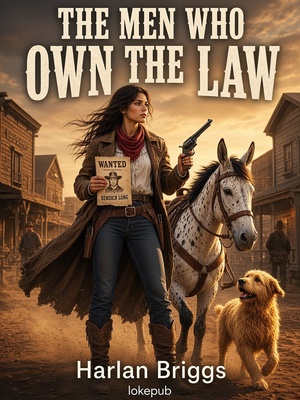
The Men Who Own the Law
Chapter 1
The sun hung low over the Dragoon Mountains, melting into the horizon like poured copper.
Heat shimmered across the flats, blurring stone and sky into a single wavering haze.
A lone rider moved through the glare—a tall, raw-boned boy not yet filled out to manhood, his slouch hat pulled low, the dust of a hundred miles ghosting his clothes.
He rode a spotted mule named Meg, her flanks rippling with the steady muscle of long travel. Behind her trotted a big yellow dog, his coat dull with trail dust, ribs showing, yet his stride sure and full of purpose. His name was Whiskey, and he followed the mule’s shadow like a heartbeat.
Every few steps, Whiskey lifted his head to taste the wind—not for game, but for danger. He was the kind of dog who didn’t wag for strangers and didn’t bark unless there was cause. Folks who’d met him once tended not to forget.
The boy’s name was Johnny Irons, and though young, there was something in the way he rode—something quiet, deliberate, and dangerous.
He carried a Pocket Colt in a shoulder rig, a Walker Colt stuck under his belt at his back, and a derringer in a holster strapped to his ankle in his right boot.
He carried a bedroll tied behind him, a canteen, and a single tattered wanted circular, folded and unfolded so many times that the creases had worn thin as silk, in his shirt pocket.
A battered tan felt hat shaded his cold eyes.
He took out the wanted poster now, smoothing it across his leg.
WANTED – Buckskin Lewis
Murder, Robbery, and Escape from Yuma Prison
Last seen in Tombstone, Arizona Territory, 1872.
Reward: $2,000 – Dead or Alive.
The paper was yellowed, the face nearly faded—smooth features, an easy smile, eyes that didn’t tell the truth—six years had passed since anyone had last spoken with him.
Lewis was thought long dead and buried. Johnny wasn’t so sure.
He wanted to visit Tombstone to see if he could resurrect the ghost of Buckskin Lewis or find his grave.
He tucked the poster back into the pocket of his tan shirt and nudged Meg forward. “If’n Buckskin is in Tombstone, girl,” he said quietly. “Then I aim to find him.”
Whiskey let out a low grunt, tail flicking once as if he understood.
The trail to Tombstone wound through thorn and stone, following the old Apache road that cut the Dragoons from east to west. The wind came hot and dry, carrying the faint tang of mesquite smoke on faraway dust.
Johnny had ridden since dawn, stopping only once to let Meg drink and to share a scrap of jerky with Whiskey. The boy’s eyes remained fixed on the horizon. Somewhere beyond those hills lay Tombstone, a new town built on the promise of silver and the certainty of death.
A buzzard wheeled overhead, lazy in the heat. Meg flicked her ears and plodded on. She never quit. She and Johnny shared that trait.
By midafternoon, the air grew so still he could hear the faint jingle of Meg’s bit and the dry rasp of his own breath. When the wind came again, it carried another sound—metal horseshoes on rock, faint yet close.
He turned in the saddle just as three riders rounded a bend ahead—miners by their hats and the dust on their coats. But Johnny saw the glint of rifles across their saddles and the way their eyes fixed on Meg.
The lead rider grinned, a lean man with a beard like old rust. “Well now,” he drawled. “Ain’t every day we see a boy ridin’ a mule worth more’n the saddle sitting on it.”
“Trail’s free,” Johnny said evenly.
The second man spat. “So’s your mule, far as I can see.”
Whiskey, seemingly sensing the men’s mood, peeled back his lips, revealing long white teeth as he growled. The men’s horses shied a little at the sound.
Johnny didn’t raise his voice. “You’d best ride around me.”
The lead rider chuckled. “Or what? You’ll set your cur on us?”
Johnny’s right hand crossed his chest, slow and easy. “He’s faster than he looks. I wouldn’t test him.”
For a moment, no one moved. Then the bearded man laughed and nudged his horse forward. It was a mistake.
Meg shifted her weight, eyes rolling white. Johnny gave her a quiet click. Her hind legs lashed out with the speed of lightning. Hoof met bone with a crack that sounded like a gunshot. The man’s shout turned into a scream as he toppled from the saddle, clutching his leg.
The others went for their guns—but Johnny’s Pocket Colt was already in his hand.
One shot kicked up dust between them, deliberate and close. The men froze.
“I said,” Johnny told them softly, “ride around. Oh, I forgot to mention that my mule kicks.”
They did. The bearded man doubled over in the saddle, clutching his busted leg.
Whiskey stayed low to the ground, growling until the last rider disappeared into the haze. Then the dog looked back at Johnny, tail wagging once.
“Yeah,” Johnny muttered, sliding the Colt back into the shoulder rig. “Reckon that’ll do. Hope no one in Tombstone is as inhospitable as those three.”
Toward evening, the land began to change. The mountains fell away, leaving open flats cut by dry arroyos and scattered mesquite. Johnny guided Meg up a stony ridge to get his bearings.
A voice called down from above. “Don’t shoot, stranger—I ain’t worth the bullet.”
Johnny looked up. An old prospector sat on a boulder, his long beard tangled with dust, a rifle resting across his knees.
“You been following that road long?” the man asked.
“Long enough.”
The prospector grinned, revealing three teeth. “Then you’ll be glad to know it ends in hell. They call it Tombstone. Boomtown sprang up overnight—miners, gamblers, killers, and fools. Ed Schieffelin found silver where everyone told him he’d find his tomb, and I reckon he found both.”
Johnny smiled faintly. “Guess I’ll find out for myself.”
The man studied him. “You’re young. Ain’t looking for work, are you?”
“I’m looking for a man.”
The prospector shrugged. “You’ll find plenty of them, but few worth finding.”
He started to turn away, then stopped. “Watch your back down there. Tombstone don’t play fair.”
“I don’t either,” Johnny said.
The prospector barked a laugh. “Then you’ll fit right in.”
Johnny rode on, leaving the old man to his rocks and his ghosts.
The last leg of the trail ran through a shallow wash choked with tumbleweed. There, half-buried in the sand, Johnny spotted the bones of an ox team and the rusted rim of a wagon wheel. He dismounted to examine the wreck.
The wood was charred black, the smell of ash long since faded. A half-melted coin gleamed beside the wheel hub. Johnny picked it up and turned it between his fingers. It was a Mexican silver coin, scorched on one side.
Whiskey sniffed at the ground and let out a low growl.
Johnny dropped the coin. “Ain’t nothin’ here but ghosts, boy. Let’s keep moving.”
As they rode on, the wind stirred the ashes into a thin spiral that trailed behind them like smoke from a long-dead fire.
The sun was almost gone as Johnny topped the final rise. The desert below was no longer dark—it burned.
Tombstone blazed like a forge against the night, the glow of lanterns and smelters painting the sky orange.
Johnny reined Meg to a halt. “That’s her,” he said. “Silver City.”
Whiskey barked once, soft and sure.
“Yeah,” Johnny murmured. “Maybe Buckskin is down there somewhere. Might’ve changed his name, but he can’t change his soul.”
He touched Meg’s neck. “Let’s go find our ghost.”
They descended toward the town, dust rising under the moonlight.
The first building on the north edge was a tent saloon called The Gravedigger’s Luck. Lanterns cast wild light across the canvas walls. A drunk stumbled out, singing at the sky, and promptly tripped over Whiskey.
The dog didn’t move. The man went down hard, rolled, and came up swearing. “You mongrel son of?—”
Johnny’s voice cut through. “Leave it.”
The man froze at the tone, blinked in response to Johnny’s steady gaze, and backed away without another word.
They passed a wagon creaking under sacks of ore, a group of gamblers arguing over cards, and a preacher standing on a crate, shouting, “Repent! The wages of silver is death!”
Johnny muttered, “I pay in gold when I have it.”
The preacher kept shouting after him, his voice cracked and desperate, as Johnny rode down into the noise and heat of Allen Street.
Tombstone was alive—shouting, singing, and gunfire cracking in the distance like punctuation.
Miners in red shirts spilled out of saloons, girls in bright dresses leaned from balconies, and cowhands and drifters argued in the street. Johnny had ridden through boomtowns, but none had this fever. It felt as if the ground itself were trembling under the weight of silver.
A man burst from a doorway ahead, bleeding from a cut above his eye. Behind him came another, wild-eyed and drunk, carrying a revolver.
Johnny hauled Meg aside just as the man fired. The bullet whistled past, splintering a hitch post.
Whiskey sprang like lightning, jaws clamping the shooter’s arm. The man screamed, dropped the gun, and kicked. Johnny dismounted, yanked the pistol away, and cracked it across the man’s temple. He went down hard.
The first man—the wounded one—stared at Johnny. “Much obliged, kid.”
“Don’t mention it.”
He called Whiskey off, and the dog backed up, growling until the man limped away.
A few bystanders clapped or laughed. One shouted, “That boy just saved your bacon, Charlie!”
Johnny holstered his weapon and swung back into the saddle. “Come on, Whiskey,” he said. “Let’s find a quiet corner before we make any more friends.”
He found the livery on Fremont Street—a large barn with lanterns glowing through the slats. The sign read RINGO & McCABE – FEED AND STOCK.
A squat man stepped from the shadows, wiping his hands on a dirty rag. “Fine-lookin’ mule you got there. Don’t see spots like that much. She got Appaloosa in her?”
“Yelp, she’s carried me from several points in Mexico and Arizona,” Johnny said. “Knows her own mind.”
The man nodded toward Whiskey. “And that dog?”
Johnny smiled faintly. “He keeps other folks honest.”
The hostler’s grin faded. “My name is Wally. Two bits for the night. You can bed down yourself across the street at Mrs. Abernathy’s if you’ve got a dollar to spare.”
Johnny handed him the coin, led the mule to her stall, unsaddled Meg, and brushed her down with a handful of straw. “You done good, girl.”
Whiskey lay beside the stall, head resting on his paws, eyes never closing.
Johnny crouched beside him. “Watch her. Anyone comes too close, you fetch me.”
The dog’s tail thumped once.
Johnny stepped out into the street. The moon rode high and cold over the rooftops. Gunfire echoed in the distance, met by laughter. The whole town throbbed with life, greed, and madness.
He walked the boardwalk, his boots whispering on new wood, the smell of whiskey and sweat thick as smoke. He approached a huge building with a sign that read “The Crystal Palace,” its windows glinting in lamplight. Somewhere inside, a piano was being tuned, its notes sharp as knives.
Across the street, a man was hurled through a saloon door. Another stepped out, gun drawn, and fired into the air to clear the crowd. Johnny didn’t even flinch.
He stopped before the assay office window, staring at the bars of silver stacked inside. They gleamed in the lamplight, like bait for fools. His reflection ghosted across the glass—hat brim low, eyes hard.
He pulled the old wanted poster from his coat and smoothed it flat. Six years since Buckskin Lewis vanished.
“Still out there,” he murmured. “Maybe rich enough to forget his sins, but still out there.”
From the livery came Whiskey’s bark—deep, sharp, not fear but a warning.
Johnny froze. The night seemed to hold its breath.
He slid the poster away and rested his hand on the Colt under his arm.
Down the street, a shadow slipped between buildings—two figures, moving low and fast into the livery.
Johnny started running.
He reached the barn door just as one man opened the door to Meg’s stall. The other turned to face Johnny, a steel blade flashing in his hand.
Whiskey hit the man entering the stall first. The sound was raw and terrible—the crack of bone, the man’s scream, and the growl of a dog bred for battle as it lunged for the man’s throat.
Johnny fired once. The shot lit the alley like lightning. The thief facing him dropped face-first into the dirt, his knife skidding from his grasp.
For a long moment, the only sounds were Meg’s nervous snort and the hiss of a lantern somewhere inside the barn.
Johnny holstered the Colt and knelt beside the fallen man—rough clothes, reeking of whiskey. Probably thought he could sell a mule and live two weeks drunk.
He looked at Whiskey, whose muzzle was dark with blood. “You done fine, boy.”
Whiskey sat back on his haunches, panting, eyes watchful.
Suddenly, Wally appeared from the rear of the livery. He glanced at the two dead men. “I wish I could say this is the first time thieves have tried to steal mules. But mules are worth more to the miners than horses, and they will pay for them in silver.”
“What should be done about the bodies?” Johnny asked.
“Toss them into the street. The undertaker makes his rounds before dawn. The town pays him five dollars for every person he buries.”
Johnny wiped his gun clean on a coat sleeve, then rubbed Meg’s nose until she quieted, before dragging the bodies out of the barn and into the shadows.
Then he looked toward the street, where laughter and piano music still rolled, unaware or unconcerned about the two dead thieves.
“Welcome to Tombstone,” Wally said softly as Johnny finished disposing of the dead men.
He patted Whiskey’s head. “Come on, partner. Looks like this town’s got more ghosts since we arrived.”
Together, boy and dog walked back into the glow of Allen Street—two shadows swallowed by the firelight and sin of the wildest silver camp in the Territory.