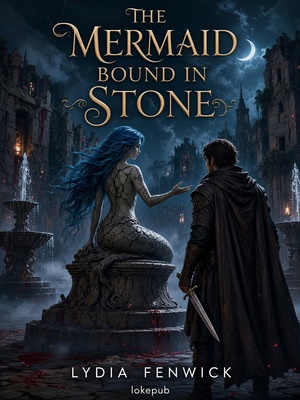
The Mermaid Bound in Stone
Prologue - Marella
Once, there was the sea. Full and shining and bright, it glistened on the horizon with worlds of never-ending promise. It was home, and it was possibility. It was familiar, yet wholly different every day.
I can barely remember it now, but I feel it when I close my eyes: the pull of water through my gills and hair, the pressure that pulsated through the depths in the darkness.
It’s still there, somewhere. Beyond the stonework and cobbles of this ancient, labyrinthine city, across the hills and pastures to the east, through the dried-up channels of long-forgotten canals, it waits for us.
And I plan to be the one to return us to its embrace.
It wasn’t always this way. Once, we swam freely between the city and the sea.
A tangle of intricate canals laced through the countryside, connecting the bustling city of Rossaia with the Adriatic Sea.
We swam through them as we pleased, splashing giggling children and bringing fish to families that lived along the banks.
That was when humans were good. And if I’ve learned anything in my centuries of imprisonment, it’s that this can no longer be said about their species.
It took millennia, but it felt like only a moment, for the most powerful men to realize that paved roads and machinery moved commerce throughout the country faster than water.
And despite the fact that water was crucial to the lifeblood of the city, they slowly began campaigning to fill in the canals.
Of course, we fought back. We spoke to the people, to the children and families with whom we shared fish and laughter. But they were few.
The powerful turned us into monsters, unclothed heathens who lured men to their deaths and drowned babies for sport. And the further humans lived from the water, the more readily they believed these lies. Who, after all, were the scaled creatures swimming through their city streets?
My father fought the hardest. He had been respected among the men of the city.
He, my mother, my sisters, and I stayed in Rossaia as the crusade against us began.
Hundreds of our kin chose to flee to open water, but we stayed, convinced as we were that we could change their minds.
Together, we outlined ways we could bring aid to the city—through the delivery of fish, and warnings of rising waters and potential flooding.
But nothing could sway the rising tide of change.
"The wheel of time is moving," I remember one man saying. "And your kind can do nothing to slow its course."
Still, we tried.
We were foolish.
When a child turned up drowned on the banks of a canal, the city officials immediately blamed us.
This was when the slaughter began.
Murderers, they sneered. Sirens.
And the people believed them. It did not matter that we had saved far more children from drowning over the course of our long history with humans; it only took one to turn their favor against us forever.
Many of those who had not already fled were caught with hooks, nets, and hands, pulled from the water and dangled from their fins in the town square to dry out and burn in the hot sun.
My family was spared for a while, as my father tried to continue negotiations with the city leaders, ensconced in a private pool beneath the home of a foreign diplomat who took pity on our situation.
The last time we spoke with the men, they showed up in matching flowing black robes with red silk stitched along the sleeves and collars, calling themselves Fratelli di Sangue: the Brothers of Blood.
It was not a name I’d ever forget.
"You are enacting a genocide," my father pleaded, the closest I have ever seen him to tears.
The city leaders shrugged. "Vengeance is not genocide."
"You know we were not responsible for that boy’s death."
"Perception is everything," a wrinkled old man sneered, a cigarette dangling from the downturned corners of his paper-thin lips. "Who are we to tell them what to believe?"
"Why are you doing this?" my mother asked, turning around the room, her fierce green eyes alighting on each of the men in turn. "The city will dry up if you close the canals. How will your people survive?"
"There are ways to bring water to the city that will not inhibit the growth of roads and critical infrastructure," a younger man said, this one tall and slender, with slicked-back black hair revealing a receding hairline.
"Pipes and plumbing can deliver water faster and more efficiently while leaving us room to expand the city outward. "
"And what about fish?" my father asked.
"We will transport fish from the coast using ground transportation." The man rolled his eyes like this should have been obvious. "The simple truth is that we no longer need you."
"This is a mistake." My father’s voice shook as he implored them to see reason. "The city will not thrive without its ties to the sea. It’s not just about the financial practicalities; it’s about balance with the natural world—"
Laughter exploded throughout the room.
"If you’re going to speak of superstition, then we have nothing more to talk about," the cigarette-smoking man scoffed. "We have long since advanced beyond the confines of adherence to mystical delusions."
The room fell quiet for a moment, the soft sounds of ripples around my family the only thing saving us from silence.
"That is a dangerous way to examine the world." When my mother finally spoke again, her voice was low. "Those who abandon their ties to the natural world are doomed to the same fate they impress upon it."
The man smirked. "We’re willing to take that chance."
And with a collective swish of their cloaks, the Fratelli left the room, footsteps echoing on the stone steps from the chambers long after they’d disappeared.
Only the diplomat remained, staring after them, sad resignation on his face mirroring our own.
"I suggest," he said finally, "that you follow your kinsmen and leave the city." His voice was quiet, but urgent, and he did not face us as he spoke. "I have heard them speak about their continued plans. They are… not kind. If you stay, I promise you, you will perish. They will be sure of it."
My father sighed. "As much as I’d relish seeing them fall victim to their own hubris, I cannot, in good conscience, leave the innocents of this city to suffer the consequences of the actions of a few foolish men. It is my duty as envoy."
The man shrugged and placed his hands into his pockets. "As you like," he said gently. "But I cannot continue to help you. They are planning to place a bounty on the heads of anyone who assists the merfolk. I cannot risk my own family."
And with that, he walked away.
"I will take the girls to the sea," my mother finally said, grabbing my arm and beginning to pull me towards the culvert in the wall that would lead us back into the city canals. "Once they’re safe, I’ll return to help you continue the campaign."
"How is that fair?" my oldest sister protested, swimming forward to place herself between my mother and the culvert. "This will affect us as much as it will you. It is our duty as well. We are also envoys."
"Absolutely not," my mother chided, her grip tightening on my upper arm. I said nothing. As the youngest, it seemed I should follow my sisters’ leads. But the thought of being dragged from the water by my tail fin and hung out to dry made my blood still in my veins.
My father looked at each of us in turn. One by one, my sisters shook their heads, jaws set, eyes defiant. When his eyes finally rested on me, my mother’s fingers still gripping painfully at my upper arm, I followed their lead, even as I hid my shaking hands behind my back in the dark water.
I’ll never forget the long, shattering sound of my father’s answering sigh. It echoed through the quiet chamber like a death rattle. With a deep frown, he turned to my mother. "I cannot force them to leave."
When her hand finally dropped from my arm, it left behind an imprint of her fingers, white against the rest of my tanned skin.
"Then you’ve sentenced them to death." She didn’t look at him as she spoke, and after a few tense seconds, she dove beneath the water and swam away.
It was one of the last times I’d see her alive.
The timeline from there on out became foggy; it’s been so long now that I forget the order of events and how one led to another. But I do remember that they eventually filled in the canals beyond the city walls, trapping my family, and several others, inside the gates.
After that, the slaughter began in earnest, and it wasn’t long before the escalation of violence against our people became too much for my mother to continue to witness.
So one night, long after my father and sisters had settled to sleep at the bottom of an underground canal outside of the city, my mother shook me awake and ushered me to follow her, green eyes blazing desperately and jaw set in a hard line.
I didn’t ask questions as she grabbed my hand and pulled me behind her, swimming rapidly against the flow of the canal into the heart of the city.
Bubbles trailed behind us, and I worried for a moment that the disturbance on the surface might be enough to alert any waking humans to our presence, but we made the journey undisturbed.
"Where are we going?" I finally asked when I knew we were far enough away from the rest of the family that there was no risk of being overheard.
"We’re going to fix things," she answered, still not turning to look at me.
I should have asked how, should have pulled us to a stop right there and forced her to tell me her plan. And then, I should have swum as fast as I could back to my father and begged him to stop her.
But I didn’t, and she continued to pull me along, into a dark part of the city where the water tasted like sulfur.
We slowed as debris began to fill our path; I’d never seen that much garbage and waste.
It floated both atop and throughout the canal like a soup, and it was all I could do to stop myself from retching.