The Midnight Stranger (The Midnight Encounter #1)
Chapter 1 Midnight Collision
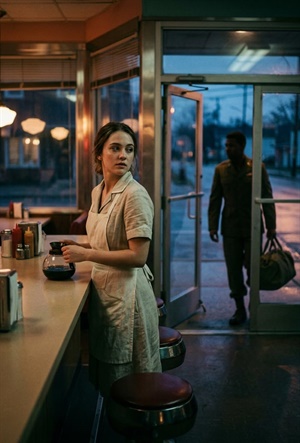
The bell above the diner door chimed at 11:47 p.m., and Marlene didn’t look up from wiping the counter.
She’d been working the late shift at Hattie’s for three years now—long enough to know that the hour between midnight and closing brought two kinds of people: truckers wanting coffee strong enough to dissolve a spoon, and locals too drunk to remember their own orders.
The footsteps that crossed the linoleum weren’t either.
Boots. Heavy-soled, deliberate. Not the shuffling stagger of a regular. She registered the rhythm before she lifted her chin—military cadence, the kind her brother used to walk with before he shipped out and never came back.
“Kitchen’s closed,” she said, still not looking. “Coffee’s fresh. Pie’s day-old.”
“Coffee sounds perfect.”
The voice was deeper than she expected. Gravel and warmth. She finally glanced up.
He stood near the door like he wasn’t sure he was allowed to come further. Army jacket, worn at the elbows. Dark hair cropped close. Jaw sharp enough to cut glass. But it was his eyes that held her in place—tired eyes, the kind of tired that sleep couldn’t fix.
Marlene’s rag stilled on the counter.
“Take a seat,” she managed. “I’ll pour.”
He slid into a booth by the window, his back to the wall. She noticed that. The way his gaze swept the empty diner before he settled, cataloguing exits, blind spots. Her brother used to do the same thing whenever he came home on leave.
She grabbed the coffee pot and a mug, then hesitated. Added a second mug.
“Mind if I join you?”
The soldier—she didn’t know his name yet, but she could already feel it sitting on the edge of her tongue—looked up with something that might have been surprise. Or relief. His eyes flicked to the CLOSED sign on the door, then back to her.
“You’re not busy.”
It wasn’t a question. She poured his coffee first, watched his fingers wrap around the ceramic like it was the first warm thing he’d held in weeks.
“Nobody comes in after midnight,” she said, sliding into the booth across from him. “Not in this town.”
“What town is this?”
“You don’t know?”
“GPS died an hour ago.” A ghost of a smile tugged at the corner of his mouth. “Been driving on fumes and instinct.”
“That’s one way to end up in Grady.” She cradled her own mug, not drinking, just letting the heat seep into her palms. “Population eight hundred and twelve. Eight hundred and eleven since Mrs. Halpern moved to Tucson last spring.”
He took a long swallow of coffee. She watched his throat move.
“You’ve got the numbers memorized.”
“Hard to forget when you’re trying to leave.”
The words came out sharper than she intended. A confession she hadn’t planned on making to a stranger. But he didn’t flinch, didn’t offer some empty reassurance about small-town charm or home being where the heart is. He just nodded, slow and knowing.
“Leaving’s the easy part,” he said quietly. “It’s staying gone that’s hard.”
Their eyes met over the rims of their mugs.
Marlene took him in—the calluses on his knuckles, the faint scar bisecting his left eyebrow, the way he held himself coiled tight even in an empty diner. A man braced for impact. A man who’d seen things and carried them still.
She recognized that, too.
“I’m Marlene,” she said.
“Gideon.”
“That a first name or a last name?”
“Yes.”
She laughed. It startled her—the sound bright and foreign in the quiet diner. He looked startled too, but not unpleasantly.
For the next hour, they talked.
Not the way people talk in diners, with weather and pleasantries and careful distance.
They talked the way strangers talk at the edge of the world—honest and urgent, as if the sun might not rise to give them a second chance.
She told him about her father’s hardware store, the one she was supposed to inherit, the future that felt more like a cage.
He told her about three tours overseas, about coming home to an apartment that didn’t feel like home anymore, about driving west because he didn’t know what else to do.
“So we’re both running,” she said.
“Looks that way.”
“Where to?”
“Haven’t figured that out yet.” He met her gaze, steady and unblinking. “You?”
Marlene traced a finger around the rim of her mug. “California, maybe. Somewhere nobody knows my name.”
“California’s overrated.”
“You’ve been?”
“Drove through once. Too many people trying too hard to be somebody else.”
“Maybe that’s what I want.”
Gideon set down his mug. His knuckles brushed the back of her hand—accidental, barely a graze—and the contact sent a current up her arm. She saw him feel it too, the way his fingers hesitated before pulling back.
“You don’t strike me as someone who needs to be somebody else,” he said.
The coffee had gone cold. The diner’s fluorescent lights buzzed overhead. Outside, the highway stretched black and empty in both directions.
“I should close up,” Marlene whispered.
She didn’t move.
Neither did he.
The air between them had changed—thickened, charged, like the pressure drop before a storm. She could hear her own heartbeat in her ears. Could smell him now, beneath the coffee: leather and cedar and something sharp, like winter air.
Gideon’s hand moved first.
Not fast. Nothing about him was fast just then. His fingers skimmed her wrist, the inside where the skin was thinnest, and her pulse jumped against his thumb like a caught thing. His eyes asked the question his mouth didn’t.
She answered by leaning forward.
Their lips met over the Formica tabletop, and it was—
Not gentle.
Gentle wasn’t what either of them needed.
His mouth was hot and insistent, stubble scraping her chin, one hand sliding up into her hair while the other found the curve of her jaw. She grabbed the front of his jacket and pulled. The angle was awkward, the table edge digging into her ribs, and she didn’t care. Didn’t care about any of it.
“Gideon.”
His name. She’d only known it an hour, and already it felt essential.
He broke the kiss, breathing hard, his forehead pressed to hers. “Tell me to stop.”
“Why would I do that?”
“Because I’m a stranger. Because we’re in a diner. Because—”
Marlene silenced him with her mouth.
This kiss was deeper, hungrier. Her tongue found his, and he made a sound low in his throat—half groan, half growl—that vibrated through her chest. His hands dropped to her hips, fingers digging into the worn denim of her jeans, and suddenly she was being lifted.
Not far. Just enough to pull her out of the booth, to get her on her feet, to press her back against the nearest wall.
The jukebox in the corner flickered to life—some old country song, something about lonesome highways—and she almost laughed at the absurdity of it. But then Gideon’s mouth was on her neck, his teeth grazing the sensitive spot beneath her ear, and laughter was the furthest thing from her mind.
“God.” The word tore out of her, breathy and broken.
“Not even close,” he murmured against her skin.
Her fingers fumbled with the buttons of his jacket. One popped loose. Then another. She could feel the heat of his body through his t-shirt, the solid wall of his chest, the way his breathing turned ragged as her nails traced down his sternum.
He pulled back just enough to look at her.
His eyes were dark. Dark and desperate and asking permission all over again.
Marlene reached for the hem of her own shirt. Peeled it up and over her head. The diner air was cold against her bare skin, her nipples tightening beneath the thin lace of her bra, but the way Gideon looked at her—
That was heat.
“You’re—” He stopped. Swallowed. Started again. “I didn’t come here expecting this.”
“Neither did I.”
She hooked her fingers into his belt loops and dragged him closer.
The wall was cold against her back. He was warm everywhere else. His mouth found her collarbone, the hollow of her throat, the slope of her shoulder. Each kiss deliberate, like he was memorizing her geography. Her bra strap slipped down. His thumb traced the edge of the lace, just above her heart.
“Still want me to stop?” she asked.
Gideon’s answer was a kiss that stole her breath entirely. One hand splayed against the wall beside her head, the other sliding up her ribcage—slow, so slow, his thumb brushing the underside of her breast with a tenderness that made her ache.
The jukebox crackled. The song changed.
Outside, headlights swept across the diner windows.
They both froze.
The car didn’t slow. The headlights passed, trailing red taillights that shrank and vanished into the dark. The highway swallowed the sound of the engine until there was nothing but the hum of the fluorescents and their own ragged breathing.
Marlene’s chest rose and fell against his palm.
“The diner’s not exactly private,” she whispered.
Gideon’s jaw tightened. “Where’s your place?”
“Two blocks away.”
He stepped back—reluctantly, she could feel his reluctance in the way his hands lingered on her hips—and retrieved her shirt from the floor. He didn’t hand it to her. Instead, he held it open, waiting for her to slip her arms in, and the gesture was so unexpectedly gentle that her throat tightened.
She dressed in silence. He shrugged his jacket back on, not bothering with the buttons.
Marlene moved to the register, her fingers trembling as she locked the till. She grabbed her keys from under the counter. Killed the lights.
The diner went dark.
Gideon stood silhouetted against the window, waiting.
“Two blocks?” he asked.
“Two blocks.”
She reached for his hand in the darkness.
His fingers closed around hers.