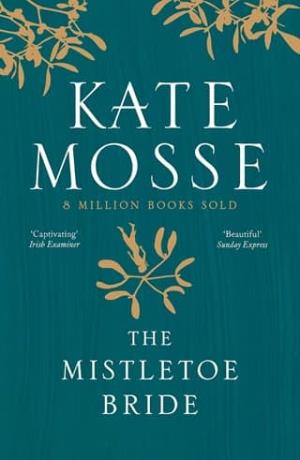
The Mistletoe Bride and Other Haunting Tales
The Mistletoe Bride
At length an old chest that had long lain hid
Was found in the castle; they raised the lid,
And a skeleton form lay mouldering there,
In the bridal wreath of that lady fair.
Refrain: Oh, the mistletoe bough,
Oh, the mistletoe bough.
from ‘The Mistletoe Bough’
THOMAS HAYNES BAYLY
I hear someone coming.
Has someone caught the echo of my footsteps on these floorboards? It is possible. It has happened before. I pause and listen, but now I no longer hear anything. I sigh. As always, hope is snatched away before it can take root.
Even now, after so long, I cannot account for the fact that no one ever ventures into this part of the house.
I do not understand how I am still waiting, waiting after all these years.
Sometimes I see them moving around below.
Sense their presence. Bramshill House has been home to many families in my time and, though the clothes and the styles and the customs are different, it seems to me that each generation is much the same.
I remember them all, their faces alive with the legends of the house and the belief that it is haunted.
Men and women and children, listening to the stories. The story of a game of hide-and-seek.
I pray that this will be the day. The end of my story. That, this time, someone at last will find me. But the halls and the corridors beneath me are silent again.
No one is coming.
And so then, as always, I am carried back to that first Christmas so very long ago.
It is my wedding day. I should be happy, and I am.
I am happy, yet I confess I am anxious too.
My father’s friends are wild. Their cups clashing against one another and goose fat glistening on their cheeks and their voices raised.
There has been so much wine drunk that they are no longer themselves.
There is a lawlessness in the glint of their eyes, though they are not yet so far gone as to forget their breeding and manners.
Their good cheer echoes around the old oak hall, so loud that I can no longer hear the lute or viol or citole set for our entertainment.
There is mistletoe and holly, white berries and red.
At the end of the table, I see my beloved father and my face softens.
He is proud of me and what this alliance will bring.
Two local families of equal stature and worth, this union will be good for both.
My mother has told me time and again how fortunate I am to be betrothed – married, as of three hours past – to a man who loves me and who is mindful of my worth.
And see how we sit together, at the head of the feast, to toast the goodly company.
I look to my husband.
Lovell is lively and bright. He touches my hand and compliments my dress, admires my blue eyes and the Christmas decorations that grace the hall.
And he – I must learn to call him husband – dances well and speaks well and makes each man believe that he, of all of my father’s guests, is the most welcome.
The scent of lilies, lily of the valley, though I do not understand how such blooms survive in the cold of this December.
I have been told Lovell has done great service to the Crown.
He is said to be brave and that he acquitted himself in the wars, but yet the new Queen does not favour him.
I do not know how this matters, if at all.
In any case, today all affairs of state are forgotten.
Lovell has opened Bramshill House to all those who should be here, regardless of their allegiance, and my father approves.
This house that will, in time, become my home.
The wedding feast continues late into the afternoon, as was the custom then.
Things are different now.
Conviviality, the best of hospitality, there is food and wine enough to satisfy even the greediest of his guests. Our guests, I tell myself, though the word sits heavy in my mouth. I must learn to wear my new responsibilities more lightly.
The servants have gone back and forth, back and forth, with flagons and plates and dishes.
No one lacks for anything. We have sung and listened to ballads of the old times, songs of love and loss and battle.
And we have danced and danced, until my feet are sore and my slippers worn through.
Lovell calls me his ‘fairy bride’, as he leads me in the cotillion.
Up and down and round and around we go. I am lighter than air, he says, barely there at all, and I can see this pleases him.
The hours pass.
Outside it has grown dark and I am weary, having sat at this table for too long.
I would like to withdraw. I would like to rest a while, though I know I cannot.
So I continue to offer smiles and nods and I listen to the old man sitting on my right, who wishes to talk of God and duty and has flecks of spittle in the corner of his mouth.
I look to Lovell again and I see that he, too, has tired of the feast. Our glances meet and he inclines his head. He is as hidebound by the traditions as am I.
All at once, I understand what I might do. I get to my feet.
‘My lords, shall we have a game?’ I say. ‘A game of hide-and-seek, for all those who yet have strength in their legs?’
My husband laughs. Straight away, the atmosphere changes.
It bristles and sharpens. The young men think of what mischief might be hidden in the shadows, the young women dream of who might come to find them.
The old men and matrons shake their heads, look indulgently on their excitement and remember their own youth.
‘We shall,’ says Lovell, clapping his hands. ‘A splendid suggestion. Only if, though, my beautiful wife will honour me with a kiss beneath the mistletoe before the game begins.’
I feel no aversion to the thought of his lips upon mine, though I would rather it not be a sport to be observed by the assembled company. But I oblige and I smile, tilt my face to his. A servant holds a bough over our heads.
The bargain is struck.
The watchers at the table applaud and roar their approval.
‘Now, let the game begin,’ I say. For this moment, I am la fille coquette.
Charming and gay and entrancing. I can play this role.
I can see Lovell’s eyes upon me and know he means to be the one who discovers my hiding place.
There is part of me that shrinks at the thought of it, but he is a gentle man.
My husband claps his hands again and all fall silent.
‘The ladies shall hide first,’ he commands. ‘The gentlemen shall seek. We will give you to the count of . . .’
But I do not hear what he says because we are already running, lightly, from the hall. Laughing and glancing back over our shoulders. Silk and brocade, our pretty gowns painting the long corridors and cavernous spaces of Bramshill House the colours of the rainbow.
I hear the chorus of male voices counting.
‘Twenty-five, twenty-six, twenty-seven . . .’
My companions, girls who have not been told how unladylike it is to show such excitement, are in high spirits.
Like me, they are grateful to be released from the table and the eyes, hands, of the old men.
We chatter, each of us choosing a room, though we keep it secret.
Young girls imagining the beau who might love them.
I think of my husband. That I am now a wife.
I take the main staircase. I do not yet know Bramshill House well – there are sixty rooms or more – and I do not want to lose my way.
‘Thirty-eight, thirty-nine, forty.’
On the landing, I hesitate, unsure of where to go. I need to be well hidden, the game loses its charm else, but not so well concealed that Lovell loses patience in the search.
‘Forty-seven, forty-eight, forty-nine.’
We are scattering in all directions, in our game of hide-and-seek, and it is Christmas. The heels of our slippers tap on the wooden floors and the pearls on the hem of my dress, hand stitched over the weeks leading up to my wedding, knock against the wainscot.
I take the next flight of stairs, up to the second floor where the smaller bedrooms are to be found.
Pearl on wood, silk on dust, my bridal gown is heavy and ornate, but it fits me well and I am not hampered by its weight.
Along the upper gallery and into a bare room, clearly little used, with a pretty fleur-de-lis wallpaper.
Perhaps I have brought the scent of lilies with me, but I fancy there is the slightest perfume in this room too.
‘Ninety-nine and one hundred.’
Their voices are faint this far up, but immediately men’s heels echo in the old oak hall and there is laughter. Some call out, paying suit to their favourite – all the Annes and the Marys and the Janes.
I hesitate again, then step inside the room.
There is no furniture here save a substantial old oak chest set below the window.
I walk closer. The wooden coffer is deep and long, the length of a man, and bound fast by four wide metal bands.
I wonder if it once held the trousseau of another bride brought to Bramshill House?
Or do its proportions suggest it was made for a lord of the manor for a voyage?
Strong and sturdy to protect its owner’s possessions from the roll and swell and jilt of the sea?
Then I hear footsteps and remember the game.
I unbuckle the ornate metal fastening and lift the lid.
It is heavy, cumbersome and the clasp is loose and rattles, though I pay little heed to that.
Rather, I am wondering if it might serve as my hiding place and, indeed, the chest is empty, save for a bolt of pale blue cotton, which lines the bottom like a cradle blanket.
I think of how pleasant it would be to lie down and rest. Then I imagine Lovell’s face as he opens the chest and sees me looking up at him, framed in lace and tulle, and my mind is made up.
I lift my bridal gown and, careful not to slip, I climb over and into the chest. I arrange my skirts around me and fold my veil to serve as a pillow, then lie back. I feel like a child again, not somebody’s wife.