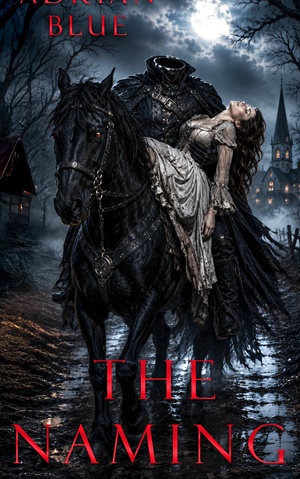
The Naming (Creatures of the Night #4)
Chapter One
The cottage where I have just delivered the Brody woman’s third child sits two valleys over from mine. By the time the babe is at her breast and Padraig Brody has counted the small coins he owes me into my palm, the sun has gone down behind the hills.
“You’ll stay till morning,” Padraig says. The cottage is small. Three children crowd it now, the newest at the breast.
“I’ve my own bed to get to,” I say.
“The road’s dark, Ailish.”
“The road’s always dark.”
He does not argue. For the walk, he gives me a heel of bread and a small jar of honey, which is generous, then holds the door while I sling my satchel across my shoulder and check the wick of my lantern. The lantern was my grandmother’s, its brass handle worn smooth by three generations of women.
“Mind the road past Crehan’s place,” Padraig says.
I look at him.
“Tomas was at the alehouse when I came to fetch you. Drinking heavy.”
“He’s always drinking heavy.”
“Heavier than that.”
I nod once, and say nothing. Padraig closes the door behind me and slides the bolt.
The road is a pale ribbon of mud between black hedgerows.
The air has the bite of a coming frost; October is nearly through.
The leaves the wind has not yet stripped from the rowans are the color of blood, and they whisper at me as I pass beneath them.
I walk steadily, my lantern throwing a small bright circle around my feet that moves with me.
It is three miles home, and I know every stone of this road.
Where the hedge opens onto Conlan’s pasture, where the old well sits crooked in the grass, where the track to my cottage cuts away just past the bent yew.
I have walked it a thousand times in daylight and a hundred in the dark, and never minded it.
Tonight I mind it.
It is not Tomas Crehan I am minding, though I do mind him, in the steady black-hearted way I always do.
I have set the bones of his wife Eithne three times in eight years.
The last time, the elbow would not stay set right, and there is a knot in it now that catches when she lifts a pot from the hearth.
On the evenings Tomas is at the alehouse, Eithne sits at her window and looks out at the road like a woman lost. Most days there is a dark circle around her eye.
There is nothing in this world I want more than for Tomas Crehan to fall down dead.
I am minding the road tonight because of the cold.
It is not the cold of the season. October has its own cold, and I know it well; what crawls up from the ground around my ankles now is a colder thing than October.
It is the cold my grandmother told me about when I was small and would not stop asking what was outside the window when the dog whined at it.
A cold ahead of him on the road, she said. Like a hand laid flat on your chest. If it comes, you are to put down your eyes and step into the hedge and reach into your purse for gold. He cannot abide gold. He cannot abide a covered face.
I have no gold. I have never had any. My grandmother had none either, nor her grandmother before her, but she taught me the rule because that is what was taught.
Rather than put the lantern out, I lower it to the ground at my feet and crouch beside it, my back against the cold prickle of holly.
The hoofbeats reach me a moment later.
They are not loud. Only the steady, measured beat of four hooves on the road. No breath. No creak of leather. Only the cold, deepening by the moment, and the hoofbeats drawing closer.
They reach me and stop.
I do not look up. My face stays turned down into the mud, my shawl over my head, and I hold my breath and count my heartbeats. The horse stands three paces from me. I hear it shift its weight.
A long silence. Then the sound of leather creaking, and a heavy thump.
I keep my eyes down.
Boots on mud. Slow. They stop in front of me, and a shape blocks what little starlight there is. I feel the stare.
He does not speak, only stands there and looks down at me.
I count—to ten, then twenty, then forty—and still he stands, and the cold deepens. He shifts, just barely. Still he has not spoken my name.
The rule is simple; my grandmother spoke it to me a hundred times, and I have known it since I was old enough to know anything. He stops for one reason. He speaks once, to say the name of the one whose time has come, and after that name there is no escape.
He has stopped.
He has not spoken.
Slowly, against everything I have been taught, I lift my face.
He towers over me, taller than any man I have ever seen, broad through the shoulder beneath a black riding cloak. Doublet and breeches dark, tall boots clotted to the knee with mud. Where a head should be, there is none. Only the open collar of the cloak and a clean dark line at the neck.
He is holding his head under his left arm.
The head’s eyes are open, looking directly at me. The color of pitch, of a night with no stars. They stare into me.
The body’s attention is on me too. I cannot say how I know it. He has no eyes, yet I have no doubt I am being observed.
I should die now. Die of the looking alone. My grandmother told me that to look on his face is to be marked; I am looking, and I am not dead.
He has not spoken my name. Slowly he lifts his free hand, holding it open toward me, palm up. I look at the open palm, then at the head under his arm, whose black eyes have not left mine, then back at the offered hand.
I rise out of the hedge. My legs do not want to work, but they carry me anyway. Picking up my lantern, I step back onto the road and stand before him, my face uncovered now, my shawl fallen to my shoulders, and look up at him.
The top of my head reaches the middle of his chest.
“You did not name me.”
He does not answer.
“You stopped,” I say. My voice is steadier than I have any right to expect. “You stopped, and you did not name me.”
He does not speak.
I lift my hand and place it on his. I jerk my chin up the road. North, toward my cottage.
“Come on, then,” I say.
He turns and leads his horse north up the road, with me by the hand.