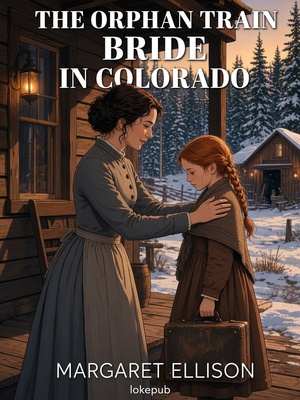
The Orphan Train Bride in Colorado
Chapter 1
Antonia Jenkins woke because she could not breathe.
The room was black. Not the ordinary black of a Mulberry Street night, with the lamp from the hall showing under the door. This was thick. It sat on her chest like a cat. When she drew a breath, it scraped down her throat and came back out as a cough.
Somewhere close, her mother was screaming.
Antonia sat up. The blanket slid off her. Her eyes stung so badly that she shut them again at once. Beneath the screaming came another sound, a low roar like wind in a chimney, only there was no wind.
"Mama?"
The word came out as a croak. Nobody answered it.
She knew what the smell was. Every child in the tenement knew it. Smoke meant a stove left open, or a lamp knocked over, or the rag man's cart alight in the yard. But this smoke was inside. It was in her room. It was in her mouth.
She got off the cot and felt for the floor with her bare feet. The boards were warm.
That was wrong. The boards were never warm, not even in August.
On her hands and knees, she crawled toward where the door should be. Her fingers found the leg of the chair by the window, then the wool of her mother's coat hanging over its back. She held on to it. The coat smelled of her mother. Soap, onions, the shop.
The screaming stopped.
Antonia waited for it to start again. It did not.
Then the door glowed. A thin orange line ran all the way around it, bright as a drawn wire, and the wood began to tick.
Something on the other side fell with a crash that shook the floor.
The line of light widened. Through the gap she saw the staircase, or what had been the staircase.
It was a column of fire from the ground to the roof.
She could not go that way. Nobody could go that way.
Little Joe's crib was in the other room. Mama and Papa were in the other room. Everything was in the other room, on the far side of that door.
She pulled herself up by the chair and put her face to the window. The glass was hot against her cheek. Below, the street was full of people. They were pointing up. A bell was ringing somewhere, coming closer, and men with brass hats were running with a ladder between them.
She could not open the window. The catch had been painted over years ago.
Behind her, the door gave way.
Heat came through the room like a hand pushing her forward. She screamed then, for the first time, and beat on the glass with both fists. The coat sleeve was still twisted in one hand, though she had no memory of taking hold of it.
The glass burst inward.
An arm in a wet wool sleeve came through the frame, then a shoulder, then a face with a great mustache streaked black.
The fireman said nothing. He caught her under the arms and hauled.
The window frame tore her nightdress. The coat sleeve tore too.
Something small came away in her fist as the wool ripped free, and the rest of the coat fell back into the room.
Then she was outside, over his shoulder, going down a ladder into the cold.
Behind her, the floor of her bedroom fell in.
* * *
How she came to be sitting on the cobbles, she did not know. There had been the ladder, and the fireman's shoulder, hard as a fence rail.
There had been a woman's voice saying, "Give her here, give her here."
Then there was a coat around her, a man's coat that smelled of tobacco. She was on the ground across the street with it pulled up to her chin.
The building was burning from the cellar to the roof.
Antonia watched it. Flames stood out of every window on the fourth floor, where they lived. The windows of the third floor had gone too. Glass lay in the street like ice. The firemen played their hose on the front. The water went up in a white arc, and the fire took no notice of it at all.
People were shouting names. Not hers. She heard Mrs. Costa from the third-floor call for her boy, over and over, up at the windows. Nobody answered her. After a while somebody led her away.
Nobody called for Antonia.
She listened for her father's voice. He had a big voice. He used it in the shop to call orders back to the cutting room. If he were in the street, she would hear him. She listened for her mother, who had a way of saying her name in three notes, going down, like a bell.
She heard neither.
Little Joe could not call for anybody. He was seven months old. He had two teeth and a laugh like water going down a drain, Papa said, which always made Mama slap Papa's arm.
The roof fell in. It went all at once, with a sound like a hundred doors slamming. A tower of sparks went up into the dark, higher than the church. The crowd stepped back as one animal.
Someone near her said, "That's all of them, then," in a flat voice.
That's all of them.
Antonia's hand was closed so tight that the nails had cut four little moons into her palm. She opened it under the coat where nobody could see.
A button lay there. A plain tin button from her mother's coat, with a scrap of gray wool still caught in the shank.
She closed her hand again.
Two women stood over her. She knew one of them, Mrs. Feeney from the second floor, who had got out with her cat and nothing else. The other was a stranger with a shawl over her head.
"Is that the Jenkins girl?" the stranger asked.
"It is. The father had the tailor's shop on Bayard. Her and the baby and the mother and him, all up on the fourth." Mrs. Feeney lowered her voice, though not enough. "They got her out the window. Only her."
"God help her. Look at the hair on her. It's full of ash."
"She hasn't made a sound. Not one. They carried her down and set her there, and she hasn't so much as sniffled. Look at her. She's watching it burn like it's a play."
"Shock," the stranger said.
"Maybe. But it isn't natural. Her whole family in there, and the child never even wept."
Antonia heard every word. She kept her eyes on the fire. It was easier to look at the fire than at the women. If she looked at the women, they would want her to speak, and she had nothing to say. Her throat was full of smoke. Her chest was full of something worse than smoke.
The fire burned until it was light. By then the front wall had fallen in, and there was nothing behind it but a black hole with steam coming out of it.
She was still watching when a policeman came to take her away.
* * *
The office of the Children's Aid Society was on a street she did not know. It had a high window, a stove with a black iron door, and a woman behind a desk who wore spectacles on a ribbon.
The woman was kind. Antonia could tell by her hands, which were slow and did not grab.
"Now then," the matron said, coming around the desk. "You're Antonia. That's a fine name. Nobody will call you anything you don't like here. Are you warm enough? You've had a dreadful time, my dear, a dreadful time. Will you sit by the stove?"
Antonia sat where she was put. The chair was too tall. Her feet hung.
The matron asked her questions. Every question was gentle, and Antonia answered none of them. How old was she? Had she any aunts or uncles, any family at all, in the city or anywhere? Could she read? Did she know her letters? Did she like porridge?
Between questions, the matron wrote in a ledger.
Antonia could read the writing upside down, because Papa had taught her at the cutting table with the order book.
Jenkins, Antonia. Female. Age eight, by the police report.
Mulberry St. fire, Sept. 3rd. Parents and infant brother deceased. No kin known.
Under that the matron wrote, Does not speak. Hair red, most striking.
A clerk came in to feed the stove. He swung the iron door open, and it clanged against its stop.
Antonia was off the chair before she knew she had moved. She was against the far wall with the button pressed into her palm so hard that it hurt.
The clerk stared. The matron said, "Thank you, Mr. Lyle. That will do," and waited until he had gone.
"It was only the stove door," she said softly. "There's no fire here but a good, shut-up one. Come and sit down, child."
Antonia came. She sat. Her heart went on knocking for a long while.
The matron wrote one more line and turned the ledger so that Antonia could not see it, but she had already seen. Starts at the stove door. Fire, most like.
She was given a bath, a dress that was too long, a nightgown, and stockings.
She was given a small carpetbag with brass corners to keep them in.
A girl who worked in the kitchen cut the burned ends off her hair and said it was a shame, such a color.
Antonia put the button in the carpetbag.
Then she took it out again and put it in her stocking, where she could feel it against her ankle.
On the fourth day, a man came.
He was neat and tired at once. His coat had creases across the back from sitting in trains, and he carried a satchel so full of papers that it would not close. He looked at Antonia the way Papa had looked at bolts of cloth, measuring.
"This is the one from the fire?"
"It is, Mr. Croft. Antonia Jenkins. Eight years old. A good, quiet child. She has not spoken since she came to us, but she understands everything. You can see it in her eyes."
Mr. Croft crouched down to her level. His knees cracked.
"Antonia, I am going to take you on a train.
A long train, all the way west, with some other boys and girls.
At every town where we stop, there are families who want children to love and to raise as their own.
Good farming families. Do you understand me? "
She understood him. Her head stayed still.
He stood up again. "Twenty-three on this run, with her. Farm country air, Mrs. Abbott. Fresh milk, honest work, a mother's arms. It mends what the city breaks. I've seen it a hundred times."
"I pray it does," the matron said. "But this child, Mr. Croft. What the fire broke..."
"A family will mend it." He was already signing the paper. "They always do."
* * *
The train left from a shed that smelled of coal and wet iron. There were twenty-three children on the platform, counted twice by Mr. Croft with his finger, and a lady chaperone in a gray bonnet who held the smallest ones by the hand.
Antonia was neither the smallest nor the largest. She had her carpetbag. It was very light.
They were put in a car with wooden benches and a stove at one end. Two big boys took the bench nearest it and would not give it up. Antonia took a seat at the far end by the window, as far from the stove as the car allowed.
The whistle blew. The car jerked. Then the shed slid away, and there was gray daylight, rails crossing other rails, the backs of buildings with washing strung between them.
She pressed her palm flat against the glass.
New York went past. Chimneys. A church steeple. A yard full of barrels. A street she thought might be Bayard, though it could not be. They were too far uptown. Somewhere back there was a black hole with steam coming out of it. Somewhere back there was everything.
The glass was cold under her hand. She kept it there until the city thinned to fields, and the fields to nothing she knew.
Then she took her hand down and looked at what she had.
One carpetbag with a dress in it that did not fit.
One tin button from her mother's coat.
And nobody. Nobody at all.