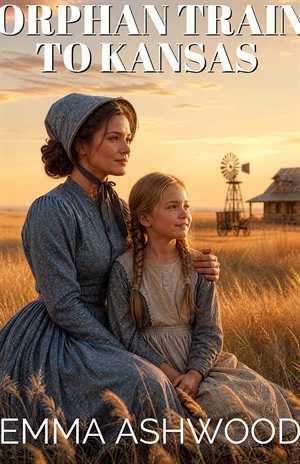
The Orphan Train To Kansas (Orphan Trains Out West #2)
Chapter 1
The railcar rocked westward through a sea of grass, carrying twenty-two scrubbed orphans toward new lives.
Lydia Marsh moved down the aisle with a comb in one hand. A licked thumb smoothed a cowlick here. Quick fingers straightened a collar there. She had been three years in the service of the Children’s Aid Society, and she knew her work.
“Stand still, young sir,” she said gently. “A gentleman does not fidget.”
The boy grinned up at her, gap-toothed and eager. Behind him, a small girl clutched the seat with both hands as though the prairie itself might swallow her.
Lydia crouched until their eyes were level. “There is nothing out that window but grass. Grass never hurt a soul.”
“It goes on forever, ma’am,” the girl whispered.
“It only seems to. At the end of it, there is a town. In that town, someone is waiting to want you.”
The girl considered this for a long moment. Then she nodded, solemn as a judge, and let go of the seat.
Sunlight streamed through the smeared windows. Dust hung in the golden shafts, turning slowly. The car smelled of coal smoke, soap, and the peppermint sticks she had handed out at dawn. Twenty-two children in their donated best, all watching the country roll by. Twenty-two lives in her charge.
Some of them had never seen a cow before this journey. One boy had asked, in perfect earnest, whether the corn grew already canned. City children, all of them. They knew the price of bread to the penny, but a sunset over open land struck them dumb.
Watching them discover the world, she sometimes felt she was discovering it too.
She was a minister’s daughter from a small town in New York State.
Every one of her sisters had married by twenty.
Lydia had chosen otherwise. When the Society advertised for agents of good character, she had answered before her mother could object.
A parlor of her own held no pull for her.
A husband, still less. There were children starving in the alleys of the city, and somebody had to carry them out.
Her father had understood, in the end. He had pressed his own Bible into her hands at the depot.
“The Lord has work for spinsters too,” he had said, smiling to soften it.
She carried the Bible in her valise still. The valise was the nearest thing she had to a home.
Toward noon, the whistle sounded. A water stop, nothing more, but the children pressed to the windows all the same. Every stop might be the one. Every platform might hold a mother.
“Not here,” Lydia told them. “Kearney is tomorrow. Rest while you can.”
A boy of ten looked up from the bench. “Will the folks at Kearney be kind, Miss Marsh?”
“The Society does not place children with unkind people.” She said it briskly, the way she said all certain things. “I inspect every applicant myself. Papers, references, the word of their minister. Nothing is left to chance.”
“But how do you know, ma’am? Just from papers?”
She sat down across from him, arranging her gray skirts. This deserved a real answer, and she gave it.
“Papers first. Then I look at them. A man who wants a son looks at your face. A man who wants a field hand looks at your shoulders. A woman with love left over holds her arms a certain way. I have learned to read the lookers the way you read a primer.”
“And if you read them wrong?”
“I do not read them wrong.”
It was not boasting, or she told herself it was not. In three years, she had placed nearly one hundred children. Her follow-up calls found them fed, schooled, and settled. The system worked when it was worked honestly. She believed that the way her father believed his catechism.
The next morning came bright and windy. At Kearney, the gathered families stood along the platform in their Sunday clothes, hats in hands, faces turned toward the slowing train.
Lydia lined her charges up outside the depot, tallest to smallest. She had brushed every head of hair herself. Chins up, she had told them. Answer honestly. Do not beg.
Then she watched the crowd, and she read it.
A stout farmer’s wife stood at the front with her hands folded over her apron.
Grief sat in the lines of her face, but so did room.
A child lost, Lydia guessed, and love with nowhere to go.
Within the hour, that woman was kneeling before the smallest girl, the one afraid of the grass, weeping into her hair.
A lean man in a good coat wanted a boy for his store. Honest enough, and his wife had kind eyes. The boy with the cowlick went to them, already talking of penny candy.
A rancher at the back studied the older boys the way a man studies horseflesh.
Lydia met his gaze and held it until he looked away.
When he applied for the twelve-year-old, she questioned him for half an hour.
Schooling, she said. Church attendance. Wages when the boy turned sixteen, written down and signed.
He agreed to every term, grudging but bound, and she let the placement stand.
Papers could hold a hard man to decency. That was what papers were for.
By late afternoon, eleven children had homes. Eleven sets of documents, signed in her careful hand. Eleven small faces, some shining, some brave, all beginning.
The little girl from the train came running back to her at the last. Thin arms went around Lydia’s waist, fierce as wire.
“You said someone was waiting to want me,” the child said into her coat. “You were right.”
“I generally am,” Lydia said, and her voice was not quite steady.
She stood on the platform while the wagons rolled away into the light. Dust rose golden behind them. One by one, they shrank to specks on the enormous land, each speck a family now.
The wind carried back a scrap of sound. A child laughing, or perhaps only a wheel wanting grease. She chose to believe it was laughing. An agent was permitted that much sentiment, she reasoned, provided it never reached the paperwork.
Overhead, the sky went on without a seam from one horizon to the other. In the city, you saw the sky in strips between buildings, as fabric comes off the bolt. Out here, it was the whole cloth. A person could be forgiven for feeling that God kept a closer watch on Nebraska.
This was the feeling she could never explain to her sisters. Not pride exactly, though pride was in it. It was more like watching bread rise. Something poor and flat, given warmth, became enough to live on.
The remaining eleven children ate supper in the depot dining room. Fried chicken, biscuits, gravy. They ate like small wolves, and she let them. Tomorrow, the train ran on to the end of the line, and the last of them would be placed there.
She moved along the table as they ate, filling cups, wiping a chin. The unchosen ones always went quiet on placement nights. Each child was doing the same terrible sum in his head. Eleven of us left. What is wrong with me?
“Kearney folk wanted little ones this year,” she told them, loud enough for all to hear. “The next town wants exactly what I have here. I have seen the letters myself.”
It was true, as far as letters went. Eyes lifted along the table. Spoons moved a little faster. Hope was a ration you could feed children with a steady voice, and she had learned to portion it carefully.
That evening, she took a room in a boarding house near the tracks. It was her fortieth such room, or her fiftieth. She had stopped counting. They were all the same room in the end. A narrow bed, a washstand, a lamp, a strip of rag rug. Somebody else’s home, rented by the night.
She set the valise on the chair and unpacked what needed unpacking. Her father’s Bible. Her writing case. The gray dress brushed out for tomorrow.
Then she sat at the little table and wrote up the day’s placements while the lamp hissed.
The smallest girl, aged five, to a farm couple of good name. The wife lost a daughter to scarlet fever last winter. An excellent placement.
The cowlicked boy, aged eight, to the storekeeper’s household. He is quick with figures. He will do well.
Her pen scratched on through the list. She recorded weights, temperaments, the terms of each agreement. Somewhere down the line, another agent would make the follow-up calls with these pages in hand. The system had a long memory, and she was one of its faithful clerks.
When the last entry dried, she read the pages over. Eleven children delivered from the gutter into decent lives. A good day’s work by any measure her father would recognize.
Below her window, a family passed along the street. A man’s low voice, a woman’s laugh, the quick feet of children being herded home to bed. Lamplight bloomed in a kitchen window across the way. A shadow moved against the curtain, setting a table for people it loved.
Lydia watched until the lamp went out.
The queer hollow feeling came then, the way it always came, quiet as fog off a river.
She had a name for it, though she never wrote the name in any ledger.
It was the arithmetic of her days. She had found belonging for one hundred children.
For herself, she had found a valise, a rented bed, and a page of signatures.
Nobody had ever stood on a platform waiting for her.
Her sisters wrote to her of ordinary things. Preserves put up, babies cutting teeth, a new stove that smoked. She read the letters twice through, always, on the day they came. Then she answered with towns they would never see, spelled carefully, as though spelling could make them real to anyone.
She did not regret her choosing. Regret was too strong a word for the small draft that came under the door on certain evenings.
For the length of one hymn, she let herself feel it, silently, the way her mother had taught her to sit with sorrow. Then she folded it away with the ledger pages.
The work was enough. She said it to the dark room, plainly, as a fact.
Mostly, she believed it. The work was real, the way bread was real. Children slept warm tonight who had slept in doorways. If her own supper was eaten alone, that was a small tithe against such a sum. Plenty of women had less purpose in a lifetime than she had in a week.
And there was tomorrow to think of. The end of the line, eleven children, a new town of upturned faces to read.
She went over her lists once more in her mind.
The older boys would go quickly there, farm country being hungry for shoulders.
The little ones might take longer. She would watch the crowd. She would match them true.
Lydia turned down the lamp and lay listening to the wind work at the eaves. Somewhere out on the grade, a freight moaned past in the dark, westbound and long.
Sleep came easily. It always did in those years. Her conscience was a swept room, and she slept in it like a child.
She could not know what waited at the end of the line. No warning reached her, not in a dream, not in the weather, not in the wide innocent dark. The next stop carried the mistake that would shadow her whole life, and she slept toward it, peacefully, with her papers in perfect order.