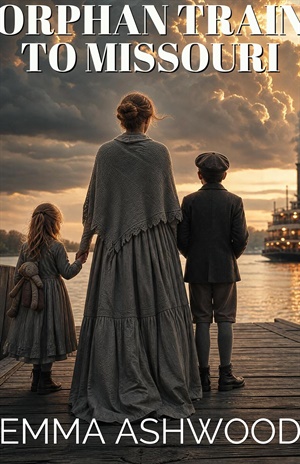
The Orphan Train To Missouri (Orphan Trains Out West #4)
Chapter 1
The train had been rolling west for two days when the boy first took notice of the girl who could not stop crying.
She sat two benches down, a small figure of five or six, folded into the corner by the window. Her shoes did not reach the floor. Her hands were knotted in her lap, and her shoulders shook with a weeping that had gone past noise into what was worse.
Nobody went to her.
There were thirty children in the car, maybe more. City children, every one, swept up from the streets and asylums of New York, then put on a train for the West. The agent in the black coat walked the aisle twice a day. He counted heads the way a man counts crates.
The boy was twelve, and he had learned long ago not to care about crying.
Crying was common where he came from. The streets were full of it, and the lodging houses too. None of it ever changed the circumstances. A boy who stopped to feel sorry lost his corner, or his papers, or his supper. The gutters taught their lessons early, and the boy had learned them all.
So he watched the little girl the way he watched everything. From a distance. With his back to the wall of the car, where nobody could come at him from behind.
She had cried through Ohio. She had cried through the long flat dark of Indiana, quiet and steady, like rain that means to fall all night. When the other small ones slept, heaped together like puppies for the warmth, she stayed apart and wept into her own thin arms.
By the second evening, something in it had begun to work on him.
He did not have a word for the feeling. It sat under his ribs like a splinter, small and sharp. It would not leave him be. He told himself she was nothing to him. He told himself the world was full of crying girls, and no boy alive could carry them all.
Still his eyes kept going back to her.
At dusk the agent came through with the basket. Supper was bread, a fist-sized piece for each child, with a tin cup of water passed along the benches. The bigger boys at the back got theirs first because they pushed. There was one agent to thirty children, and thirty children are a tide.
The little girl did not even lift her hand for her share.
A piece was set beside her on the bench. She looked at it the way a person looks at a stone. Then her face crumpled again, and she turned to the black window. There was nothing out there to see but her own small ghost in the glass.
Down the car, a big boy with heavy shoulders was already watching that untouched bread.
The boy knew the look. He had worn it himself, hungry winters past counting. Food left alone was food lost. That was a street rule, and it held on a train as sure as it held in an alley.
He got up before he had decided to.
Moving down the aisle of a rocking car takes sea legs. He had ridden the cars for two days, and he made no stumble of it. He sat down on the bench across from the girl, plain as you please, and rested his elbows on his knees.
“You going to eat that?” he asked.
The weeping hitched. Two eyes came up to him, brown and swollen, wary as a cat’s.
“It’s good bread,” he said. “Better than I got most days back home. You don’t eat it, somebody bigger will. That’s the truth, so I’m telling it.”
Her chin trembled. “I’m not hungry,” she whispered.
“Everybody’s hungry,” he said. “Some just forget to notice.”
Gently, so as not to spook her, he drew his own piece from his coat pocket. He broke it in two, put the bigger half into her hands, then closed her small fingers around it with his own.
“Eat that much,” he said. “Just that much. Then you can cry all you want, and I won’t say a word against it.”
For a long moment she only looked at him.
Then, in the smallest bites he had ever seen a child take, she began to eat. Tears ran down while she chewed. She ate anyway. When his half was gone, he set her own piece in her lap, and she ate that too, hiccupping between bites.
He had meant to go back to his own bench then.
Instead, he stayed. The dark came down over the fields outside, and the lamps were turned low.
All around them children settled into sleep, like birds going quiet at night.
The girl’s crying wore itself out at last. Somewhere in Illinois, with the wheels drumming the same word beneath them, she tipped sideways against the wall and slept.
The boy sat watch a while, for no reason he could name.
In the morning, the cold woke him first. It had come down from the north in the night, a raw gray cold that breathed through every seam of the car. The children woke stiff, with white breath, complaining in small voices.
The girl was shivering so hard her teeth clicked.
She had a thin dress, a thinner shawl, and nothing else in the world. He looked at her a moment. Then he shrugged out of his coat, a man’s cast-off cut down rough at the sleeves, and dropped it over her like a blanket.
“I run warm,” he said before she could speak. It was a lie and his arms were prickling already, but he said it steady. “Anyway I’m used to worse. You keep it till the sun’s up proper.”
She pulled the coat to her chin. Above the collar her brown eyes watched him with a new glint. It was not trust yet. It was the place where trust starts.
Trouble came at noon, the way trouble does, when the bread basket went round again.
The big boy with the heavy shoulders came down the aisle behind the agent, trailing him like a gull behind a plow. Where a small child was slow to take a share, his hand was quick. He had gathered a second piece already, then a third, working the car with an old, practiced ease.
When he came to the little girl’s bench, he put out his hand for her bread.
He did not get it. The boy’s hand closed on his wrist, and the two of them stood locked a moment in the swaying aisle, measuring each other.
“That one’s hers,” the boy said.
“Says who?”
“Says me.”
The big boy was taller by a head, and heavier. For a moment it could have gone to blows. But the look on the smaller boy’s face made him think better of it. Street boys know one another at a glance, the way dogs do. What he saw was a boy with nothing left to lose a fight over.
“Keep her, then,” the big boy muttered, and moved on down the car.
The boy sat down across from the girl as if nothing had passed. Her bread lay untouched in her lap. Her eyes were very wide.
“Eat,” he said, mild as morning. “It’s yours. Nobody takes what’s yours while I’m sitting here. That’s settled, so put it out of your mind.”
That was the day she began to talk.
Not much at first. A word, a question, silence again for an hour.
She had come from a foundling home on Twelfth Street.
Her mother was dead of the fever. There had been a father once, gone to the war before she could walk, and never come home from it.
The home had been cold, but there had been a matron who sang sometimes. She missed the singing.
He listened the whole slow afternoon, prairie light crawling across the floorboards, while she laid out her small life like a handful of buttons.
“What’s your name?” he asked her when the light was going amber.
She looked down at her shoes. When the answer came, it came in a whisper, so soft he had to lean in for it.
“Nora.”
She said it the way a person speaks of their last possession.
And that, he understood, was near enough the truth of it.
The agent had gathered them all on the platform in New York, before ever they boarded, and told them plainly how it would be.
New homes, new families, a new start in the West. Some families, he said, might wish to give a child a new name, and the child would be wise to take it kindly.
New names, handed out like new clothes.
“Nora,” the boy said, out loud, so she would hear it said. “That’s a good name. That’s a name worth keeping.”
“The man said they might change it.” Her voice wobbled. “When we’re picked. He said we ought to be glad of whatever we get, and not make a fuss. He said we have to answer to what we’re called.”
“Folks can call a thing what they like,” he said. “Doesn’t make it so. You were Nora before them, so you’ll be Nora after them. Some things don’t change hands.”
She studied him, brown eyes grave in the failing light. “Do they get to change yours?”
“They can try.”
“What is it? Your name?”
He looked at her a while. A name was not a thing he handed out. But she had given him hers, so he leaned across the aisle and gave her his the same way. Low, next to her ear, where no other soul could take it.
Nora kept it. He watched her take it in, grave and careful, the way she took everything.
Outside, the sun went down over a country neither of them had ever seen. Somewhere ahead, past the dark, were the towns with the platforms, the rows of strangers, the choosing. Every child in the car knew it was coming. None of them said so.
“They’ll pick us different places,” Nora whispered. “Won’t they? You and me.”
He could have lied. Later he would wonder if he should have. But she was looking at him the way she had looked since the bread. To her he was the one solid plank in a flooding river. He found he could not put a lie on top of that.
“Maybe,” he said. “Likely.”
Her face began to come apart again.
“Hey now.” He took her hand, small and cold, in both of his. “Listen to me. Are you listening?”
She nodded, tears standing ready.
“Whatever this train does with us, I’ll keep your name safe.
Nora. I’ll carry it every place I go. And when I’m grown, or before it, I’ll come find you.
I don’t care where they put you. I’ll ask at every town, every door, every landing on every river until I do.
That’s a promise, and I don’t make them. ”
“Ever?”
“Ever. This is my first. So it’s got to be kept, or I’ll have none at all.”
A six-year-old cannot weigh a promise. She can only feel the size of it. Nora looked at this fierce, thin boy, the only kind part left in her whole broken world, and she believed him utterly.
The train ran on into the dark, carrying the two of them west, together for now.
And in the corner of a rattling car, a girl slept without crying for the first time in four days. Her small hand stayed in his all night, holding on to a promise that would have to last her twenty years.