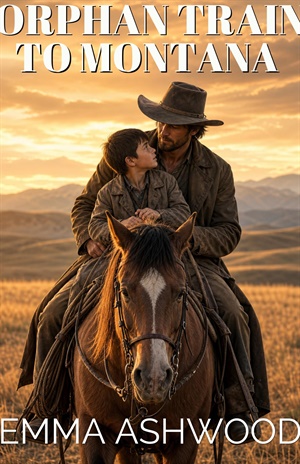
The Orphan Train To Montana (Orphan Trains Out West #1)
Chapter 1
Steam came off the great black engine in clouds. The boy had never stood so near to anything so alive.
It towered over him, taller than any wagon, taller than a house.
Its iron flanks were streaked with soot.
Deep inside it a fire roared. He could feel the heat of it even here, a strange warmth in the gray cold of the dawn.
The engine hissed and breathed. It shuddered on its rails like a beast that wished to run.
Then the whistle screamed, sudden and shrill.
The boy flinched hard. At once, he was ashamed of the flinch.
All down the platform, the other children flinched too.
There were a great many of them. Two dozen, perhaps, or more.
Every one had been scrubbed pink and dressed in stiff donated clothes.
Every one wore a paper tag pinned to the breast. They stood in clusters in the thin light, small and uncertain, their breath smoking in the cold.
They were bound west, all of them, up the same long iron road.
Not one knew what waited at the end of it.
A name was not among the boy's few possessions.
In the streets, he had been called many things.
Some were only cruel. Others were worse.
Not one had ever felt like his. He had answered to whatever got him fed, and let the rest fall away.
A boy with no people learned not to set much store by names.
There was no one to call him in to supper.
There was no one to say his name over him with love.
What he owned instead was a handful of hard knowledge.
He knew the smell of wet brick after rain.
He knew the cold of a doorway at three in the morning.
The stone took the warmth out of a body and gave nothing back.
He knew the long ache of an empty belly.
It gnawed worst just before dawn, when the city was quiet.
These were his only true possessions. A boy in his place learned not to want for more. Wanting only made the having harder.
Of his mother, he remembered nothing he could trust.
There had been a woman once, perhaps, far back at the beginning of him.
A low voice in the dark. A hand smoothing his hair off his brow.
A warmth he could not name. It came to him sometimes between waking and sleep, then was gone before he could hold it.
The memory was thin as smoke. It would not stand still to be looked at.
His father was not even that much. There was simply no one there, a blank where other children kept a face.
Ten years old he was, or near enough.
No one had ever told him the day of his birth.
So he had chosen one for himself long ago.
A day in early spring. It seemed a hopeful sort of month to belong to.
The hard frosts were breaking by then. The first thin green showed at the edges of the gutters.
A boy could believe in spring that the worst was behind him.
He had needed to believe that. So he gave himself a spring birthday and told no one, for there was no one to tell.
Until a week past, the narrow streets had been his whole world.
He had run errands for pennies, darting between the carts.
He had carried parcels too heavy for his thin arms. The string cut red lines into his fingers.
When the pennies failed, he slept where he could.
A stairwell, if he found one unlocked. The lee of a chimney.
Once, through a whole hard winter, the boards beneath a stranger's porch.
Then the men from the Children's Aid Society found him asleep under a market stall.
He had slept there three nights running, curled small against the cold brick wall.
They were not unkind, those men.
They lifted him by the collar, the way a man lifts a kitten. They brushed the wet straw from his coat with brisk, impersonal hands. They turned his face up to the gray light to look him over. One of them nodded, as if a small sum had come out right.
"This one will do," said the taller of them. "Young enough yet to be placed out."
A great brick building swallowed him after that.
It was full of children, more than he had ever seen in one place.
They lined the benches and the long, bare rooms. None of them laughed.
None played the way children in the streets still found ways to play.
They only waited. They had the patient, hollow stillness of those who have learned that waiting is most of life.
The boy took his place among them and waited too.
He was good at waiting. It was nearly all he had ever done.
In a tin bath, a stern-faced woman scrubbed him until his skin glowed.
She worked at him with a hard brush and a cake of yellow soap.
Neck and ears and the backs of his hands.
The water went black around his knees, then browner still.
He had not known he carried so much of the city upon him.
He watched it sluice away. He felt strangely lighter for the loss of it, and strangely smaller too.
A stiff shirt came next, smelling sharply of lye.
The cloth scratched at his washed neck. Then the woman pinned the paper tag to his breast and stood back to judge her work.
What the tag said, he could not read.
No one had ever taught him his letters. The marks upon it were a fence he could not see over. He turned his eyes up to the woman instead, and waited to be told their meaning.
"You are going west," she said. "Out west, there are families who want children. You will be chosen by one of them. Mind you behave, and mind you smile."
Chosen. The word turned over in him like a coin held warm in a closed fist.
He kept it close. He did not let it show on his face. To show a thing was the surest way to have it taken. But it glowed there, down in his chest, small and stubborn and bright. Somewhere west, there was a family. Somewhere, there was a door that would open for him.
They had brought the children to the station before light.
Now a young woman moved down the platform, counting heads, marking them in a small book.
Miss Cornwell, she said her name was. She had a tired, careful face.
It was the face of a woman who has done a hard thing many times, and means to do it well once more.
She promised to see them safely west. The boy believed her, more or less. She had kind eyes under the tiredness.
Two by two, the children climbed aboard.
A seat by the window fell to the boy. The hard wood was worn smooth by other travelers.
A smaller child pressed in beside him, sniffling, clutching a rag doll with one button eye.
The boy said nothing to him. Speaking led to knowing.
Knowing led to losing. That was a sum he had worked out long ago in a colder place than this.
So he kept his peace. He looked out through the smeared glass and waited for the world to move.
Then the cars lurched, and the platform began to slide away.
He pressed his face to the cold glass. The brick walls of his only world slipped past, faster and faster, until they blurred.
Yards gave way to scattered houses. The houses thinned to fields.
And then there was only land. More of it than he had dreamed could exist. It rolled out flat and brown beneath a wide pale sky.
So much of anything he had never seen. It frightened him a little, that bigness. It thrilled him, too.
Up and down the aisle, Miss Cornwell went, drilling them gently as the miles unspooled.
"Sit up straight," she told them. "Do not slouch. When a family looks at you, look back kindly. Answer every question clear and polite. Do not whine, and do not sulk."
Beside the boy, she stopped a moment and her voice dropped lower.
"The good homes go to the children who please," she said. "No one chooses a sullen child. No one chooses a sickly one. Remember it."
A nod was all he gave her. But he understood her down to the ground.
Making himself useful enough to be fed was the one trade he had ever learned. He knew how to be quiet. He knew how to be quick. He knew how to read a grown person's mood and bend to it. If smiling was the price of a home, he would smile until his face ached and call it cheap.
Hour upon hour, the land slid by.
Towns came and went, no more than a clutch of low roofs against the sky.
They were gone before he could fix his eyes on them.
Rivers flashed silver in the distance and were lost again.
Cattle stood in far fields like scattered stones.
And the whole long while, he thought of the family that might be waiting out there.
A mother with a warm, low voice, like the one half-remembered in the dark.
A father who might set a hand on his shoulder and call him son.
The hope was not spoken aloud. It was barely even thought.
Still it burned in him, fierce and secret and bright.
Across the aisle, an older boy watched him with flat, knowing eyes.
Thirteen, perhaps, lean and hard, with a white scar splitting one eyebrow. He had the look of a boy who had stopped expecting anything good.
"You're hoping," the older boy said. It was not a question.
The boy gave no answer.
"I can see it on you. First-timers always hope." Bitterness soured every word. "I've ridden this train before. Twice. Two homes. Both of them sent me back."
The smaller child stopped his sniffling to listen. Still the boy kept his own face shut as a door.
"They don't want sons out here," the older boy went on. "They want hands. Strong backs for the fields. You're a thing to be used, same as a plow or a mule. The little soft ones, maybe they get loved. Not us. Never us. You'll see."
"You don't know that," the boy said. It was the first word he had spoken all day.
A laugh answered him, with no joy in it.
"I know it better than I know anything," the older boy said. Then he turned to his own window and said no more. The silence he left behind was worse than his words.
The boy turned back to his own glass. The endless grass ran gold in the falling light. Bitter men see only the worst, he told himself. The older boy was bitter clean through. Somewhere ahead, a door stood open, surely, with lamplight spilling warm onto a swept step.
But a small cold seed had been planted, and it would not be dug out.
A strong back. A thing to be used. The words lodged in his chest beside the bright hope. The two of them did not lie easy together. He turned them over and over and could not make them stop.
Night came down over the plains.
The cold crept into the car, up through the floorboards, in around the window frames.
Beside him, the small child slept at last, worn out with weeping.
His head tipped slowly onto the boy's thin shoulder.
Very still the boy held himself so as not to wake him.
He looked down at the rag doll with its one-button eye.
A knot pulled tight in his chest and would not loosen.
Sleep was a long time coming.
Beneath him, the wheels beat their steady iron rhythm, on and on. They carried him through the dark toward whatever waited at the end of the line. He stared into the black glass and saw only his own faint face staring back.
Choose me, he thought, to the country he could no longer see. Whoever you are, out there. Please. Just choose me. I will be so good. I will work so hard. You will never once be sorry that you did.
West the train ran through the night. And west the boy rode with it. A tag pinned to his coat. A doll-clutching stranger asleep on his shoulder. He was bound for a family he could not picture and could not, for all his trying, stop himself from wanting.