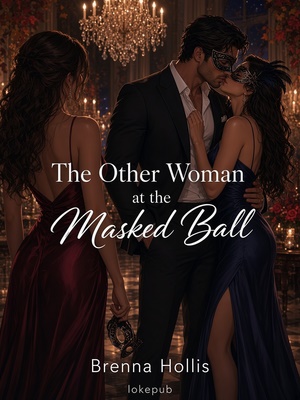
The Other Woman at the Masked Ball
Chapter 1
Chapter One
Annie
Just like always, the first one comes out too dark.
I lean over the tray, red safelight warming the backs of my hands, and watch the little cemetery on the paper drown itself in shadow.
A row of crooked stones. A white pine bent over them like an artist planned it.
Fog caught low against the mountain. Too dark, but not a lost cause.
Most people would toss it in the bin; I don’t.
I lift the print with tongs and let it drip into the tray beside me.
The sharp tang of fixer hangs heavy in the damp air, easily overpowering the cheap vanilla candle burning on the high shelf.
The flame gutters every time the old vent kicks on.
Somewhere behind the wall, pipes knock, a noise I like to pretend belongs to the ghosts of the old estate.
Probably telling me to get the hell out.
This space used to be a storeroom, tucked behind the back staircase and forgotten among scraps of lumber and surplus hardware left over from decades of repairs.
My laptop sits balanced on a pair of dried paint cans.
Not for the aesthetic, but because the haphazard clutter feels like a quiet rebuke of everything beyond the doorway.
Out in the main halls, everything gleams. The floors shine like glass.
The portraits on the walls, generations of Reed’s ancestors, follow anyone foolhardy enough to walk past without the proper pedigree, casting judgment straight from the grave.
Staff members carry cut flowers, folded linens, and silver trays through corridors they’d never be permitted to enter without an employment contract.
Even they occasionally cast a glance my way, knowing I don’t belong here any more than they do.
But here, in this room, my photographs hang from clips strung on wire.
And just like me, none of them fit the upstairs standard: a ruined barn outside Hot Springs; an iron gate half-swallowed by vines; the steeple of a forgotten church choked with kudzu; a back road in Cocke County drenched in gray fog.
The kind of things Catherine all but sneers at while playing nice about her daughter-in-law’s “little hobby”.
I slide another sheet into the developer and tap the timer. This is the only room in the house where my prints ever surface. Catherine prefers art with provenance, the kind of piece she can gesture toward and say, “Ah, yes. We have the money to buy that right there”.
I’m okay with that. When I married Reed, I never realistically expected his family to accept me.
I arrived an outsider and mostly made peace with staying one.
Reed had already defied them once by choosing a state school on a football scholarship he didn’t even need.
He turned down the money, but kept the roster spot.
And that’s how he met his “wrong side of the tracks” wife: a girl majoring in communications and falling hard for the quarterback who, for some reason, just wanted to run with the riffraff.
The door behind me squeaks on its hinges.
“Don’t turn on that light,” I say, hoping it isn't Catherine looking to ruin an hour of work.
“Don’t worry. I enjoy being with my wife in the dark.”
We’ve been married almost six years, but I still feel that quick jolt at the sound of his voice—deep, quiet, and resonant.
“Do you flirt with all the women you corner in darkrooms?”
“Only the ones I’ve given my last name to.”
I turn. Even under the dim amber glow, his silhouette is unmistakable.
His suit jacket is gone, his tie loosened, and his hair rumpled where he’s run a hand through it.
Outside of these quiet spaces, he’s all Dillon polish: tall, poised, and expensive-looking.
Here, he’s already rolling his sleeves up past his forearms.
He steps closer, and I turn back to the tray, watching the silver halides react. He peers over my shoulder.
“That the cemetery in Bear Claw Junction?”
“That it is. The one past Aunt Lanie’s.”
“I remember that place,” he murmurs, his breath brushing my ear. A shiver trails down my spine. “I remember what we did in that cemetery the first time you took me down there.”
I turn around, his arms bracketing me against the table. “Shhh. The only people supposed to know about that are you and me.”
“And all those ghosts. If I recall, that was part of the thrill, you little bad girl.”
His lips find mine as he steps in, his weight pressing me back against the edge of the heavy worktable. The jolt nudges the board holding the laptop, waking the screen with a flash of blue light.
Reed pulls back, glancing at the monitor where a woman is creeping down a darkened hallway. A bemused smile tugs at the corner of his mouth.
“Thought you hated this one,” he says, watching the heroine make the fatal decision to venture deeper into a basement where someone was murdered ten minutes ago.
“I’m hate-watching it.”
And just like that, we’re back in college, crammed onto a narrow couch in the dorm lounge.
“Still don’t see why you hate it,” he says, watching the masked killer stalk past an open door. “It’s not like horror heroines are hired for their decision-making. If they made smart choices, they’d get in a car and head for the city, and the movie would be fifteen minutes long.”
“Laurie Strode had sense.”
Reed lets out a quiet sigh. “Not this argument again.”
“She wasn’t at a remote campground. She was in her own neighborhood, fighting on familiar turf.” I point a finger at the screen. “This girl came out to the woods on a dare and didn’t have the good sense to turn around before she became the final body on the list.”
“Well, I’m not sure I agree, but I’d want no one else beside me but a girl who tells me how the cow ate the cannoli.”
“Cabbage,” I correct. Back when we first met, I’d been unapologetically raw about my Appalachian roots. Over the years, I’ve sanded down the accent, the idioms, and the sharp corners that came from being raised on lard biscuits and sweet tea. “I'm surprised you remembered that.”
“Oh, Mrs. Dillon, I remember everything.” His gaze drops to mine, dark and steady, warming the small room. His hand slides up from my waist, fingers finding the bare skin just beneath the hem of my sweater, and my breath hitches.
He lifts me easily, settling me onto the clear edge of the table so he can stand between my knees.
“Mr. Dillon,” I murmur, resting my hands on his chest. “What if the staff walks in?”
“The woman who wasn’t worried about scandalizing the dead is worried about the staff?” he murmurs, brushing his lips against my jaw. I tilt my head back, giving in to the heat of him, letting myself forget the rest of the house. He pauses, looking down at me. “You’ve gotten too proper, wife.”
“Then make me improper.”
“Thank God.”
Beside us, my phone chirps.
Three sharp, tinny notes. A brief pause. Then three more.
Both of us freeze. On screen, the heroine screams as she runs through the dark.
Reed’s forehead settles against mine, his breath coming uneven against my cheek. We both know that chime. The tracking app we’ve lived by for two solid years.
I reach blindly behind me, silencing the alarm. The screen glows pale green. Temperature logged. Cervical fluid noted. Peak fertility window open.
Reed watches my face. “Tonight?”
I swallow the knot in my throat and slide the phone face-down against the wood. “Yeah. Tonight.”
He nods, the tension lingering in the set of his shoulders. “Tonight it is.”
He steps back, and the warmth between us vanishes like heat sucked into a flue. Just like that, the mood evaporates. Back to the protocol. The exact timing the doctors outlined. The optimal temperatures.
We know the script by heart: every fertility specialist within a three-hundred-mile radius; the sharp bite of alcohol swabs before a needle; the exact drop in a nurse’s tone right before she delivers bad news.
The last loss was three months ago. Long enough that I tell myself I should have scar tissue over it by now, because it wasn't the first. The only mercy is that no one else carries the weight of it. Catherine knows there’s no grandchild in the nursery where society expects one to be, but they don't know the truth. They don’t know about the losses.
They don’t know about the endless rounds of hormones, or how mechanical intimacy becomes when it’s scheduled around a chart.
That belongs to us. And as agonizing as it is, keeping it between our walls is the only thing that makes it bearable. It keeps us standing together against the rest of the estate. You and me against the odds.
Reed’s fingers find mine, tangling through them. He pulls me back against his chest. “We don’t have to think about it right this second.”
“Good. I’ve run out of dark jokes about needles and empty rooms.”
“Annie,” he says softly, pressing his lips to the crown of my head.
“You and me against the world,” I whisper, closing my eyes against the wool of his shirt.
“You and me, kid.”
Outside the workroom, I step back into the performance of being the Mrs. Reed Dillon everyone in his life can stomach.
My spine straightens. My accent thins as much as I can manage.
East Tennessee still slips out whenever I’m angry, bone-tired, or a little too happy, so I brace myself not to be any of those things.
Not while walking the corridors of Stanhope House, one of the Dillon ancestral estates. The name predates the Dillons, left over from the family who built the place before a marriage folded the property into Reed’s family generations ago.
No one has ever ordered me to be “less Southern”. It’s just easier this way. The more refined I seem, the fewer sideways glances I collect. No more cousins trying out “y’all” like a parlor trick. No more Catherine cooing over how “dear” I sound whenever I draw out a vowel.
I know the forks now. I know the surnames, the prep schools, and the exact difference between a genuine peck on the cheek and an icy air kiss, both of which would get you a “What the hell you tryin’ to do to me, girl?
” back home. I know how to stand in a circle of women who grew up skiing in resorts I only ever saw in dentist-office magazines and pretend I belong.
Reed’s fingers find the small of my back as we pass under the watchful oil-painted gaze of his great-grandfather.
“Dinner in the library?” he asks.
“Only if we can reenact the scene from Beauty and the Beast where she sings from the ladder.”
“Glad you mentioned it,” he murmurs. “I’ve been working on my growl.”
“Reed Dillon, my hero.”
We turn toward the east passage and find Catherine in the morning room, flanked by enough staff to qualify as a small business.
Cream envelopes fan across the mahogany table.
Black silk ribbon coils beside calligraphy place cards.
A woman with a clipboard rattles off floral specs that sound entirely too technical for me to parse.
The upcoming Halloween masquerade has been Catherine’s sole focus for six weeks.
“Reed,” she says, glancing up. “I need five minutes before you vanish again.”
“Of course,” he says. His hand slips from my lower back as he approaches the table.
Catherine’s eyes rake over me, assessing my dark sweater, worn denim, and the haphazard knot holding up my hair. She offers a thin, placating smile.
“Annie, dear. Have you been working?” She delivers the word like I’ve been out scraping roadkill or breeding rabid weasels.
“Yes. Just a few prints.”
“Super,” she murmurs, turning an ivory card between manicured fingers. “I was just telling Margaret that Lexi Cavanaugh handled the foundation gala beautifully last month. Some women are simply born with a knack for entertaining.”
The staff keeps moving around the table, none of them the wiser that Catherine is deliberately pressing her thumb into a fresh bruise.
“That’s wonderful,” I say evenly. I swallow down “Well, don’t that just beat all.”
Lexi Cavanaugh’s name shadows me through Stanhope House like the eyes in the gallery portraits.
Always lurking. She’s the lifelong family friend, the blue blood everyone assumed Reed would marry before he fell for a girl shooting college football games on a beat-up DSLR.
Lexi has the pedigree, the lockjaw vowels, the effortless grace.
She was born inside these limestone walls and understands their codes better than I ever will.
I learned the dialect through harsh submersion; Lexi is a native speaker.
And just like every other time her name gets dropped, I remind myself that I’m Mrs. Reed Dillon.
I’m the girl who wore his worn-out practice jersey to sleep back in college.
The girl he dragged into abandoned antebellum ruins at midnight, reckless with the certainty that his last name would keep us out of jail. I’m the one wearing his heirloom band.
Reed’s phone buzzes against his palm, and he checks the screen. “That’s Glen. I told him I’d look over the perimeter logistics this afternoon.”
He turns to me, pressing a brief, proper kiss against my cheek. “I’ll be back soon. See you in the library, Belle.”
The nickname drops to a whisper, quiet enough to remind me that he chose me, not Lexi.
Catherine gives me another bloodless smile and turns back to curating the spectacle of the season. A masquerade where everyone hides behind velvet and silk.
What she doesn’t realize is that I’ve been wearing a mask since the day I moved in.