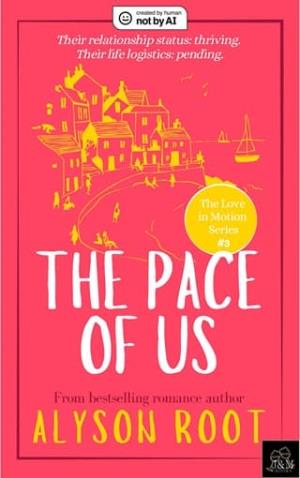
The Pace of Us (The Love in Motion #3)
1. Eden
Eden
I run a thumb over the rim of the sudsy blue tub.
My hands smell like the distilled tears of anxious, middle-class mothers everywhere.
I glance over the mountain of t-shirts on the counter, each one folded with the same care a mortician might lavish on a body.
Sloane has a “system,” a religious devotion to laundry cycles that makes the most sense if you imagine the world is ending and the only survivors will be the ones with perfectly maintained delicates.
I do not have the same devotion, but if I shrink or bleach one of her tops again, she might just divorce me.
I separate the whites—Sloane’s crisp socks—from the darks: my own near-legendary collection of band shirts that have all faded to grey.
Starting the machine, I dial in the temperature, and the washer coughs to life with a heroic shudder.
Slapping the lid closed, I step back to survey my kingdom of soapy order.
As I lean against the counter, the French doors to the porch glint with that showy, come-hither sunlight that’s only supposed to exist in commercials.
Outside, the lawn is due for a mow, a fact I can’t unsee now that I’ve been a homeowner for six years.
It’s like something takes over your body the second you have house keys placed in your hands.
My eyes are now trained to look for house-related chores at all times.
It fucking sucks, because the list is endless.
Our house is a five-bed, three-bath, open-plan modern affair with more windows than some European cathedrals.
The kind of place you never expect to actually live in when you’re a broke art student.
Hell, even when I started making money from my paintings, I never pictured myself living in a place like this.
Sloane and I moved in six years ago, after a hunt for something “grown-up” that could fit all our junk, plus a rotating cast of over-caffeinated friends and my mother, who visits so often I’m starting to wonder if she’s taken up urban camping as a hobby.
I haul the laundry basket—white load only, thank you—through the kitchen, past the island scattered with fitness magazines and Sloane’s colour-coded calendar, out onto the porch.
The air is edged with cold, but the sun is so bright I feel like I’m about to become the world’s palest sundried tomato.
I drop the basket onto the bench and march to the side of the garage, where the push mower awaits.
The machine is vintage, rescued from a garage sale by Sloane, who went through a whole upcycling phase. That was an interesting time in our lives. It turns out she’s just as weird as I am.
It’s red and slightly rusted, but the recoil starter works on the first pull. The engine roars—okay, sputters—and I set out to tame the lawn. I cut in slow, careful lines, green stripes so sharp you could file paperwork on them.
With every pass, I get more existential. Who am I? Why am I voluntarily mowing a lawn? Where did the girl who used to spend hours of the day and night painting until her eyes went blurry? Why do my shins now feel naked unless coated in a fine dusting of grass clippings and regret?
Somewhere in the middle of row three, I lose the plot and start envisioning the world’s first punk rock home-and-garden magazine: “Rebel Lawns: The Only Suburban Guide with Actual Bite Marks on the Cover.” It’s a good fantasy, but I have to pause to rescue a stray tennis ball from under the rhododendron.
Sloane and I don’t even own a dog, which means the neighbourhood canines have started viewing our yard as their personal playground.
I lob the ball over the fence and finish the mow, contemplating if poop picking is in my near future.
Back inside, I realise the kitchen faucet is still leaking. The drip is slow but persistent, and each plunk into the sink is like a guilt-trip from the ghost of environmentalism future. Sloane taped a Post-it above the faucet that says, “Pls fix.”
I stare at the Post-it, then at my own two hands, like maybe I can will them into being more competent with tools and not just paintbrushes.
It’s not that I can’t fix a faucet. I’ve fixed harder things—like my relationship with Sloane all those years ago.
It’s just that fixing a faucet feels so cruelly domestic, so un-Eden post-homeownership, that it’s morally offensive to my entire system.
But Sloane will come home and notice, and she’ll do that thing where she doesn’t say anything but stands at the kitchen island, sipping water and shifting her weight from side to side like she’s at mile eight of a marathon, and the guilt will eat at me, and then I’ll try to snog my way out of it, and she’ll laugh, kiss me back, and fix it herself in thirty seconds.
Which is, on balance, worse for my pride.
I find the wrench set under the sink, next to the stockpile of almond butter and protein bars.
After a brief, humiliating battle with the faucet’s undercarriage, I manage to tighten a thing that feels important.
I run the water, and, to my astonishment, the drip is gone.
In the sudden silence, I feel a surge of power I haven’t felt since the first time I used a power drill and didn’t strip every screw.
I am, at least for the next three minutes, a domestic goddess.
I check the time: 4:22 p.m. Sloane gets home around six usually, so that gives me at least an hour to paint and another half hour to panic-clean any evidence that I spent most of the day listening to podcasts about Victorian serial killers instead of working on my commissions and completing jobs around the house.
It’s a pitfall of working from home. Maybe I should look at getting a shared space or something. That way, I might stop talking to inanimate objects around the house as I clean.
My studio is technically the “bonus room”—a feature every American house seems to have.
Like an appendix, it’s there in case you need extra storage or a place to dump failed hobbies.
I try not to take it personally because we needed the other rooms for people, and there’s no reason I should take up a double bedroom for an easel.
I settle in among the canvases and half-squeezed tubes of acrylic and survey the work in progress.
It’s a large-format commission for a tech start-up. They want “dynamic energy” and “something that reflects our team values,” but not anything “too literal or aggressive,” which, from me, is like asking a Doberman to please manifest the gentle, bashful energy of a vegan house cat.
The canvas is an explosion of colour, sharp lines bleeding into each other like the aftermath of a mutant birthday party.
I’ve hidden a few subtle skulls—barely detectable, but enough to amuse myself when the inevitable press release goes out about their “passionate, collaborative, high-velocity workplace.” It’s the small victories.
In truth, I don’t need to take on these kinds of commissions anymore.
Gran did such a good job of being my manager that I have regular gallery shows and nearly all my work sells on opening night.
Gran says I’m to keep my feet on the ground, though, and doing a few jobs that are simply there to pay the bills is a good thing.
The woman’s never steered me wrong, so I do as I’m told.
After thirty minutes of painting, I realise I’m bored and hungry. I scrounge up a sleeve of Girl Scout cookies from last year, which are always in season if you have enough anxiety and a strong jaw. I’m munching my way through the box when I hear the garage door open.
Sloane is home early, which makes me smile like a dope.
I leap up, my first instinct being to hide the cookies because I have a habit of eating all our comfort food when I’m left to my own devices.
Instead, I set them on the counter to make it look like I was saving some for her, which is a lie but an affectionate one.
She sweeps in, the door slamming shut behind her, joggers mud-splattered from her usual post-work trail run. She’s all sun-flushed skin and windblown hair and kinetic energy. She’s breathtaking, and she’s mine. I like to remind myself of that wonderful fact daily.
Sloane kisses me on the cheek before noticing the silence of the kitchen faucet. She stares at it, then at me, then back at the faucet, like she’s trying to find the catch in the magic trick.
“You fixed it?” she says.
I shrug, feigning nonchalance. “It was either that or drown under a rising tide of minor household annoyances. Also, it was on your list.”
She grins, broad and surprised. “I’m impressed.”
“Don’t be. I probably stripped all the threads and voided the warranty.”
Snagging a cookie, she nudges my shoulder with hers. “What’d you paint today?”
“Some tech bros’ idea of revolutionary art. There’s a hidden skull in it.”
“There always is.” She chuckles, and there’s this softness in her voice that I can never quite prepare for. “You want to go out tonight?”
I blink. “Like, outside? With people?”
We are the quintessential house lesbians on our street, and I can’t remember the last time we ventured outside.
“There’s a show at the Foundry. Lila’s band is playing.”
Lila is Sloane’s employee. She’s a few years younger than us but is very much on our wavelength, so we hit it off from day one. Her band is this eclectic mashup of music. Every concert is a surprise because you never know what style they’re going to play.
I glance down at my paint-splattered sweats and black t-shirt, which is more holes than shirt at this point. “I’ll put on a clean hoodie.”
Sloane gives me a look, a fond one, the kind you can only earn after a decade of being both someone’s partner and their greatest project. “We could just stay in and watch a movie,” she says, which I know is her last attempt at giving me an out.
I weigh the options. The inertia of the day—laundry, lawn, faucet, painting—has worn me into a soft, pliable shape that’s more in line with blankets and silent rooms than packed music venues. But Sloane wants to go. She wouldn’t have brought up the concert otherwise.
“Let’s go,” I say, surprising myself. “I hear the Foundry has that new sour beer on tap.”
Sloane lights up and heads off to shower, pausing at the stairs. She looks over her shoulder, and for a second, I think she’s about to invite me in with her to have a bit of naughty time.
She winks. “You’re a domestic goddess, you know.”
Not what I was hoping for. I flip her off, but I’m smiling. Maybe it’s the sunlight, or the endorphin carryover from a day spent conquering the mundane, but I’m almost excited to go out. I even fish out my Docs and a band shirt that smells only slightly like old paint.
An hour later, we pull up to the Foundry parking lot.
The place is pulsing with music and the weird collective energy of people who have spent all day pretending to be adults and are now ready to make poor decisions in public.
Lila’s band is already on stage, and half the crowd is up front, head banging with the precise abandon of people who have desk jobs and chiropractors.
To my surprise and delight, I spot Pia and Todd. Todd waves us over to a booth where Pia is holding court, and as soon as I sit down, she launches into an update about Arin’s latest food aversions. Her three-year-old boy is the cutest thing on the planet.
We fall into the rhythmic banter that comes when you’ve known people long enough to speak in unfinished sentences and references to things that happened ten years ago.
Jenna and Kiera show up halfway through, and the table expands, and even though we’re packed in tight, it feels less like a sardine can and more like an impromptu living room.
Lila’s band is improbably good—tight and melodic, but with enough weird time signatures to keep the crowd guessing. Sloane leans in close under the pretence of telling me she likes the drummer, but I know she’s just happy, and that’s enough.
By the set’s end, my throat is raw from shouting over the music.
Sloane grabs my hand, laces her fingers with mine, and pulls me toward the gravel patio outside, where the air is still cold but the cigarette smoke is less omnipresent than I remember.
We stand there, just the two of us, listening to the dull thump of the next band sound-checking inside and the distant hum of Friday night.
I look at Sloane, who is looking at me, and she grins. “I’m glad we went out.”
“Me too.” I mean it.
She kisses me, and I taste sour beer and Girl Scout cookies.
I also taste her desire. It’s been a few weeks since we had sex, because apparently working and being in your thirties means there is no spare energy most of the time for raucous sex.
However, unlike the books and movies, I don’t believe that spells the disaster of lesbian bed death.
I think it says we’re working hard at life and trying to manage all the bullshit.
When Sloane and I do have sex, it’s filled with passion and love, just like it’s always been.
“Are you ready to go home?” she purrs against my lips.
I’m already dragging her away before she finishes her sentence. I might be tired from a day’s work, but I’ll rally if it means I get to feel Sloane beneath me.
She laughs as I usher her to the door, telling her to wait by the car. If she goes back to the table, we’ll be here another half hour saying goodbye. I don’t give Pia a chance to say a word. I grab our shit, kiss her on the cheek and wave to them as I haul ass to get to my wife.